
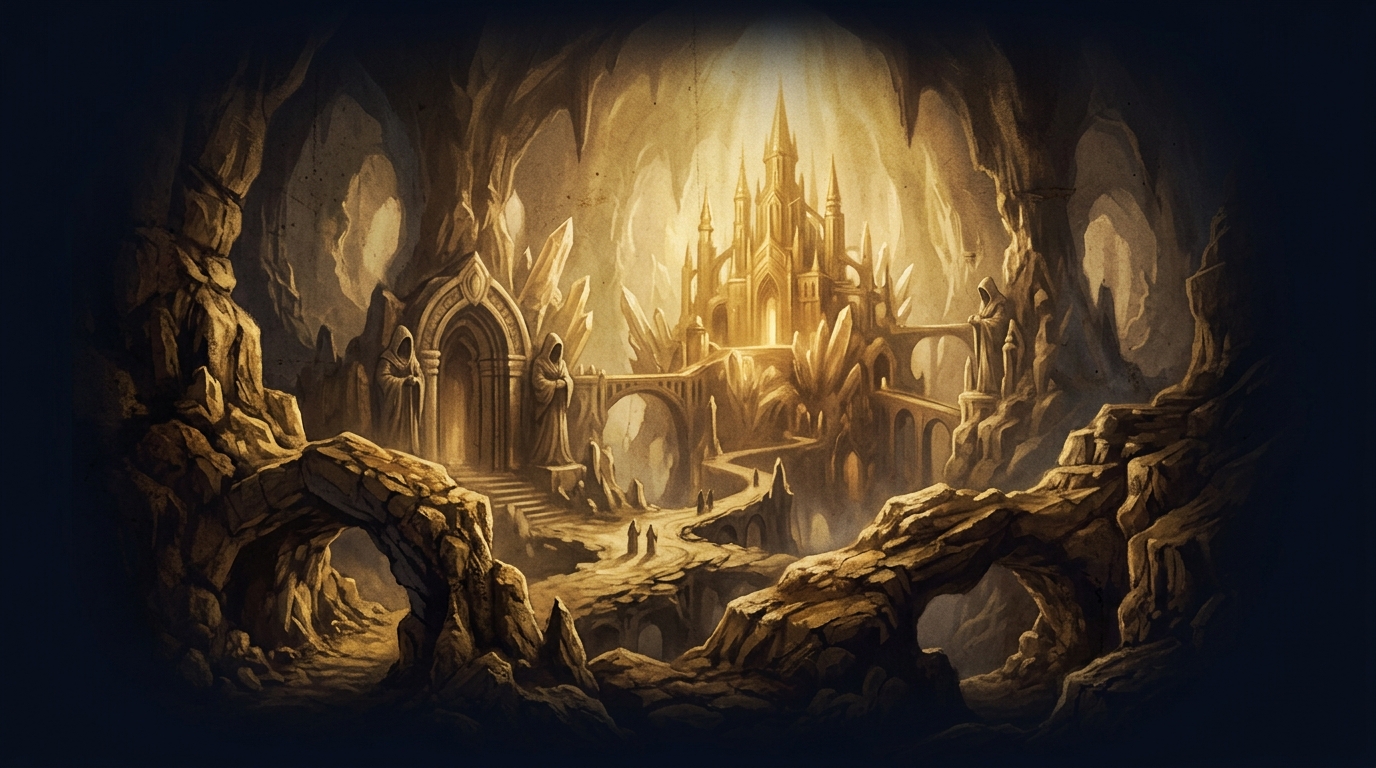
 Codex Illustration
Agartha
Agartha is the name given, within Theosophical and esoteric traditions, to a purported hidden subterranean kingdom of immense antiquity — a realm of perfected beings, forbidden knowledge, and secret masters said to govern the unseen currents of human history from beneath the earth's surface.
Overview
The word 'Agartha' (also rendered Agarttha, Agharti, or Agharta) entered Western esoteric vocabulary primarily through the 1886 work of French occultist Alexandre Saint-Yves d'Alveydre, who claimed to have received its description through a process he called 'archaeological synthesis' and through alleged communications with Indian initiates. Saint-Yves portrayed Agartha as a vast underground civilization of millions of souls governed by a sovereign figure he called the 'Brahâtmâ,' a supreme spiritual ruler who commanded the spiritual destinies of the surface world. The tradition was amplified and popularized by Helena Petrovna Blavatsky and the Theosophical Society, who wove it into a broader cosmological fabric involving root races, lost continents, and hidden Mahatmas guiding human evolution. For Blavatsky, subterranean sanctuaries represented refugia of ancient wisdom that had survived the destruction of Lemuria and Atlantis — civilizations she described as pre-Aryan and proto-spiritual, now preserved beneath mountain ranges and remote plateaus.
The concept was further elaborated by Ferdinand Ossendowski, a Polish explorer and writer, whose 1922 travelogue 'Beasts, Men and Gods' recounted stories he claimed to have gathered from Mongolian lamas and nomads describing an underground realm called Agharti, whose King of the World periodically emerged to deliver prophecies. René Guénon, the French metaphysician, directly critiqued Ossendowski's account in his 1927 study 'Le Roi du Monde' ('The King of the World'), arguing that Ossendowski had plagiarized or distorted genuine esoteric tradition while acknowledging that a real, if symbolic, metaphysical doctrine of a spiritual center of the world did exist across many traditions. Guénon's treatment is one of the more intellectually serious engagements with the subject, distinguishing between authentic primordial symbolism — such as the concept of an 'axis mundi' or world center — and the fantastic literalism into which popular accounts had collapsed.
Agartha became entangled with the parallel legend of Shambhala, the Tibetan Buddhist concept of a hidden northern kingdom of wisdom and peace, referenced in the Kalachakra Tantra and other Buddhist texts. Though Shambhala in its original Buddhist context is a pure land attainable through spiritual practice rather than a literal geographical location, Western esotericists frequently conflated the two traditions, treating both as references to the same physical underground realm. This conflation accelerated in the early twentieth century as European explorers, Theosophists, and eventually Nazi occultists became obsessed with finding a living master race or spiritual headquarters in Central Asia or beneath the Himalayas. The historical record documents genuine expeditions to Tibet motivated at least in part by such beliefs — including the controversial 1938-1939 SS Ahnenerbe expedition led by Ernst Schäfer — though no subterranean civilization was discovered.
In American fringe culture, Agartha merged with distinct but parallel mythologies: the Hollow Earth theories of John Cleves Symmes Jr. in the early nineteenth century, the claimed subterranean dwellers of Mount Shasta associated with Lemurian survivalists, and the writings of Richard Shaver, whose 'Shaver Mystery' stories published in 'Amazing Stories' magazine in the 1940s described malevolent underground beings called Deros. Each of these streams feeds the contemporary composite legend of Agartha as encountered online and in popular media — a vision of a technologically advanced, spiritually superior, or alternatively sinister civilization hidden beneath the crust of the earth, accessible through polar openings, deep cave systems, or secret initiatory knowledge. Archaeologically and scientifically, no evidence supports the existence of such a civilization. What the legend does illuminate, however, is the persistent human intuition — expressed across Tibetan, Hindu, Mongolian, and Western esoteric traditions — that somewhere beyond the visible world, authority, wisdom, and hidden order reside.
Key Claims
Timeline
Evidence
Multiple Perspectives
Biblical Lens
Scripture Threads
Sources & Further Study
Questions to Explore
Go Deeper Path
Follow the Thread
Continue the Investigation
You’ve reached the Full Archive portion of this Case File.
Ask the Archivist
about this fileSign in to ask the Archivist
Create a free account to ask the Archivist 1 grounded question each day, cited straight from the CODEX case files.
Discussion
0Share findings, questions, and evidence with fellow Seekers. Be respectful and cite sources where you can.
No comments yet. Be the first to open this thread.