
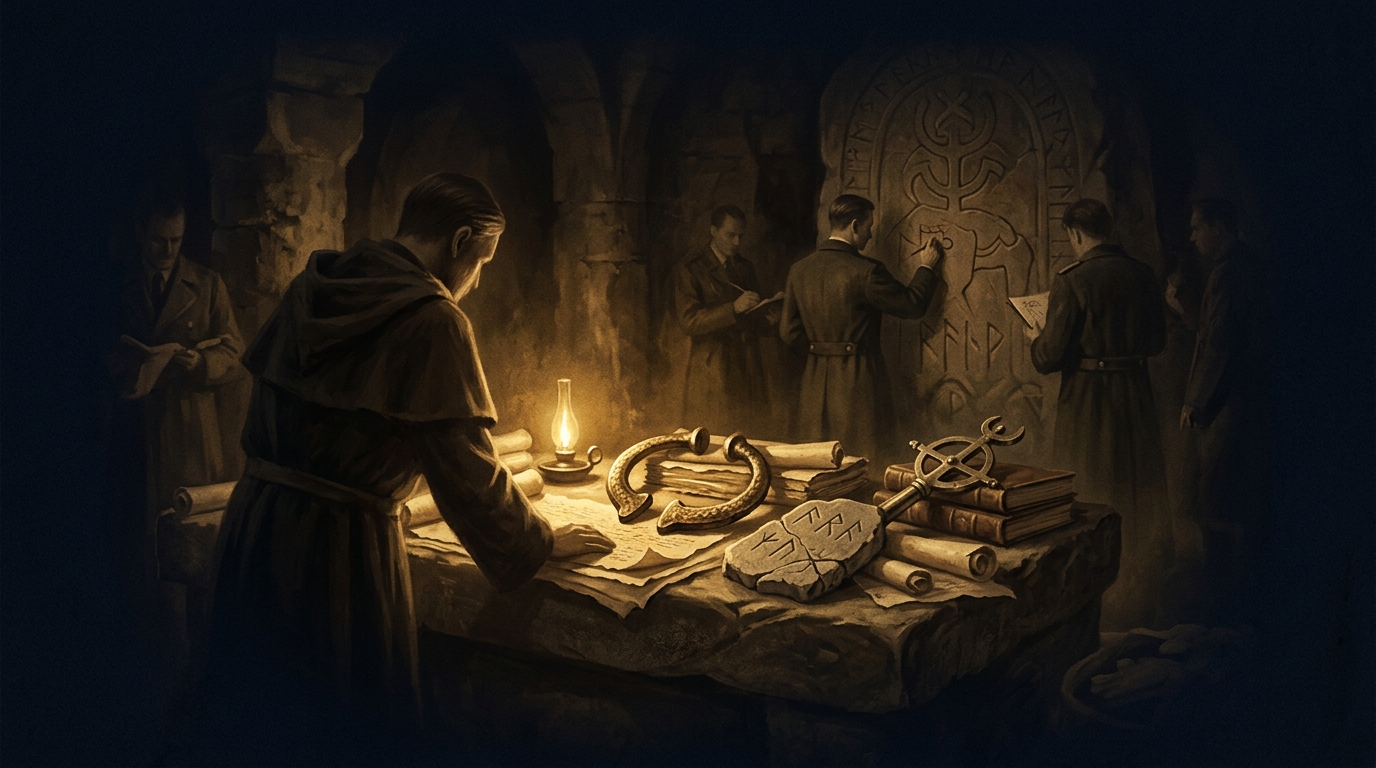
 Codex Illustration
Ahnenerbe
Founded in 1935 by Heinrich Himmler, the Ahnenerbe was the SS's official research institute — a taxpayer-funded apparatus dedicated to proving Aryan racial supremacy through archaeology, folklore, and esoteric inquiry, producing a documented archive of ideological science that remains one of history's most disturbing marriages of scholarship and state terror.
Overview
In the summer of 1935, Heinrich Himmler — Reichsführer of the SS and a man obsessed with Germanic antiquity — co-founded the Ahnenerbe Forschungs und Lehrgemeinschaft, which translates roughly as the 'Ancestral Heritage Research and Teaching Society.' What began as a small, semi-private study group attached to the SS would, by the early 1940s, become a sprawling organization with dozens of research divisions, hundreds of staff academics, and a mandate to scour the ancient world for evidence that the Aryan race represented humanity's supreme and originary civilization. The institute's work was not merely fringe: it employed credentialed scholars — classicists, folklorists, geographers, physicians, and archaeologists — and published peer-reviewed-style journals. This veneer of academic legitimacy made it one of the most dangerous pseudo-scientific enterprises of the twentieth century.
The Ahnenerbe's actual research agenda was wide and contradictory, ranging from serious archaeological fieldwork to outright occult fantasy. On the more conventionally academic side, the institute funded studies of Norse runes, Germanic folk traditions, Icelandic sagas, and pre-Christian Germanic religion. Its expedition to Tibet in 1938-1939, led by zoologist Ernst Schäfer, is among the most documented of its international projects; the mission produced genuine ethnographic and zoological data, yet was framed from the outset within the ideological assumption that Tibetans might harbor traces of Aryan ancestry. Similarly, Ahnenerbe researchers conducted archaeological surveys in Scandinavia, the Levant, and North Africa, often legitimately uncovering ancient sites while simultaneously distorting their findings to serve the racial narrative of the Reich. The record is thus messy: real scholarship contaminated at its root by an ideological demand for predetermined conclusions.
The darker chapters of the Ahnenerbe's history extend beyond misappropriated archaeology into outright atrocity. During the Second World War, portions of the institute became directly entangled with the concentration camp system. The most notorious case involves Dr. August Hirt at the University of Strasbourg, who — with Ahnenerbe support and official SS sanction — oversaw the creation of a skeletal collection drawn from murdered Jewish prisoners at Natzweiler-Struthof. Dr. Sigmund Rascher, whose hypothermia and altitude experiments at Dachau were partially administered under Ahnenerbe auspices, represents another direct line from pseudo-scholarly ambition to documented war crimes. These were not peripheral figures; they were credentialed professionals operating within institutional structures. The Nuremberg Doctors' Trial addressed many of these crimes, and historian Michael Kater's landmark 1974 scholarly study 'Das Ahnenerbe der SS' remains the foundational academic treatment of the institute's full organizational history.
The Ahnenerbe's postwar cultural legacy is complex and, in some respects, still unfolding. Declassified intelligence records, including those from the U.S. Office of Strategic Services, confirm that Allied investigators took a serious interest in the institute's activities — partly for evidence of war crimes, partly out of concern about what technical or esoteric knowledge it may have gathered. Popular culture, drawn to the institute's more exotic expeditions and occult-adjacent rhetoric, has substantially mythologized the Ahnenerbe, projecting onto it a mystical coherence and dark power it arguably never possessed. The institute was less a unified occult lodge than a sprawling, underfunded, bureaucratically chaotic academic department that happened to be staffed by racists operating under a murderous regime. The distinction matters: separating documented institutional history from the overlaid mythology is essential to understanding how ideological science operates — and how it continues to operate when ambition is married to power and the pursuit of forbidden legitimacy.
Key Claims
Timeline
Evidence
Multiple Perspectives
Biblical Lens
Scripture Threads
Sources & Further Study
Questions to Explore
Go Deeper Path
Follow the Thread
Continue the Investigation
You’ve reached the Full Archive portion of this Case File.
Ask the Archivist
about this fileSign in to ask the Archivist
Create a free account to ask the Archivist 1 grounded question each day, cited straight from the CODEX case files.
Discussion
0Share findings, questions, and evidence with fellow Seekers. Be respectful and cite sources where you can.
No comments yet. Be the first to open this thread.