
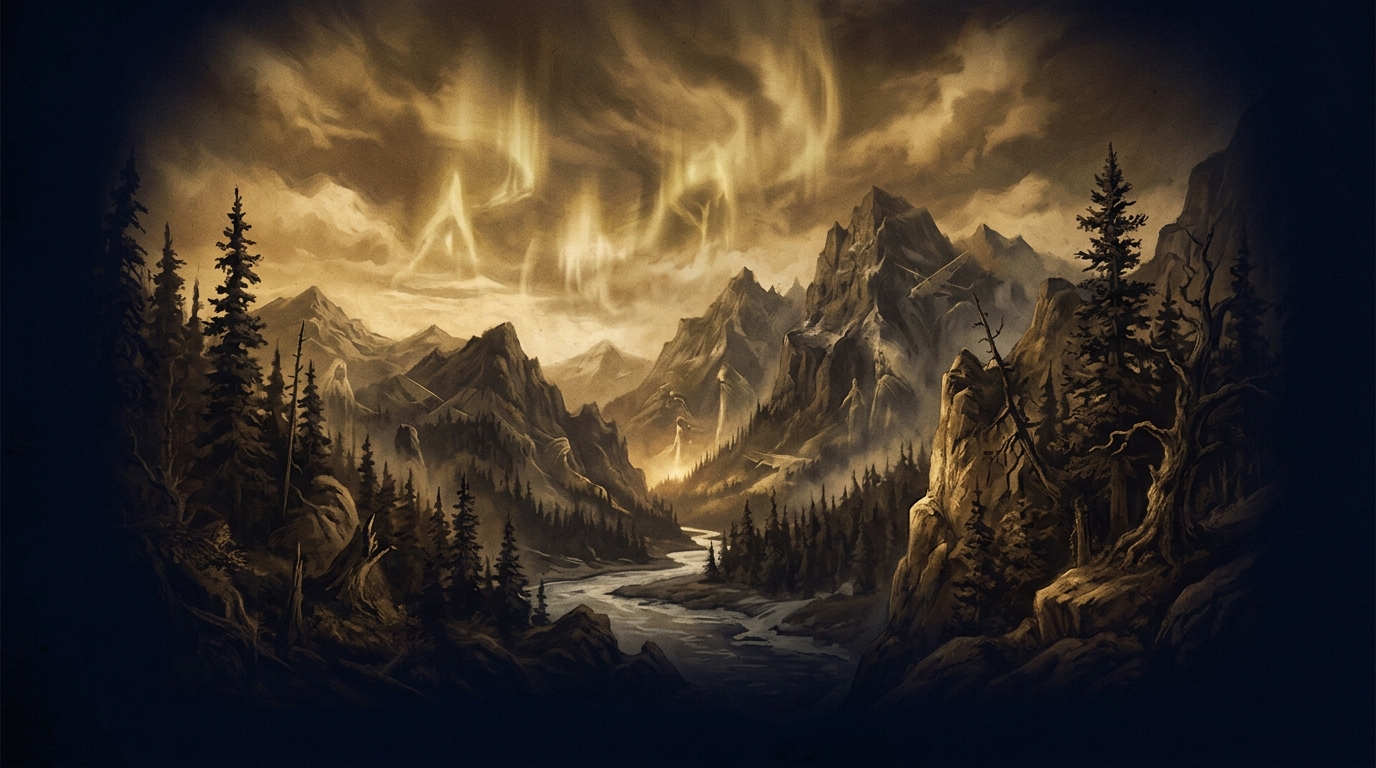
 Codex Illustration
Alaska Triangle
A vast, ill-defined region of Alaska stretching from Juneau to Barrow to Anchorage has accumulated an extraordinary statistical record of missing persons and vanished aircraft — a documented anomaly that intersects indigenous supernatural traditions, extreme wilderness geography, and unresolved questions about what, if anything, underlies the numbers.
Overview
The term 'Alaska Triangle' is not a formal designation recognized by any government agency or academic institution; it emerged gradually in popular media to describe a loosely bounded region of interior and coastal Alaska where disappearances — of people, aircraft, and occasionally vessels — appear to occur at rates that some investigators consider disproportionate even when adjusted for population density, remote terrain, and extreme weather. The region is enormous, encompassing some of the most geographically hostile and least-charted terrain in North America: dense boreal forest, glaciated mountain ranges, arctic tundra, unpredictable magnetic anomalies, and weather systems that can materialize with lethal speed. The documented missing-persons rate in Alaska is, by some analyses, approximately twice the national average per capita, a figure cited repeatedly in journalism but less frequently subjected to rigorous peer-reviewed scrutiny. Alaska's National Park Service and state troopers have acknowledged that recovery operations in these backcountry environments are extraordinarily difficult, and many cases that would be resolved in more accessible terrain simply cannot be investigated thoroughly.
The most high-profile single disappearance associated with the region — and one of the most consequential in American political history — occurred in October 1972, when a twin-engine Cessna 310 carrying House Majority Leader Hale Boggs of Louisiana, along with Congressman Nick Begich of Alaska, pilot Don Joslin, and aide Russell Brown, vanished somewhere between Anchorage and Juneau during a campaign flight. Despite one of the largest search-and-rescue operations in Alaskan history at that time, involving dozens of military and civilian aircraft over thirty-nine days and covering tens of thousands of square miles, no wreckage, no remains, and no conclusive evidence of the aircraft's fate were ever recovered. The case remains officially open. This disappearance is not anomalous as an isolated event — small aircraft accidents in Alaska are tragically common — but its scale, its political significance, and its utter lack of resolution gave the region a particular weight in American public memory.
Tlingit oral tradition, which has been practiced and transmitted across coastal and southeastern Alaska for millennia, includes accounts of the Kushtaka — a shape-shifting entity known in English renditions as the 'land-otter man.' In Tlingit cosmology, the Kushtaka is not a simple monster but a complex and ambivalent being capable of luring people, particularly those lost in the wilderness, away from human community, sometimes to their deaths and sometimes — in certain narrative traditions — to a kind of supernatural transformation. Ethnographers including Frederica de Laguna, whose fieldwork among Tlingit communities in the mid-twentieth century produced foundational scholarly documentation, recorded these traditions with care. Whether the Kushtaka tradition constitutes a genuine indigenous explanation for wilderness disappearances, a culturally embedded mechanism for processing the very real dangers of the Alaskan environment, or something else entirely, is a question that demands respect for indigenous epistemology rather than hasty categorization.
More recently, the Alaska Triangle has attracted attention from researchers and media programs interested in geophysical anomalies, including reports of unusual magnetic disturbances, infrasound from glacial movement, and electromagnetic irregularities that some investigators claim may disorient aviation instruments or human cognition. These claims have not been subjected to sustained peer-reviewed study in the context of the Triangle specifically, though geophysical research on Alaskan terrain and aurora-related electromagnetic phenomena is a legitimate scientific field. The region also attracts comparison to the Bermuda Triangle and Nevada Triangle — similar zones of alleged anomalous disappearance — and scholars of folklore note that the 'triangle zone' as a narrative category has become a durable genre of modern popular culture, one that packages genuine statistical ambiguity inside a compelling geographic frame.
Key Claims
Timeline
Evidence
Multiple Perspectives
Biblical Lens
Scripture Threads
Sources & Further Study
Questions to Explore
Go Deeper Path
Follow the Thread
Continue the Investigation
You’ve reached the Full Archive portion of this Case File.
Ask the Archivist
about this fileSign in to ask the Archivist
Create a free account to ask the Archivist 1 grounded question each day, cited straight from the CODEX case files.
Discussion
0Share findings, questions, and evidence with fellow Seekers. Be respectful and cite sources where you can.
No comments yet. Be the first to open this thread.