
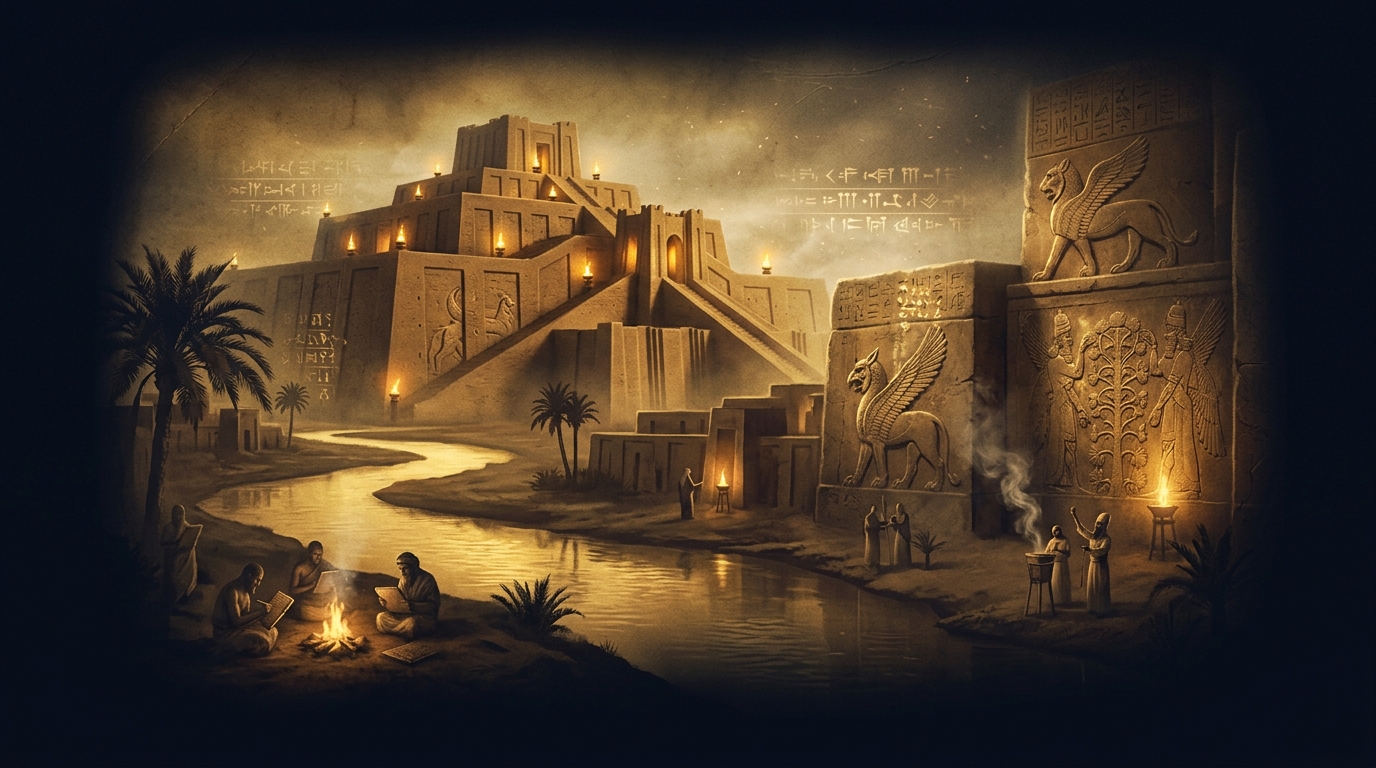
 Codex Illustration
The Ancient Near East
The Ancient Near East—encompassing Mesopotamia, the Levant, Anatolia, and Egypt—is the cradle of writing, law, urban civilization, and the mythological traditions that directly shaped the biblical worldview. Understanding this world is essential to reading Scripture and human prehistory with integrity.
Overview
The Ancient Near East (ANE) broadly designates the civilizations that flourished across the Fertile Crescent and surrounding regions from roughly the fourth millennium BC through the conquests of Alexander the Great in the fourth century BC. This arc of land, stretching from the Nile Delta through Canaan, Phoenicia, Syria, Mesopotamia, and into Anatolia, produced humanity's earliest cities, legal codes, monumental architecture, and literary traditions. The Sumerians of southern Mesopotamia are credited with the invention of cuneiform writing around 3200 BC, which enabled the preservation of administrative records, religious hymns, and epic narratives that modern scholars continue to decipher and interpret. Civilizations such as Akkad, Babylon, Assyria, Ugarit, and Egypt each developed distinctive but interlocking cosmologies, pantheons, and ritual systems that shared surprising structural similarities.
Archaeological recovery of ANE materials has accelerated dramatically since the mid-nineteenth century. The decipherment of cuneiform by Henry Rawlinson and colleagues beginning in the 1840s, followed by the excavation of Nineveh's library under Austen Henry Layard, opened the textual world of ancient Assyria and Babylon to modern readers. Subsequent excavations at sites like Ugarit (Ras Shamra), discovered in 1929, yielded Ugaritic alphabetic texts that revealed the religious world of Canaan with unprecedented clarity, directly illuminating the names, titles, and council structures referenced in the Hebrew Bible. The ANE is not merely historical background; it is the living intellectual and cultural environment within which the biblical authors wrote, argued, and proclaimed a distinctive theology.
For biblical scholars, the ANE context is indispensable rather than incidental. Terms like 'Elohim,' 'Baal,' 'El Elyon,' the 'divine council,' the 'sea of chaos,' and the 'underworld' all carry precise meaning within this wider cultural matrix. Michael Heiser, drawing on decades of Semitic scholarship, argued forcefully that the Hebrew Bible is not a reaction against ANE mythology in simple terms, but a deliberate theological polemic that accepts the same cosmic geography while radically reframing the identity and sovereignty of YHWH. The God of Israel is presented not as one deity among many equals, but as the incomparable Sovereign over all other elohim—a claim only intelligible against the ANE backdrop it subverts.
Beyond the biblical dimension, the ANE raises persistent questions about the transmission of knowledge, the origins of mythological motifs (flood narratives, divine-human hybridization, primordial wars), and the mechanisms by which complex civilizations emerged so rapidly in the archaeological record. Debates continue regarding the historical cores behind epics like Gilgamesh, the nature of Sumerian kingship traditions, and the degree to which later traditions—including apocalyptic Judaism and early Christianity—remain in dialogue with far older ANE frameworks. The Ancient Near East is thus not a closed historical chapter but a living conversation partner for theology, archaeology, comparative religion, and the study of human consciousness itself.
Timeline
Evidence
Multiple Perspectives
Biblical Lens
Scripture Threads
Sources & Further Study
Questions to Explore
Follow the Thread
Continue the Investigation
You’ve reached the Full Archive portion of this Case File.
Ask the Archivist
about this fileSign in to ask the Archivist
Create a free account to ask the Archivist 1 grounded question each day, cited straight from the CODEX case files.
Discussion
0Share findings, questions, and evidence with fellow Seekers. Be respectful and cite sources where you can.
No comments yet. Be the first to open this thread.