
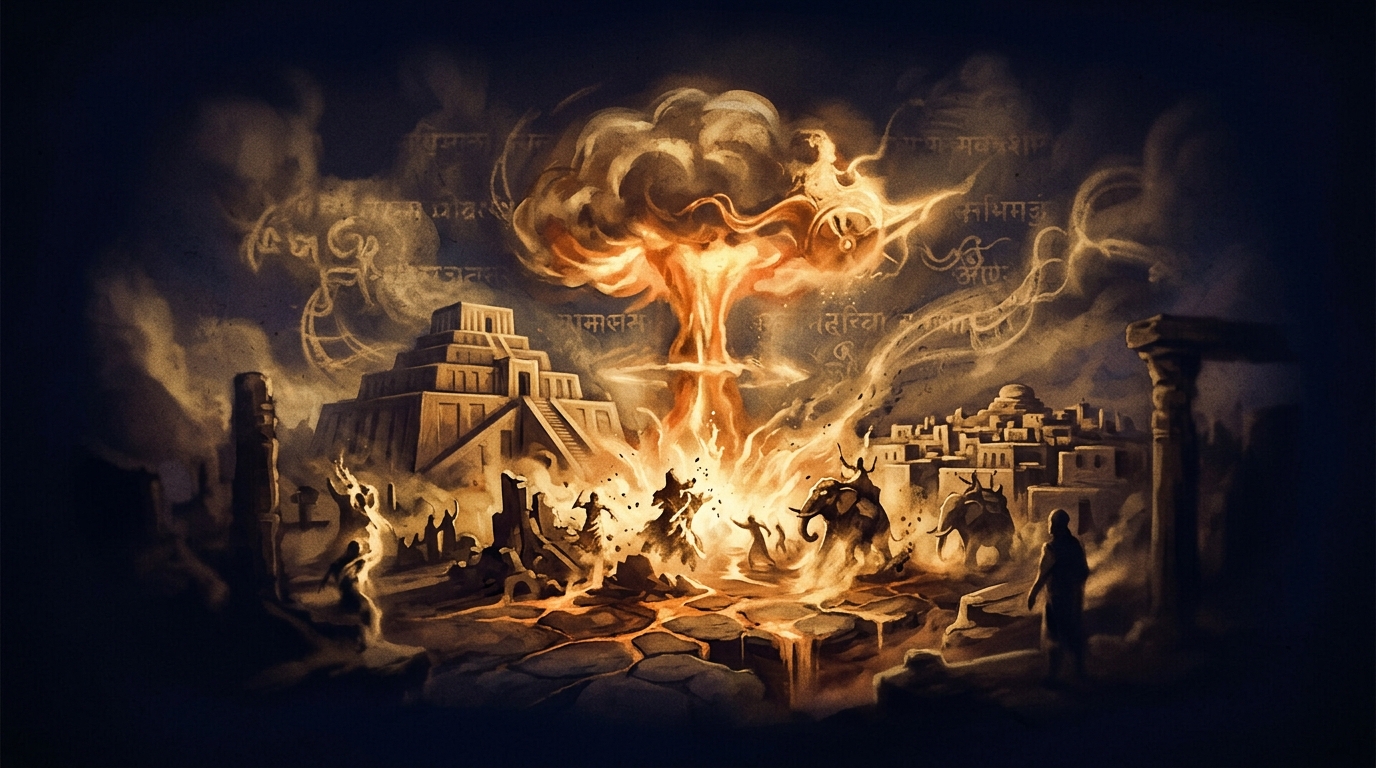
 Codex Illustration
Ancient Nuclear War Claims
A contested fringe theory holds that ancient texts and archaeological anomalies — particularly at the Indus Valley site of Mohenjo-daro and in the Sanskrit epic the Mahabharata — preserve fragmentary memory of a prehistoric nuclear exchange, a claim met with serious geological, textual, and archaeological objections.
Overview
The ancient nuclear war hypothesis rests on two principal pillars: the physical condition of certain archaeological sites and the literary content of ancient epics. At Mohenjo-daro, the mature Indus Valley city abandoned around 1900 BCE, excavators in the twentieth century noted scattered skeletal remains lying in streets and open spaces, apparently unburied, and some investigators reported glassy or fused material in portions of the site. Proponents of the nuclear war theory, most prominently popularized in the 1960s writings of Davenport and Vincenti and later amplified by New Age authors, argued that this evidence pointed to a catastrophic, high-heat event of unnatural origin. Separately, passages from the ancient Sanskrit epic the Mahabharata — particularly descriptions of the astra weapons wielded by divine heroes, including the brahmastra — employ vivid imagery: blinding light, pillar-like clouds, scorched earth, survivors losing hair and nails. To a modern reader familiar with nuclear blast descriptions, the resemblance is arresting.
The geological and archaeological rebuttal is substantial. The so-called 'vitrification' at Mohenjo-daro has been disputed by multiple scholars and archaeologists, including those affiliated with the Archaeological Survey of India and independent reviewers. The glassy material claimed by Davenport and Vincenti was never independently verified or formally published in peer-reviewed archaeological literature; mainstream excavation reports, including those of Sir John Marshall and later Ernest Mackay, describe a city that declined gradually, possibly from flooding, salinity, or the gradual southward shift of the Indus River system. The skeletal remains, when analyzed, show no evidence of radiation exposure and appear to represent a small, atypical sample rather than mass casualties from a single event. Forensic and geological specialist Mark Kenoyer, among others, has noted that the deaths likely occurred over time. The site shows nothing analogous to the compressive shock signatures or isotopic anomalies documented at genuine high-energy impact or weapons-test sites.
The literary evidence presents its own interpretive challenges. Sanskrit scholars such as A. L. Basham and, more recently, researchers in the academic study of Indo-European epic traditions have emphasized that the astra weapons described in the Mahabharata belong to a well-established tradition of divine-warrior hyperbole found across ancient cultures — from Homeric battle poetry to Mesopotamian descriptions of divine wrath. The brahmastra and similar weapons are invoked through mantra and meditation, controlled by the mental discipline of the user, and embedded within a cosmological-theological framework utterly unlike any modern weapons program. Reading them as technological blueprints, these scholars argue, imports a modern materialist interpretive grid onto texts designed to convey sacred hierarchy, dharmic consequence, and cosmic order. Comparative mythologist Wendy Doniger and Indologist Patrick Olivelle have both cautioned against literalist readings of ancient epic warfare that strip context from religious and narrative function.
The theory has proven remarkably durable in popular culture, migrating from the fringe books of the 1960s into television documentaries, internet forums, and the ancient astronaut framework popularized by Erich von Däniken and, more recently, by the History Channel series Ancient Aliens. Its persistence reflects a genuine human intuition — widely noted by historians of religion — that ancient peoples possessed knowledge and experienced catastrophes that do not fit neatly into standard progressive models of civilization. While the specific nuclear war hypothesis lacks credible empirical support, the broader questions it gestures toward — about the depth of lost knowledge, the ambiguity of myth as historical memory, and the nature of large-scale catastrophes in prehistoric and early historic periods — are legitimate subjects of ongoing scholarly inquiry in fields ranging from archaeoastronomy to catastrophism studies.
Key Claims
Timeline
Evidence
Multiple Perspectives
Biblical Lens
Scripture Threads
Sources & Further Study
Questions to Explore
Go Deeper Path
Follow the Thread
Continue the Investigation
You’ve reached the Full Archive portion of this Case File.
Ask the Archivist
about this fileSign in to ask the Archivist
Create a free account to ask the Archivist 1 grounded question each day, cited straight from the CODEX case files.
Discussion
0Share findings, questions, and evidence with fellow Seekers. Be respectful and cite sources where you can.
No comments yet. Be the first to open this thread.