
 Codex Illustration
Apollo 20
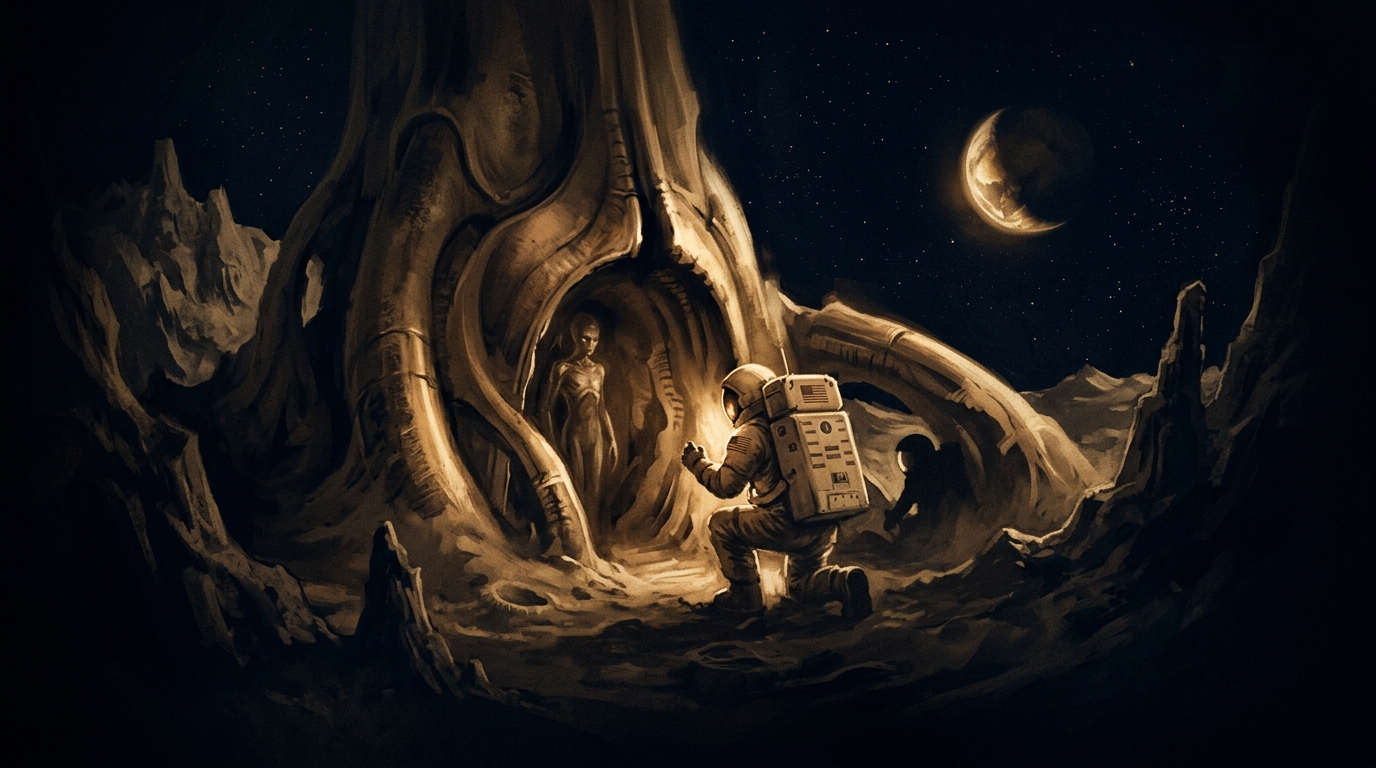
In 2007, a series of videos appeared on YouTube claiming to document a secret 1976 joint American-Soviet lunar mission that allegedly discovered an ancient alien spacecraft and a preserved humanoid body on the far side of the Moon — a story that captivates millions yet rests on no verifiable evidence whatsoever.
Overview
The Apollo 20 narrative emerged suddenly in the spring of 2007 when a YouTube user identifying himself as William Rutledge — claiming to be a retired NASA astronaut then living in Rwanda — uploaded footage purportedly filmed during a clandestine lunar mission in August 1976. According to Rutledge's account, the mission was the third in a secret series (following Apollo 19 and 18) conducted after NASA's publicly announced cancellation of Apollo missions 18 through 20 in September 1970. The alleged mission purportedly launched aboard a Saturn V rocket from Vandenberg Air Force Base in California — a facility never equipped for Saturn V launches — and landed near the Delporte crater region of the lunar far side, where a massive derelict spacecraft of clearly non-human origin had been detected in Lunar Orbiter imagery. The claim drew initial attention partly because some online commentators identified what they believed were anomalous elongated objects in genuine archival Lunar Orbiter photographs, lending a superficial veneer of photographic legitimacy to the narrative.
The centerpiece of the story — and its most viscerally compelling element — was the alleged recovery of a humanoid figure from within the derelict craft, described by Rutledge as a female entity in a state of suspended animation or biological preservation. This figure, widely known in later internet retellings as 'Mona Lisa,' was depicted in the uploaded footage as having elongated facial features, closed eyes, and what appeared to be organic material fused or grown over portions of her body. Rutledge also claimed a second entity was found in a more deteriorated state. The footage purported to show close-up examination of this figure inside a lunar module, accompanied by narration describing her physiological condition. The narrative incorporated additional details designed to increase plausibility: references to real mission parameters, the use of authentic-sounding NASA jargon, and the invocation of the Cold War context in which a joint American-Soviet operation might have been conceivable and kept secret.
Investigation by digital media analysts, space history researchers, and amateur debunkers moved quickly and methodically. The alleged Saturn V launch footage was identified as a reversed and reprocessed clip of the genuine Apollo 15 launch. The lunar surface footage exhibited lighting inconsistencies incompatible with the conditions prevailing at the claimed landing site and time. The 'Mona Lisa' figure was assessed by multiple analysts as a fabricated prop or digitally manipulated image, with some researchers identifying similarities to theatrical latex prosthetics. NASA's own mission archives confirm that no Saturn V rocket was prepared at Vandenberg Air Force Base at any point during the Apollo program; the facility simply lacked the infrastructure. Furthermore, a mission of this scale would have required thousands of contractors, engineers, and support personnel — a workforce whose silence across nearly five decades would represent a logistical impossibility without parallel in the history of covert operations. The videos themselves were later traced to William Rutledge's account being managed, at least in part, from France, not Rwanda.
Despite its thorough debunking within specialist communities, the Apollo 20 narrative has proven remarkably persistent in the broader cultural imagination. It circulates continuously across YouTube, conspiracy forums, social media platforms, and alternative history websites, often presented to new audiences stripped of any critical context. The story's longevity illustrates several important dynamics in modern digital folklore: the power of cinematic visual material to override critical analysis, the appetite for narratives that reframe official history as deliberate concealment, and the way the genuine mysteries of the Moon — its complex geology, the real anomalies studied by planetary scientists, and the partial opacity of Cold War-era space programs — provide fertile ground for confabulation. In this respect, Apollo 20 functions less as a factual claim and more as a cultural artifact: a twenty-first-century myth dressed in the technical language of the Space Age.
Key Claims
Timeline
Evidence
Multiple Perspectives
Biblical Lens
Scripture Threads
Sources & Further Study
Questions to Explore
Go Deeper Path
Follow the Thread
Continue the Investigation
You’ve reached the Full Archive portion of this Case File.
Ask the Archivist
about this fileSign in to ask the Archivist
Create a free account to ask the Archivist 1 grounded question each day, cited straight from the CODEX case files.
Discussion
0Share findings, questions, and evidence with fellow Seekers. Be respectful and cite sources where you can.
No comments yet. Be the first to open this thread.