
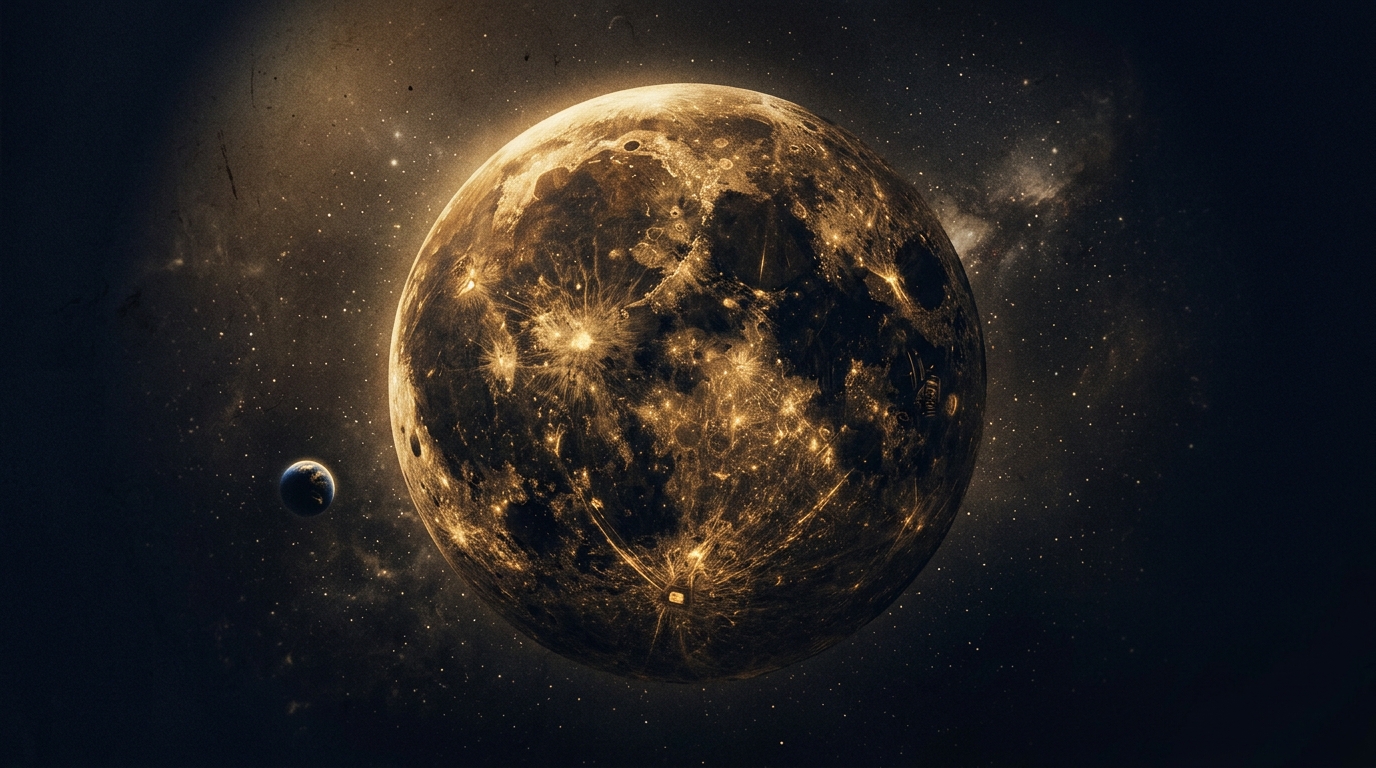
 Codex Illustration
Artificial Moon
Among the most audacious proposals in fringe cosmology is the claim that Earth's Moon is not a natural satellite at all, but a constructed or deliberately placed object — an idea that sits at the outermost boundary of speculation, yet draws, with selective emphasis, on genuine anomalies in lunar science that mainstream researchers continue to study and debate.
Overview
The hypothesis that Earth's Moon is an engineered or artificially positioned body has circulated in various forms since at least the mid-twentieth century. In its most developed popular form, the argument draws on a cluster of genuine scientific curiosities: the Moon's near-perfect alignment to produce total solar eclipses (its apparent diameter almost exactly matching the Sun's from Earth's surface), the surprisingly circular nature of its orbit, its anomalously low density compared to Earth's mantle, and the so-called 'hollow Moon' seismic data from Apollo-era experiments, in which the lunar surface 'rang like a bell' following deliberate impacts. None of these observations, taken individually or together, constitute scientific evidence for artificial construction — but proponents argue that their coincidental accumulation strains credibility. The idea received its most widely circulated early articulation in a 1970 article by Soviet scientists Mikhail Vasin and Alexander Shcherbakov published in the journal Sputnik, which proposed that the Moon might be a hollowed-out planetoid navigated into Earth orbit by an advanced intelligence.
Mainstream planetary science offers a robust counter-narrative. The dominant scientific model for lunar origin — the Giant Impact Hypothesis, first proposed in detail at a 1984 conference by Hartmann, Davis, Cameron, and Ward — holds that approximately 4.5 billion years ago, a Mars-sized body designated Theia collided with the proto-Earth, ejecting material that coalesced into the Moon under gravitational forces. This model accounts for the Moon's compositional similarities to Earth's mantle, its relative lack of iron (consistent with the ejected material being primarily silicate crust), and its angular momentum. The near-circular orbit and the eclipse coincidence are, under this model, the product of tidal locking over deep time and geometrical happenstance respectively. The seismic 'ringing' observed in Apollo data is explained by the Moon's extremely dry, fractured interior, which propagates seismic energy with unusual efficiency — not by structural hollowness.
Despite the scientific consensus, the artificial Moon hypothesis has proven culturally persistent and has been absorbed into several overlapping speculative traditions. Ancient astronaut theorists, particularly in the vein popularized by Erich von Däniken and later Zecharia Sitchin, have incorporated it into broader narratives about extraterrestrial intervention in human prehistory, sometimes linking it to the Anunnaki mythos and claims about genetic engineering. A separate thread, traceable partly to the work of David Icke and others in the conspiratorial tradition, frames the Moon as a 'signal amplifier' or control mechanism used by nonhuman intelligences to manipulate human consciousness — a claim with no scientific basis whatsoever. More restrained fringe researchers note genuine unresolved questions in lunar science, such as the still-debated details of Theia's composition and the precise origin of transient lunar phenomena (unexplained lights and color changes observed on the lunar surface for centuries), arguing that intellectual honesty demands keeping certain questions open.
From a broader cultural and theological perspective, the Moon has occupied an extraordinary place in human imagination across every civilization. It governed calendars, shaped religious observance, and served in the Hebrew Bible and ancient Near Eastern cosmology as a 'lesser light' ordained to rule the night — a deliberate act of divine placement in the created order. The artificial Moon hypothesis, whatever its scientific standing, participates in a very old human intuition that the heavens are not random but arranged, that the cosmos carries intention. Whether one locates that intention in the act of a Creator God, an unknown intelligence, or mere anthropic selection bias, the Moon's peculiar fitness for its role continues to invite questions that span the gap between science, theology, and wonder.
Key Claims
Timeline
Evidence
Multiple Perspectives
Biblical Lens
Scripture Threads
Sources & Further Study
Questions to Explore
Go Deeper Path
Follow the Thread
Continue the Investigation
You’ve reached the Full Archive portion of this Case File.
Ask the Archivist
about this fileSign in to ask the Archivist
Create a free account to ask the Archivist 1 grounded question each day, cited straight from the CODEX case files.
Discussion
0Share findings, questions, and evidence with fellow Seekers. Be respectful and cite sources where you can.
No comments yet. Be the first to open this thread.