
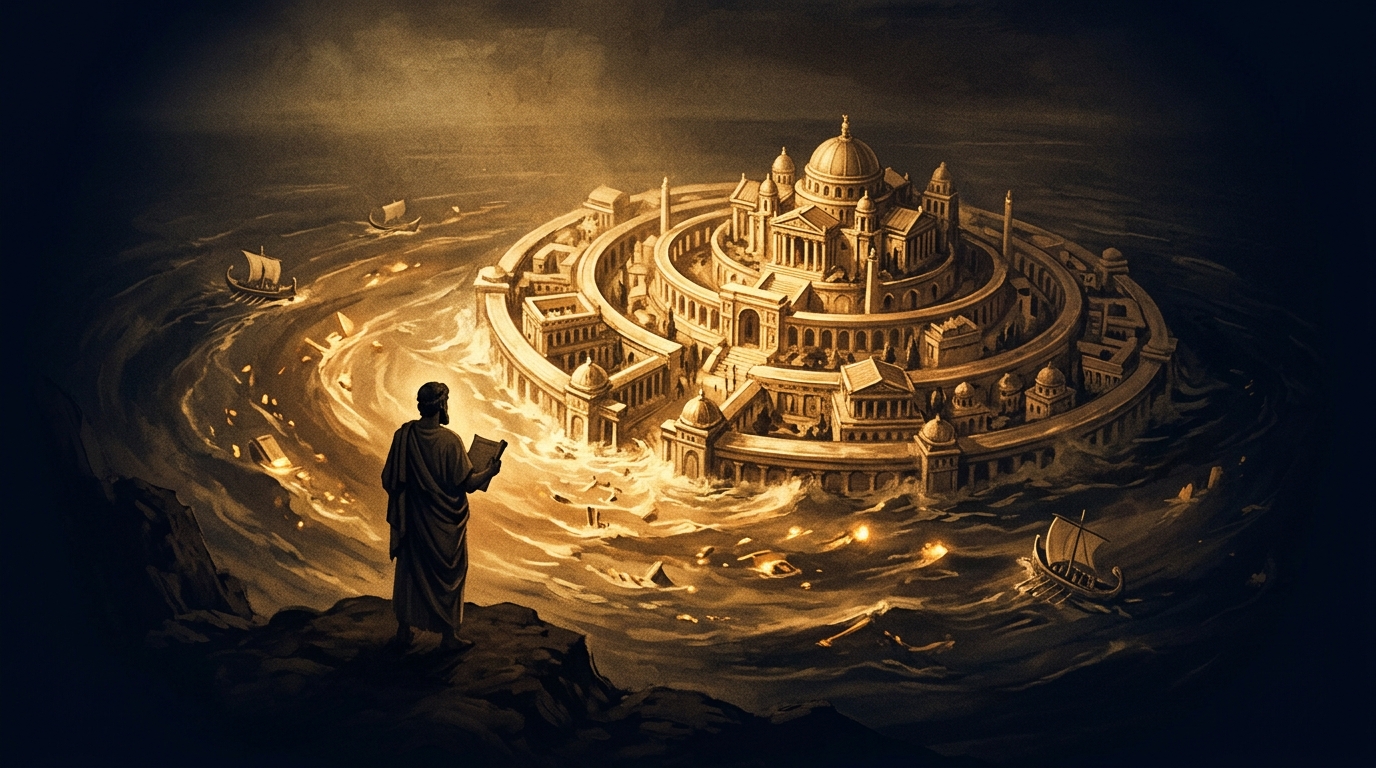
 Codex Illustration
Atlantis
First described by the Athenian philosopher Plato in the fourth century BC, Atlantis is a legendary island civilization said to have sunk beneath the ocean after a divine catastrophe — a tale that has captivated scholars, mystics, and explorers for over two millennia.
Overview
Atlantis enters the historical record exclusively through two dialogues written by Plato around 360 BC: the Timaeus and the Critias. In these texts, Plato presents an account attributed to the Athenian statesman Solon, who allegedly received it from Egyptian priests at Sais. According to the narrative, Atlantis was a vast and powerful maritime empire located beyond the 'Pillars of Hercules' (the Strait of Gibraltar), which flourished some 9,000 years before Solon's era. Its inhabitants were described as the semi-divine offspring of the sea god Poseidon, blessed with extraordinary technology, wealth, and a sophisticated constitutional order. Over generations, however, moral corruption took hold, and the gods — led by Zeus — resolved to punish the Atlanteans. In a single catastrophic day and night, the island sank into the ocean.
The central scholarly question has always been whether Plato intended Atlantis as a historical account, a philosophical allegory, or some combination of both. The majority of classical scholars and historians — including figures such as Aristotle, who reportedly dismissed the story — regard Atlantis as a literary device crafted by Plato to explore themes of hubris, civic virtue, and divine justice. The Critias breaks off mid-sentence, suggesting an unfinished composition rather than a continuous historical tradition. Others, however, point to the specificity of geographic and institutional details as evidence that Plato drew on genuine oral traditions, possibly including memories of Minoan Crete, the Mycenaean world, or even the catastrophic volcanic eruption at Thera (Santorini) around 1620 BC.
Modern archaeological and geological investigations have not produced any physical evidence of a sunken advanced civilization in the Atlantic or Mediterranean. Nevertheless, serious researchers have proposed dozens of candidate locations: the Azores, the Canary Islands, the Bahamas, the Antarctic continent, the Iberian Peninsula, and most persistently the Aegean. The Bimini Road — a natural formation of limestone blocks off the Bahamas discovered in 1968 — generated considerable popular excitement but was subsequently evaluated by geologists as a natural beachrock formation. Similarly, underwater structures near Yonaguni, Japan have been proposed by some enthusiasts as Atlantean remnants, though mainstream geologists classify them as natural erosional formations.
In the nineteenth and twentieth centuries, Atlantis was dramatically transformed from a classical philosophical text into a cornerstone of alternative history. Ignatius Donnelly's 1882 book Atlantis: The Antediluvian World popularized the idea that Atlantis was the common ancestor of all ancient civilizations, the source of flood myths worldwide, and home to a vanished super-race. This tradition was amplified by Theosophist Helena Blavatsky, the trance readings of Edgar Cayce, and later by authors such as Graham Hancock, whose work blends legitimate archaeological curiosity with speculative reconstruction. Mainstream archaeology regards these frameworks as unsupported by stratigraphic or material evidence, while acknowledging that pre-modern maritime cultures were more sophisticated than nineteenth-century scholarship assumed.
Timeline
Evidence
Multiple Perspectives
Biblical Lens
Scripture Threads
Sources & Further Study
Questions to Explore
Carry the Investigation
Field gear inspired by this Codex case file.
Follow the Thread
Continue the Investigation
You’ve reached the Full Archive portion of this Case File.
Ask the Archivist
about this fileSign in to ask the Archivist
Create a free account to ask the Archivist 1 grounded question each day, cited straight from the CODEX case files.
Discussion
0Share findings, questions, and evidence with fellow Seekers. Be respectful and cite sources where you can.
No comments yet. Be the first to open this thread.