
 Codex Illustration
Ba'al
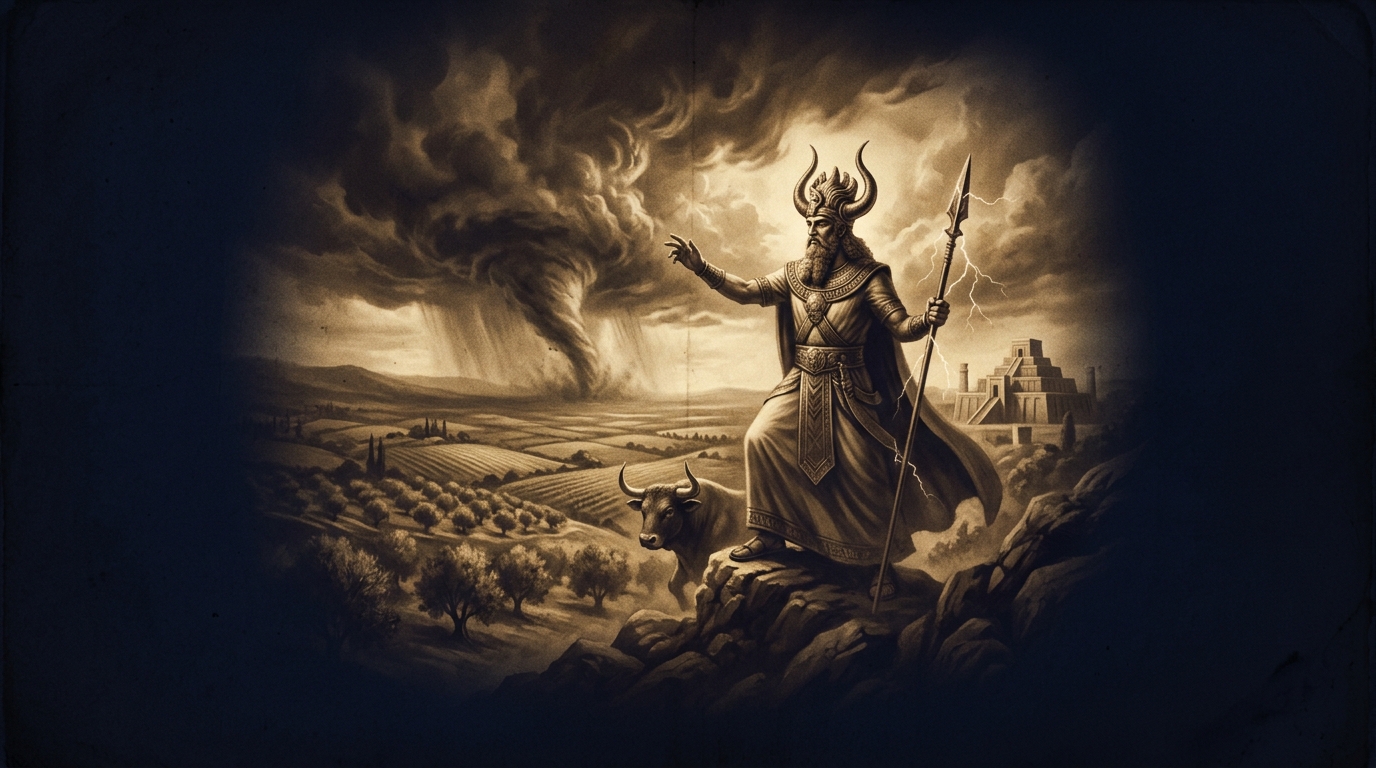
Ba'al — 'Lord' in Semitic — was the preeminent storm-and-fertility deity of the ancient Canaanite and Ugaritic world, whose documented rivalry with YHWH across centuries of Israelite history makes him arguably the most theologically significant foreign deity in the Hebrew Bible, and whose mythological profile continues to generate serious scholarly debate about the nature of the 'gods of the nations' in ancient Israelite thought.
Overview
Among the deities of the ancient Near East, few cast as long a shadow across religious history as Ba'al — specifically Ba'al-Hadad, the storm god whose thunderous voice was heard in the rain that watered Canaan's crops and whose battles with primordial forces shaped the cosmology of an entire civilization. The Ugaritic texts recovered at Ras Shamra in northern Syria beginning in 1929 revealed a remarkably sophisticated mythological system in which Ba'al occupies the central dramatic role: he defeats Yam, the god of sea and chaos, claiming kingship among the divine assembly; he constructs a palace-temple on Mount Zaphon (his sacred mountain); he descends into the realm of Mot (Death) and is mourned as slain before rising again — a cycle that many scholars, cautiously, read as a ritual-mythological pattern tied to the agricultural seasons. These tablets, datable to roughly the fourteenth to thirteenth centuries BC, provide the most complete picture of the religious world Israel inhabited and, critically, the world the Hebrew prophets were arguing against.
The Hebrew Bible's engagement with Ba'al is not incidental — it is relentless and theologically charged. From the apostasy at Baal-Peor in Numbers 25, where Israelites joined in sacrificial rites to the local manifestation of the deity, to the thunderous confrontation on Mount Carmel where the prophet Elijah challenged four hundred and fifty prophets of Ba'al to a contest of divine fire (1 Kings 18), the biblical narrative frames Ba'al not as a harmless fiction but as a genuine rival claimant to Israel's loyalty. The specificity of the polemic — naming local manifestations such as Baal-Zebub of Ekron (2 Kings 1:2-3), a deity consulted by the ailing King Ahaziah — suggests that the biblical authors were engaging real religious institutions rather than constructing straw men. The later New Testament corruption of that name into 'Beelzebul' (Greek: Βεελζεβούλ), applied in the Gospels as a title for the prince of demons (Matthew 12:24), traces a semantic arc from Canaanite storm god to demonic lord that rewards careful tracing.
Scholars working in the tradition of Michael S. Heiser have argued — with careful attention to the biblical text itself — that the Hebrew authors did not simply dismiss the gods of the nations as nonexistent figments. Passages such as Deuteronomy 32:8-9 (especially the Dead Sea Scrolls reading 'sons of God' rather than 'sons of Israel'), Psalm 82, and the broader divine council imagery throughout the Psalms and prophetic literature suggest a worldview in which these entities were understood as real supernatural beings — 'elohim' in the broad Hebrew sense — assigned by the Most High to govern the nations following the Babel event, who subsequently corrupted their stewardship and became objects of idolatrous worship. Within this framework, Ba'al is not merely a cultural misunderstanding but, in the biblical authors' own categories, a rebellious member of the divine assembly — a 'son of God' gone wrong — whose worship constituted a catastrophic loyalty transfer by the nations and a temptation Israel repeatedly failed to resist. This reading does not require endorsing Canaanite theology; it requires taking the biblical polemic seriously on its own hermeneutical terms.
The afterlife of Ba'al in later traditions is equally arresting. Hellenistic-era Jewish literature identified Ba'al with specific demonic powers; Second Temple texts show an increasing tendency to systematize the 'gods of the nations' as a hierarchy of fallen spiritual beings. The name 'Beelzebub' passed through Syriac and Latin Christianity as a term for Satan or a chief demon, embedding a Canaanite storm god into the vocabulary of medieval demonology and eventually popular culture. Modern scholars of comparative religion note intriguing structural parallels between the Ba'al Cycle's death-and-resurrection motif and other ancient Near Eastern fertility narratives — parallels that require neither sensational harmonization nor dismissive reduction, but careful typological analysis that respects the integrity of each tradition. Ba'al remains, in short, one of antiquity's most richly documented and theologically consequential divine figures.
Key Claims
Timeline
Evidence
Multiple Perspectives
Biblical Lens
Scripture Threads
Sources & Further Study
Questions to Explore
Go Deeper Path
Follow the Thread
Continue the Investigation
You’ve reached the Full Archive portion of this Case File.
Ask the Archivist
about this fileSign in to ask the Archivist
Create a free account to ask the Archivist 1 grounded question each day, cited straight from the CODEX case files.
Discussion
0Share findings, questions, and evidence with fellow Seekers. Be respectful and cite sources where you can.
No comments yet. Be the first to open this thread.