
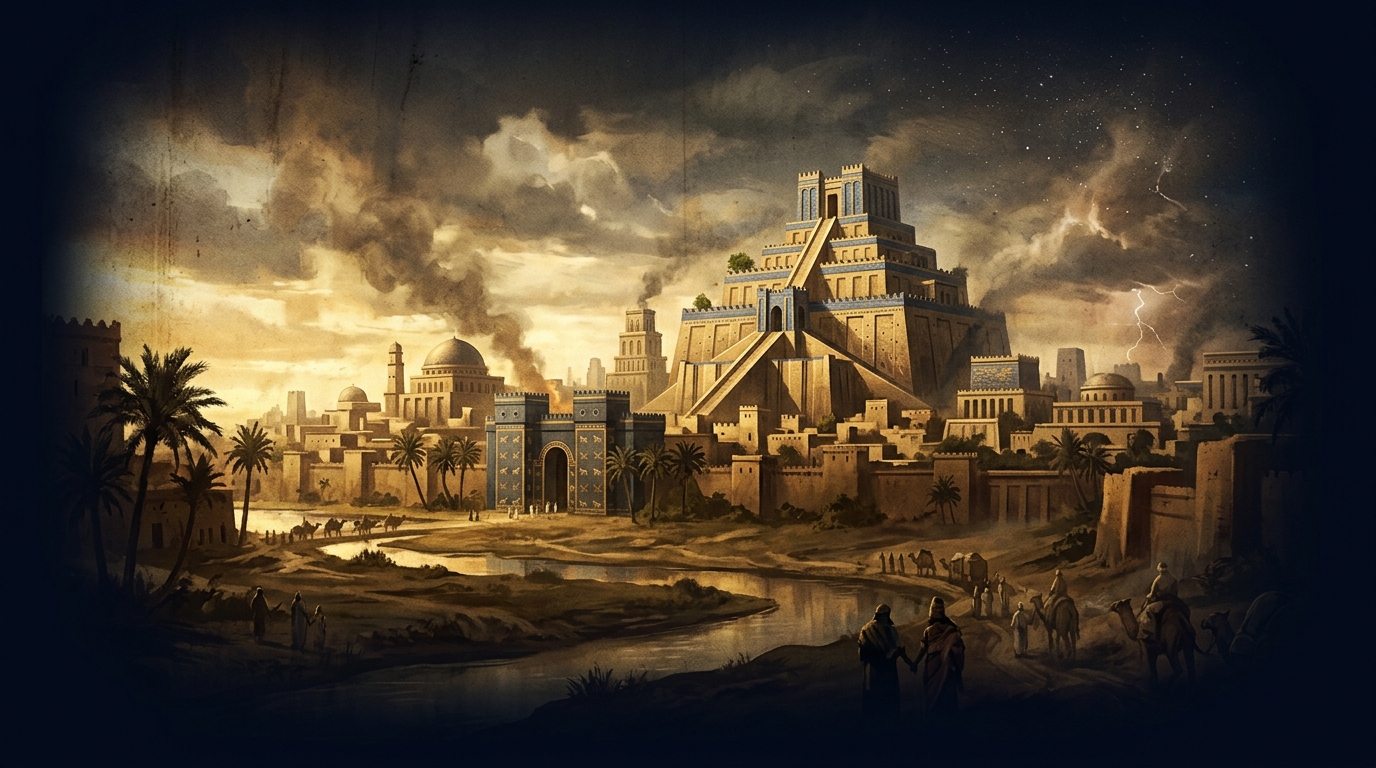
 Codex Illustration
Babylon
Rising from the alluvial plains of southern Mesopotamia, Babylon became the most celebrated city of the ancient world — a seat of imperial power, astronomical science, legal innovation, and theological ambition whose shadow stretches from Genesis to Revelation.
Overview
Babylon (Akkadian: Bāb-ilim, 'Gate of God') occupied a strategic position on the Euphrates River in what is now central Iraq, approximately 85 kilometres south of modern Baghdad. Its origins are traceable to the third millennium BC, but it rose to regional prominence under the Amorite king Hammurabi (c. 1792–1750 BC), who unified Mesopotamia under his rule and promulgated the famous law code bearing his name. The city's physical grandeur reached its zenith under the Neo-Babylonian Empire (626–539 BC), particularly during the reign of Nebuchadnezzar II, who reconstructed its monumental core — the Ishtar Gate, the Processional Way, the ziggurat Etemenanki ('House of the Foundation of Heaven and Earth'), and what later traditions associated with the Hanging Gardens. Archaeological excavations led by Robert Koldewey between 1899 and 1917 uncovered the city's layout, confirming many ancient descriptions and providing physical correlates for biblical and classical accounts.
Babylon functioned simultaneously as a political capital, a religious center, and a crucible of intellectual achievement. Its scribal schools produced canonical literature including the Enuma Elish (the Babylonian creation epic), the Epic of Gilgamesh in its most complete recension, and vast archives of astronomical observations that would influence Greek science. The city's temples and priesthood were organized around the patron deity Marduk, whose exaltation above the Babylonian pantheon in the Enuma Elish mirrors — and may have polemically informed — theological developments in surrounding cultures. Babylonian mathematics, using a sexagesimal (base-60) system, yielded computational achievements in algebra and astronomy centuries before Greek equivalents, a fact well-documented in cuneiform tablet collections now housed in the British Museum and the Vorderasiatisches Museum in Berlin.
In biblical literature, Babylon occupies a uniquely charged symbolic space. The Tower of Babel narrative in Genesis 11 is set in the land of Shinar — a Hebrew name for Babylonia — and the ziggurat-building project described therein finds a plausible physical referent in Etemenanki. The Neo-Babylonian Empire's destruction of Jerusalem (586 BC) and the subsequent exile of the Judean population gave 'Babylon' a theological weight in Hebrew consciousness that persisted long after the city's political decline. The prophetic literature of Isaiah, Jeremiah, Ezekiel, and Daniel engages Babylon both historically and eschatologically, and the Book of Revelation deploys 'Babylon' as a coded designation for Rome — and, in some interpretive traditions, for any hegemonic anti-divine civilization.
From the perspective of the Divine Council worldview developed by scholars such as Michael S. Heiser, Babylon's theological significance extends to questions of cosmic rebellion and territorial authority. Deuteronomy 32:8–9 (in the Septuagint and Dead Sea Scrolls reading) situates the division of nations — including those descended through Babel — under the jurisdiction of divine beings, while Marduk's enthronement theology in the Enuma Elish reflects a parallel but rival account of cosmic order. The city's eventual fall to Cyrus the Great in 539 BC, accomplished virtually without battle, was interpreted in Jewish and later Christian tradition as divine judgment — a theme formalized in prophetic texts and carried forward into apocalyptic literature. Babylon thus stands as one of antiquity's most richly documented intersections of political history, religious cosmology, and eschatological imagination.
Timeline
Evidence
Multiple Perspectives
Biblical Lens
Scripture Threads
Sources & Further Study
Questions to Explore
Follow the Thread
Continue the Investigation
You’ve reached the Full Archive portion of this Case File.
Ask the Archivist
about this fileSign in to ask the Archivist
Create a free account to ask the Archivist 1 grounded question each day, cited straight from the CODEX case files.
Discussion
0Share findings, questions, and evidence with fellow Seekers. Be respectful and cite sources where you can.
No comments yet. Be the first to open this thread.