
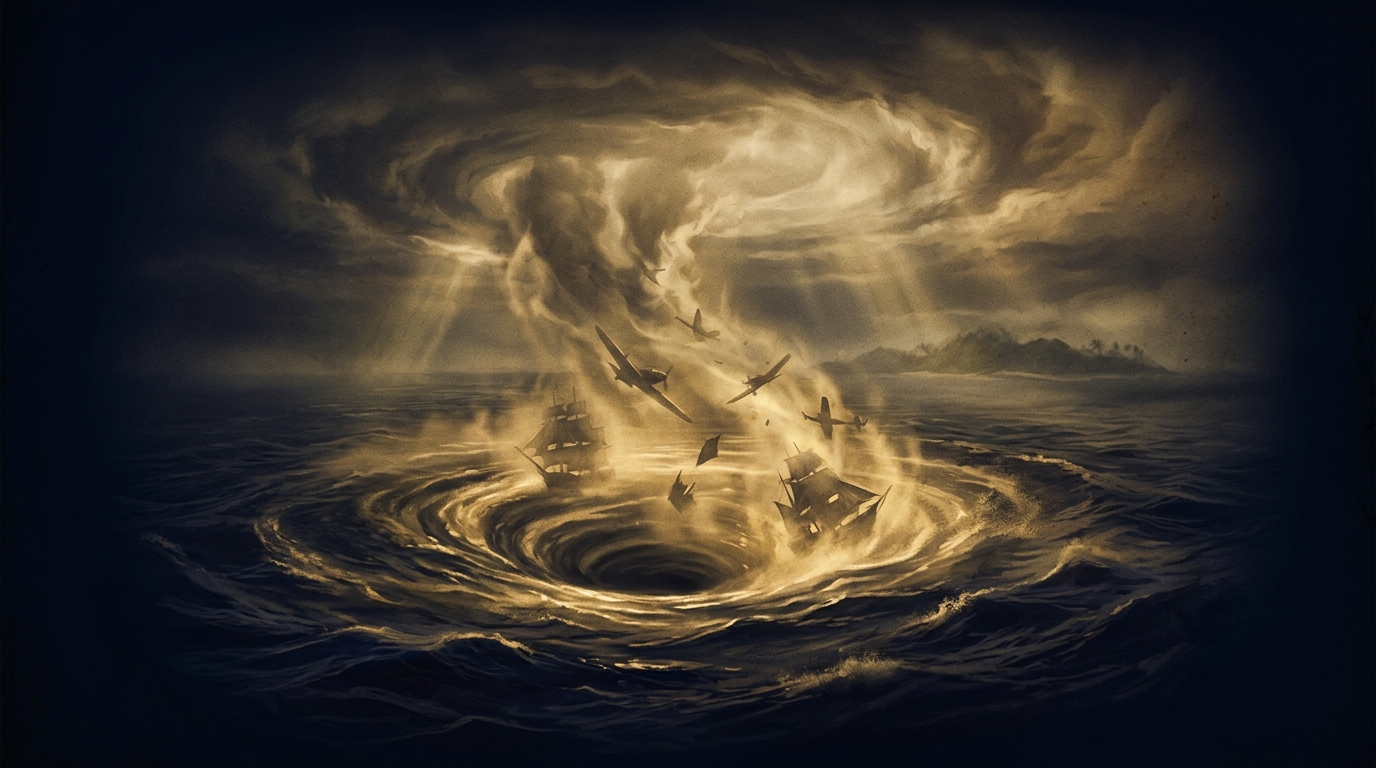
 Codex Illustration
Bermuda Triangle
A loosely defined region of the western North Atlantic, roughly bounded by Miami, Bermuda, and Puerto Rico, the Bermuda Triangle has accumulated decades of legend around ship and aircraft disappearances — yet rigorous statistical and meteorological analysis suggests its loss rates are not meaningfully anomalous compared to other heavily trafficked ocean regions.
Overview
The phrase 'Bermuda Triangle' entered popular consciousness largely through Vincent Gaddis's 1964 Argosy magazine article and was subsequently amplified by Charles Berlitz's 1974 bestselling book of the same name. The region encompasses some of the busiest maritime and aviation corridors in the world — a fact that critics argue is routinely omitted from popular accounts. Documented incidents within the area include genuine tragedies: the 1945 disappearance of Flight 19, a Navy training exercise involving five TBF Avenger torpedo bombers, remains one of the most studied and genuinely puzzling aviation mysteries of the twentieth century, though official investigation attributed it primarily to navigational disorientation and fuel exhaustion. What the popular literature rarely acknowledges is that Lloyd's of London — one of the world's most data-driven risk assessment institutions — does not charge higher insurance premiums for vessels transiting the Triangle, a quietly telling actuarial verdict.
The scientific and meteorological case for mundane explanations is substantial. The region is subject to rapid, violent weather systems including waterspouts and sudden squalls that can develop faster than standard warning systems can track. The Gulf Stream, running through the area at speeds up to five knots, is capable of dispersing wreckage and human remains over vast distances in hours, complicating recovery efforts and fueling speculation about 'vanishings.' The seafloor topography includes the Puerto Rico Trench — the deepest point in the Atlantic at roughly 8,376 meters — where sunken vessels would be extraordinarily difficult to locate. The United States Coast Guard, in its own official assessments, has consistently attributed losses in the region to human error, mechanical failure, and environmental hazard, noting no pattern distinguishable from other ocean zones of comparable traffic.
The cultural life of the Bermuda Triangle myth is, in some respects, more interesting than the physical geography. Beginning in the 1970s, the region became a focal point for paranormal speculation: proposed explanations have ranged from the scientifically plausible (methane hydrate eruptions causing localized sea-surface density collapses) to the geologically fringe (remnant crystal energy technology from Atlantis) to the extraterrestrial (underwater alien bases). The methane hydrate hypothesis — popularized by Australian geoscientist Joseph Monaghan — has received limited scientific attention and remains unconfirmed as a cause of any specific incident. The Atlantis connection derives almost entirely from the discovery of the so-called 'Bimini Road,' a formation of underwater limestone blocks near North Bimini in the Bahamas; mainstream geologists classify this as a natural beachrock formation, while alternative researchers continue to dispute that conclusion.
Perhaps the most intellectually honest verdict on the Bermuda Triangle comes from Lawrence David Kusche's meticulous 1975 investigation, 'The Bermuda Triangle Mystery — Solved,' in which he systematically examined the primary records — weather logs, Coast Guard reports, newspaper archives — for each incident claimed by Berlitz and others. Kusche found that a significant number of the alleged disappearances had been misrepresented: some had occurred outside the claimed boundaries, some during storms that were omitted from popular accounts, some had straightforward explanations that were suppressed for narrative effect, and at least a few vessels had never been reported missing in the first place. Kusche's work remains the most rigorous documentary audit of the legend and is widely regarded by historians and geographers as the definitive skeptical corrective — though it has not, of course, diminished the cultural fascination.
Key Claims
Timeline
Evidence
Multiple Perspectives
Biblical Lens
Scripture Threads
Sources & Further Study
Questions to Explore
Go Deeper Path
Follow the Thread
Continue the Investigation
You’ve reached the Full Archive portion of this Case File.
Ask the Archivist
about this fileSign in to ask the Archivist
Create a free account to ask the Archivist 1 grounded question each day, cited straight from the CODEX case files.
Discussion
0Share findings, questions, and evidence with fellow Seekers. Be respectful and cite sources where you can.
No comments yet. Be the first to open this thread.