
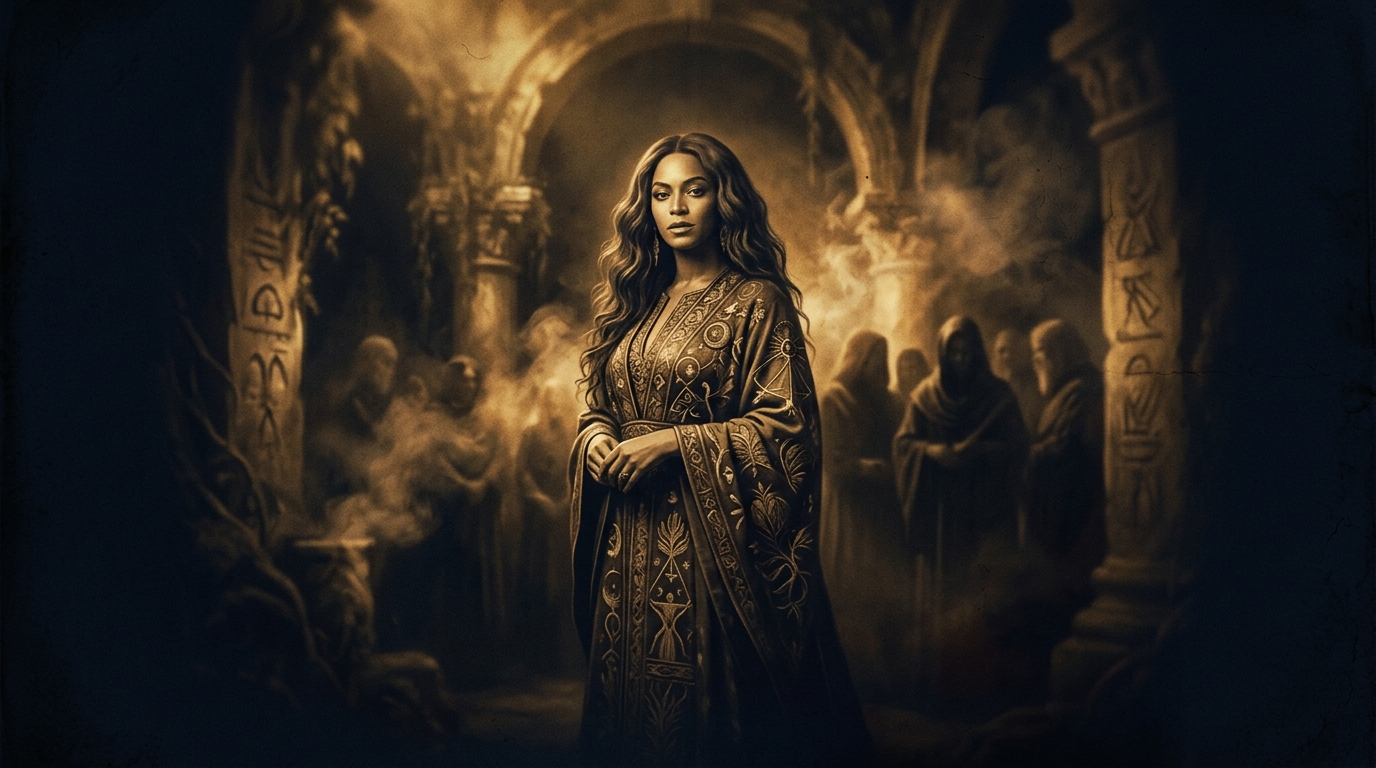
 Codex Illustration
Beyoncé
Beyoncé Giselle Knowles-Carter is one of the most commercially successful recording artists in history — and, by the logic of contemporary conspiracy culture, one of its most mythologized figures, accused variously of Illuminati membership, occult initiation, and the embodiment of a manufactured alter ego engineered by shadowy forces.
Overview
Beyoncé Knowles-Carter (born September 4, 1981, in Houston, Texas) rose to global prominence as the lead vocalist of Destiny's Child before achieving a solo career of extraordinary commercial and critical reach. Her documented biography — multiple Grammy Awards, record-breaking stadium tours, critically acclaimed visual albums including 'Lemonade' (2016) and 'Renaissance' (2022), and a business portfolio spanning Ivy Park, Parkwood Entertainment, and co-ownership of Tidal — is a matter of public record extensively covered by mainstream journalism and music criticism. She is, by any empirical measure, a dominant figure in twenty-first-century popular culture. That stature alone has made her a natural target for the mythologizing machinery of internet conspiracy culture, which has constructed an elaborate parallel narrative around her persona, her symbolism, and her corporate associations.
The most persistent conspiracy claims center on three overlapping allegations. First, that Beyoncé is a member of or tool of the so-called 'Illuminati' — a shadowy global elite alleged to control entertainment, finance, and government. Second, that her performances and music videos contain deliberate occult imagery, including Baphomet-related hand gestures (the 'Roc diamond' or 'Roc sign' associated with Jay-Z's Roc Nation label), pyramid iconography, and alleged Masonic symbolism. Third, that her publicly discussed performance alter ego 'Sasha Fierce' — a stage persona she introduced and later said she had outgrown — represents not a psychological performance strategy but evidence of dissociative identity programming, allegedly linked to CIA MKUltra-style trauma conditioning. These claims circulate primarily through internet videos, social media threads, and self-published books, and they draw on a pre-existing template of 'music industry occult control' narratives that have attached themselves to dozens of artists across several decades. None of these specific allegations has been substantiated by verifiable evidence.
The 'Beyism' or 'National Church of Bey' phenomenon adds a distinctive cultural layer to this dossier. Beginning around 2013–2014, a loosely organized satirical or semi-ironic online community emerged presenting Beyoncé as a literal deity figure — 'Queen Bey' — worthy of worship. The phenomenon was partly tongue-in-cheek fan expression, partly a commentary on celebrity idolatry in secular culture, and partly absorbed into earnest devotion by some participants who appeared to blur the satirical frame. Journalists including Brittney Cooper (writing in academic contexts) and cultural critics at outlets such as The Atlantic explored the phenomenon as a lens for examining race, gender, and the quasi-religious investment audiences place in Black female excellence. The 'church' itself, while generating considerable media coverage, appears to have been initiated as performance and social commentary rather than a genuine religious organization, though the sociological reality of intense celebrity devotion it exposed is not easily dismissed.
When assessed dispassionately, the evidentiary landscape around Beyoncé and the occult is almost entirely composed of pattern-matching, selective visual interpretation, and the application of a pre-formed conspiratorial template. The Roc Nation 'diamond' hand gesture, for example, is a documented brand symbol of Shawn Carter's (Jay-Z's) entertainment company, not a covert Illuminati salute, though its triangular shape has proven irresistible to symbolic over-reading. Visual motifs in her productions — Egyptian iconography, serpent imagery, fire, darkness, goddess aesthetics — are consistent with a long tradition of pop performance art that draws on world mythology and visual spectacle, and they are routinely analyzed in those terms by music critics, cultural studies scholars, and art directors. That said, the social and theological questions these phenomena raise — about celebrity worship, manufactured persona, and the appetite modern culture has for quasi-sacred figures — deserve serious reflection independent of whether any conspiracy is real.
Key Claims
Timeline
Evidence
Multiple Perspectives
Biblical Lens
Scripture Threads
Sources & Further Study
Questions to Explore
Go Deeper Path
Follow the Thread
Continue the Investigation
You’ve reached the Full Archive portion of this Case File.
Ask the Archivist
about this fileSign in to ask the Archivist
Create a free account to ask the Archivist 1 grounded question each day, cited straight from the CODEX case files.
Discussion
0Share findings, questions, and evidence with fellow Seekers. Be respectful and cite sources where you can.
No comments yet. Be the first to open this thread.