
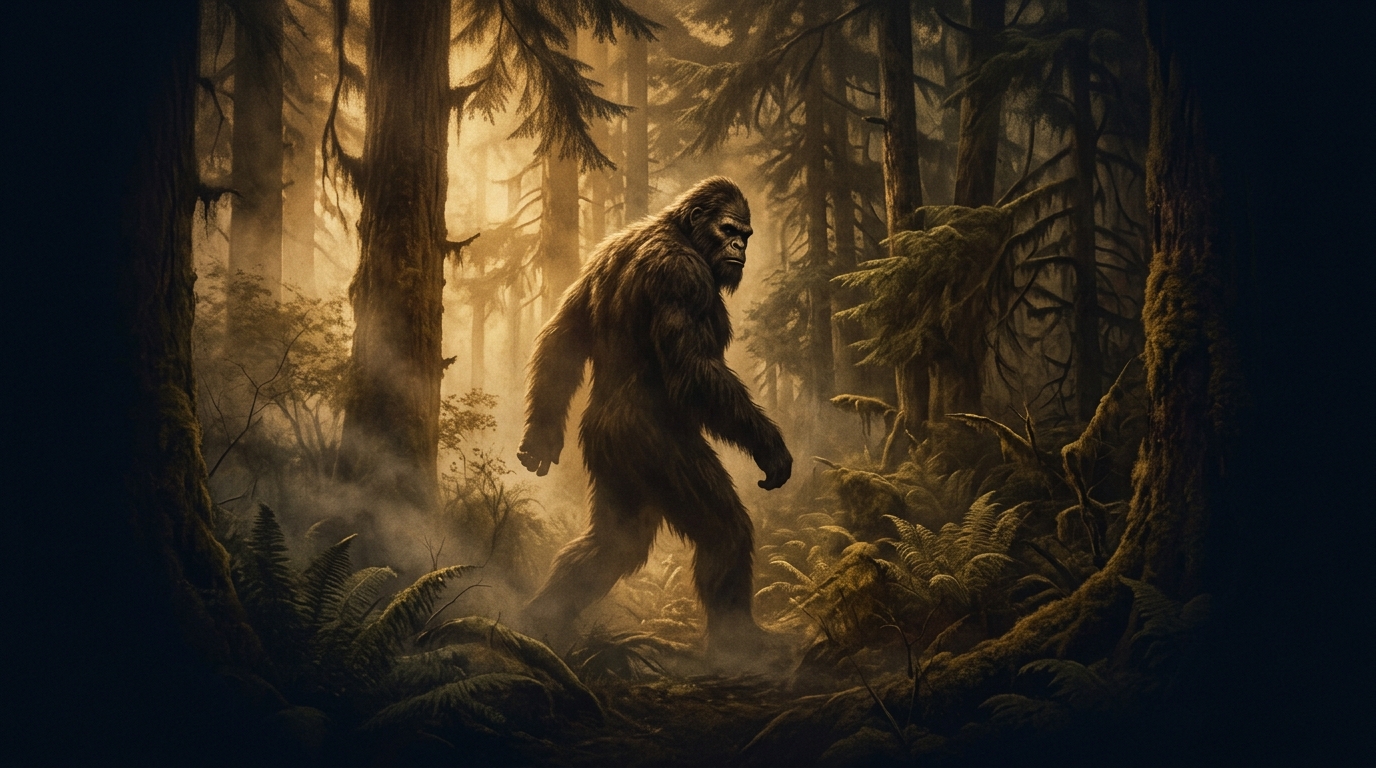
 Codex Illustration
Bigfoot
Across North America, Indigenous traditions, frontier accounts, and thousands of modern eyewitness reports describe a large, bipedal, hair-covered figure moving through wilderness—a creature that has never been physically confirmed, yet stubbornly refuses to dissolve entirely into legend.
Overview
Few figures in the cryptid canon have generated as much evidence, controversy, and cultural weight as Bigfoot—known also as Sasquatch, a name drawn from the Halkomelem word 'sásq'ets,' meaning 'wild man.' Reports of large, upright, hair-covered beings in forested North American terrain predate European settlement by centuries; numerous Indigenous nations from the Pacific Northwest to the Appalachians preserve oral traditions describing encounters with such creatures, sometimes as spiritual entities, sometimes as flesh-and-blood beings sharing the landscape with human communities. These traditions are not monolithic—their meanings, categories, and moral weight vary considerably across cultures—but their geographic distribution and antiquity give pause to those who would dismiss the phenomenon as a purely modern invention.
The modern Bigfoot phenomenon in its popular form crystallized in the late 1950s, when a Humboldt County, California, road construction crew reported finding large, human-like footprints near their equipment in 1958—a story widely circulated by journalist Andrew Genzoli in the Humboldt Times. This was followed in 1967 by the single most contested piece of alleged physical evidence: the Patterson-Gimlin film, a short 16mm sequence filmed near Bluff Creek, California, purporting to show a female Bigfoot moving through a clearing. Cryptozoologists, physical anthropologists, costume designers, and gait analysts have spent decades debating its authenticity without reaching consensus. The film remains, in the words of anthropologist Grover Krantz, 'the most important piece of evidence in the debate,' regardless of one's ultimate verdict on it.
The evidentiary landscape is uneven and frankly frustrating. On one hand, the sheer volume and geographic breadth of sighting reports is remarkable—the Bigfoot Field Researchers Organization (BFRO) maintains a database of thousands of submissions spanning every U.S. state and Canadian province—and some reports come from trained observers such as law enforcement officers, wildlife biologists, and military veterans. Physical evidence—hair samples, footprint casts, alleged recordings of vocalizations—has been collected and analyzed, though results have consistently been inconclusive or negative when subjected to rigorous scientific examination. DNA analyses of submitted samples, including a notable 2014 study led by Bryan Sykes at Oxford University, returned results matching known species. No verified remains, no confirmed skeleton, no definitive biological sample exists.
What the Bigfoot phenomenon reveals most clearly, perhaps, is the intersection of deep wilderness psychology, cultural memory, projection, genuine perceptual error, deliberate hoax, and—at its most interesting—the possibility that science's absence of evidence is not always equivalent to evidence of absence. The wilderness environments described in most encounters are genuinely vast and poorly surveyed; large mammals have been confirmed as new species to Western science well into the twentieth century. The phenomenon also intersects, at its edges, with broader questions about human perception, the limits of testimony as evidence, and the deep human instinct to sense something watching from the tree line—what folklorist Joshua Blu Buhs, in his cultural history of Bigfoot, identifies as a longing for the wild 'other' that modernity has systematically erased.
Key Claims
Timeline
Evidence
Multiple Perspectives
Biblical Lens
Scripture Threads
Sources & Further Study
Questions to Explore
Go Deeper Path
Follow the Thread
Continue the Investigation
You’ve reached the Full Archive portion of this Case File.
Ask the Archivist
about this fileSign in to ask the Archivist
Create a free account to ask the Archivist 1 grounded question each day, cited straight from the CODEX case files.
Discussion
0Share findings, questions, and evidence with fellow Seekers. Be respectful and cite sources where you can.
No comments yet. Be the first to open this thread.