
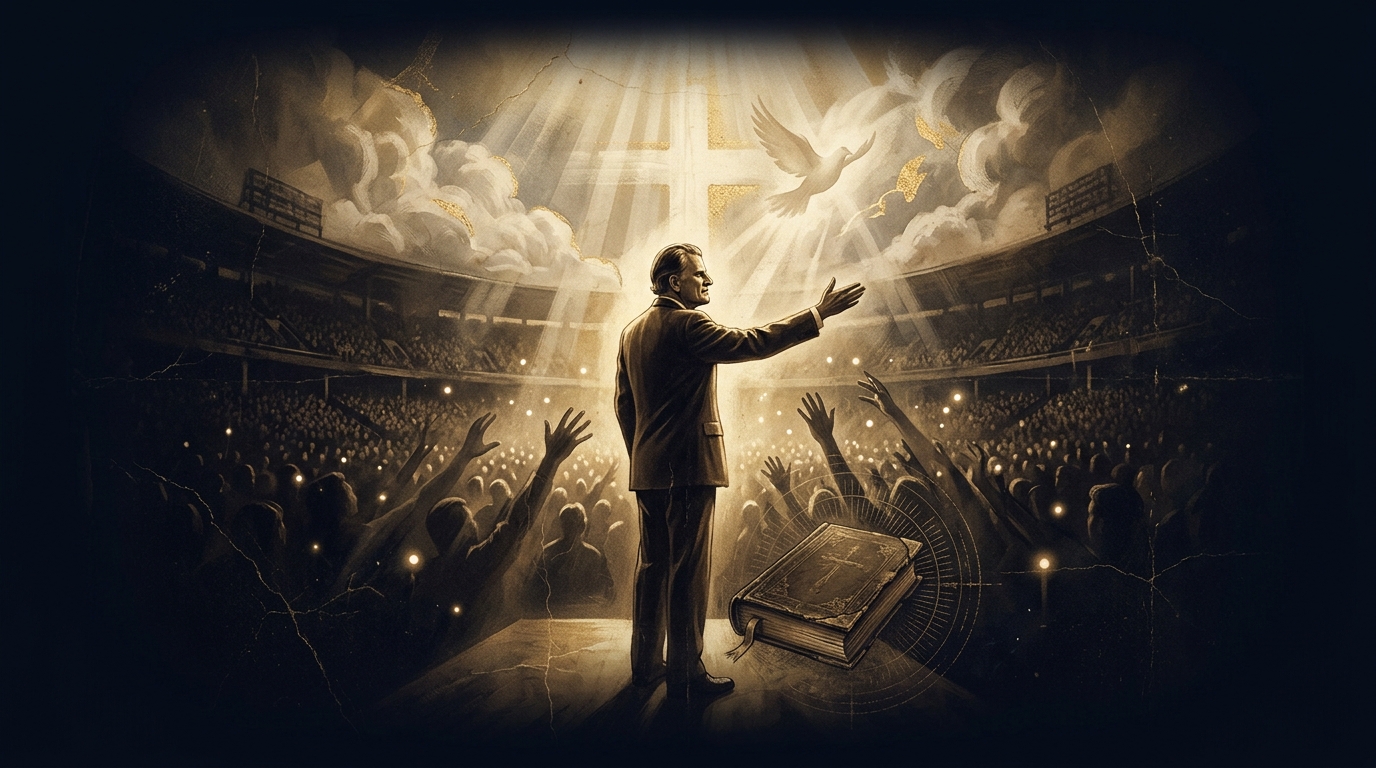
 Codex Illustration
Billy Graham
For six decades, William Franklin Graham Jr. stood before more human beings and proclaimed the Christian gospel in person than any preacher in recorded history — a fact documented, not romanticized — counseling presidents, filling stadiums on six continents, and shaping the moral and spiritual vocabulary of modern America.
Overview
William Franklin Graham Jr. was born November 7, 1918, on a dairy farm near Charlotte, North Carolina, and converted to Christian faith at age sixteen during a revival meeting led by evangelist Mordecai Ham. After brief studies at Bob Jones College and the Florida Bible Institute, he completed a bachelor's degree at Wheaton College in Illinois, where he also met his wife, Ruth Bell Graham. His early pastoral and Youth for Christ work gave him a platform that, by the landmark 1949 Los Angeles crusade — extended from three weeks to eight by popular demand and amplified by William Randolph Hearst's directive to 'puff Graham' — catapulted him to national prominence. That moment is documented in contemporaneous newspaper archives and Graham's own autobiography, *Just As I Am* (1997). Within three years he had founded the Billy Graham Evangelistic Association (BGEA) and launched *Hour of Decision*, a radio broadcast that eventually reached an estimated audience in the tens of millions weekly.
Graham's ministry was distinguished not only by its scale but by its deliberate ethical architecture. In 1948, in a Modesto, California, hotel room, Graham and his core team — Cliff Barrows, Grady Wilson, and George Beverly Shea — drafted what became known as the Modesto Manifesto, a voluntary covenant addressing the four most common critiques of traveling evangelists: financial accountability, sexual propriety, cooperation with local churches, and avoidance of inflated attendance statistics. This documented agreement, unusual for its era, is widely credited by historians of American religion, including Grant Wacker (author of *America's Pastor*, Harvard University Press, 2014), with insulating Graham's reputation through decades of ministry and public scandal that destroyed contemporaries. Graham also made a point of desegregating his crusades beginning in the early 1950s, reportedly removing the ropes dividing Black and white sections in his Chattanooga crusade tent with his own hands — a historically attested act, though its precise date and circumstances have been recounted in slightly varying forms across biographies.
Over the course of his public ministry, Graham preached in person to an estimated 215 million people across more than 180 countries and territories — a figure cited by the BGEA and echoed by secular historians, though like most cumulative attendance statistics it carries inherent estimation uncertainty. He conducted private and sometimes formal meetings with every U.S. president from Harry Truman to Barack Obama, serving variously as spiritual adviser, confessor, and in at least one notable case (Richard Nixon), an uncomfortably close confidant whose access to the Oval Office drew later criticism. The release of Nixon White House tapes in 2002 revealed Graham making antisemitic remarks in a private 1972 conversation — a documented episode Graham later publicly acknowledged and for which he expressed remorse. Scholars such as Steven Miller (*Billy Graham and the Rise of the Republican South*, 2009) have examined how Graham's ministry, intentionally or not, shaped the political alignment of American evangelical Protestantism.
Graham's theological method was notably simple and consistent across six decades: a brief biographical narrative, a direct proclamation of human sinfulness and divine grace through the atoning death of Jesus Christ, and an appeal — the famous 'altar call' — for public response, always accompanied by George Beverly Shea's singing and Cliff Barrows's choir. His signature phrase, 'The Bible says,' repeated as rhetorical anchor throughout each message, signaled his commitment to scriptural authority while remaining deliberately ecumenical in his appeal. He died on February 21, 2018, at his home in Montreat, North Carolina, at age ninety-nine. His burial at the Billy Graham Library in Charlotte drew national figures across party and denominational lines — a moment historians will likely read as the close of a particular chapter in American religious life.
Key Claims
Timeline
Evidence
Multiple Perspectives
Biblical Lens
Scripture Threads
Sources & Further Study
Questions to Explore
Go Deeper Path
Follow the Thread
Continue the Investigation
You’ve reached the Full Archive portion of this Case File.
Ask the Archivist
about this fileSign in to ask the Archivist
Create a free account to ask the Archivist 1 grounded question each day, cited straight from the CODEX case files.
Discussion
0Share findings, questions, and evidence with fellow Seekers. Be respectful and cite sources where you can.
No comments yet. Be the first to open this thread.