
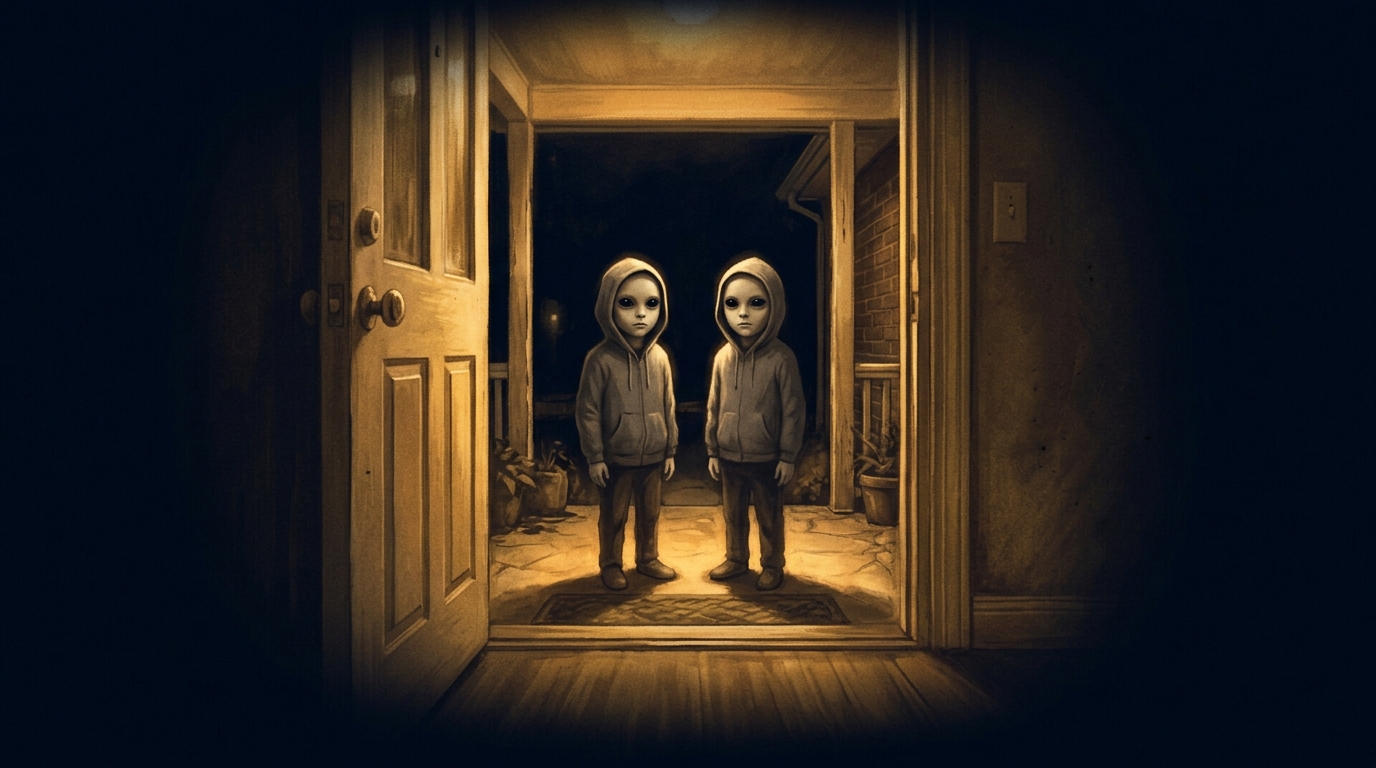
 Codex Illustration
Black-Eyed Children
Since the late 1990s, a peculiar and unsettling archetype has propagated through online communities and eyewitness testimony alike: children with entirely black eyes — no iris, no sclera — who appear at doorsteps or alongside roads, urgently requesting entry into homes or vehicles. Whether one regards them as modern urban legend, psychological phenomenon, or something stranger, the Black-Eyed Children occupy a singular and revealing position at the intersection of fear, folklore, and the unknown.
Overview
The modern Black-Eyed Children (BEK) narrative is most often traced to January 1998, when journalist Brian Bethel posted an account to a paranormal email list describing an encounter in Abilene, Texas. Bethel claimed two adolescent boys approached his car after dark, requesting a ride home; he was overwhelmed by an irrational, paralyzing fear before noticing their eyes — described as entirely and unnaturally black. He drove away without granting their request. The account spread rapidly through early internet forums and paranormal websites, and Bethel later repeated the story in media interviews, maintaining its authenticity. No corroborating witnesses to this specific encounter have emerged, and no physical evidence was produced. Bethel's narrative, whatever its ultimate nature, served as the primary seed from which an entire folklore genus grew.
In the years that followed, particularly after 2012 when the phenomenon received coverage in tabloid outlets, paranormal podcasts, and eventually a pair of low-budget horror films, reports multiplied dramatically. Witnesses across the United States, the United Kingdom, and occasionally elsewhere described pale-skinned children — typically appearing to be between eight and sixteen years old — knocking on doors late at night, flagging down vehicles on isolated roads, or standing silently near playgrounds. A near-universal feature of these reports is the insistence on entry: the children reportedly state, with unnatural calm and sometimes in oddly formal language, that they 'just need to come inside' or 'need to use the phone.' Witnesses consistently describe an overwhelming sense of dread that precedes or accompanies visual confirmation of the eyes. Crucially, in the vast majority of accounts, no witness reports actually granting entry, and the children allegedly vanish when refused or when the witness flees.
Folklorists and cultural critics have examined the BEK phenomenon as a case study in how contemporary legend-cycles are born and amplified in the digital age. Researcher David Weatherly, who published a dedicated study in 2012, catalogued hundreds of alleged encounters, though the methodology of his collection was not peer-reviewed academic fieldwork. The phenomenon shares structural DNA with older supernatural intruder archetypes: the stranger at the threshold, the uncanny child, and the being that requires invitation before it may enter — motifs present in vampire mythology, fairy lore, and various demonic encounter traditions worldwide. Scholars such as Jan Harold Brunvand, who studied contemporary legends, and folklorists working in the tradition of Linda Dégh have provided frameworks for understanding how such narratives fulfill deep-seated psychological and cultural functions, even when their literal truth is unverifiable.
What distinguishes the BEK phenomenon from simple internet fabrication is the consistency of reported phenomenology across apparently unconnected witnesses: the paralyzing fear prior to visual confirmation of the eyes, the insistence on threshold-crossing, the pale complexion, the formal and oddly adult speech patterns, and the apparent inability to act without the witness's consent. Whether these consistencies reflect a genuine anomalous stimulus, the self-reinforcing spread of a compelling narrative template, or some combination of both, remains genuinely open. The archive notes, without adjudicating, that the phenomenon's structural parallels to both folkloric encounter-beings and to certain categories of anomalous experience reported in other contexts — sleep paralysis entities, shadow figures, doorstep apparitions — invite careful comparative study rather than easy dismissal.
Key Claims
Timeline
Evidence
Multiple Perspectives
Biblical Lens
Scripture Threads
Sources & Further Study
Questions to Explore
Go Deeper Path
Follow the Thread
Continue the Investigation
You’ve reached the Full Archive portion of this Case File.
Ask the Archivist
about this fileSign in to ask the Archivist
Create a free account to ask the Archivist 1 grounded question each day, cited straight from the CODEX case files.
Discussion
0Share findings, questions, and evidence with fellow Seekers. Be respectful and cite sources where you can.
No comments yet. Be the first to open this thread.