
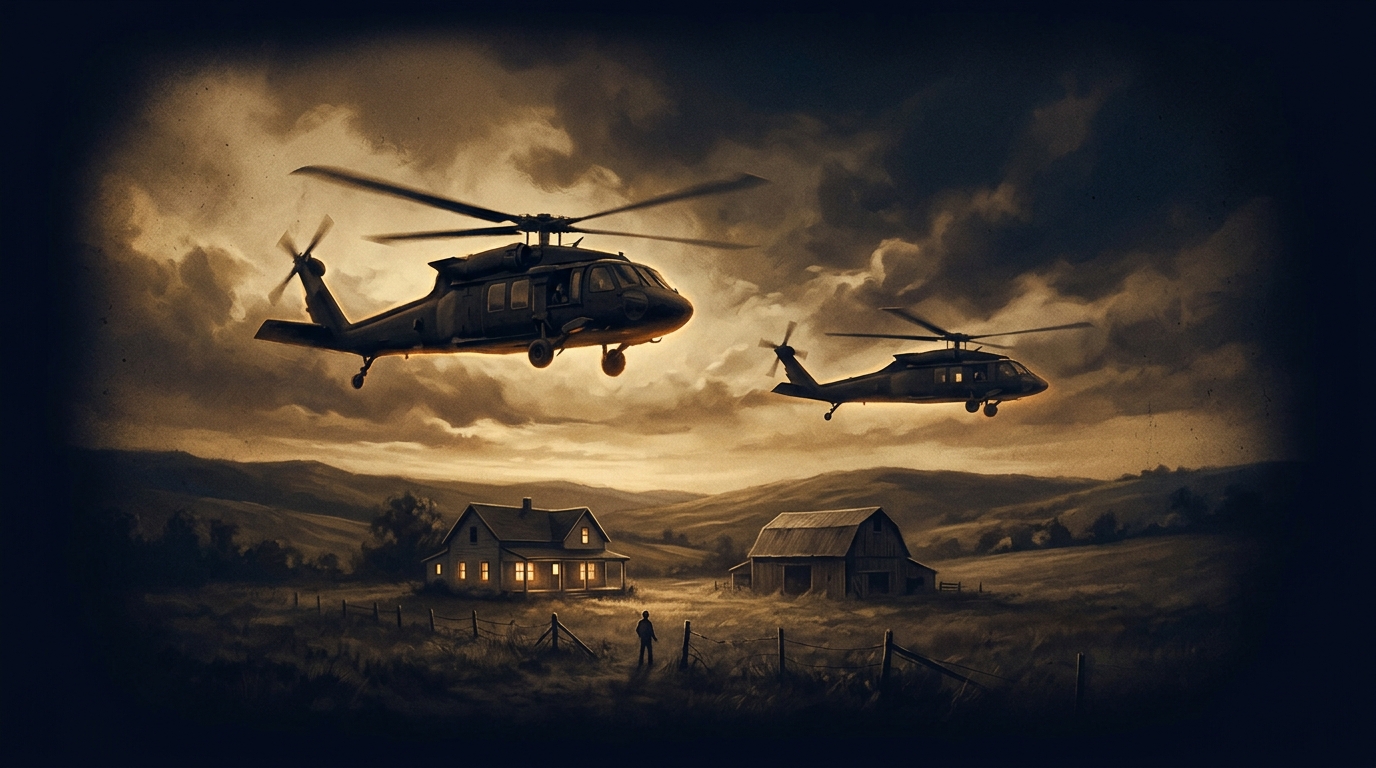
 Codex Illustration
Black Helicopters
Since at least the 1970s, reports of unmarked, low-flying dark helicopters have circulated across rural America, spawning a durable mythos that straddles documented military exercises, livestock-mutilation investigations, and a fully realized New World Order surveillance narrative that reached peak cultural saturation during the militia movements of the 1990s.
Overview
The phenomenon known as 'black helicopters' occupies an unusual position in the archive of American political culture: it rests on a foundation of genuinely documented events — unmarked military and federal law-enforcement aircraft have, in fact, conducted low-altitude operations over civilian areas — while simultaneously serving as the organizing symbol of a conspiratorial worldview that attributes omniscient government surveillance to a shadowy globalist apparatus. The earliest documented complaints of unusual helicopter activity in the United States emerged in the late 1960s and early 1970s, coinciding with both the growth of cattle-mutilation reports across the western plains and the expansion of federal drug-interdiction programs that employed unmarked rotary-wing aircraft. Investigative journalists and congressional inquiries of that era confirmed that agencies including the Drug Enforcement Administration and the Bureau of Alcohol, Tobacco and Firearms operated aircraft without visible insignia, a practice legal under certain federal statutes but alarming to rural landowners who had never consented to overflights.
The motif crystallized into explicit political symbology during the 1990s, driven by a convergence of factors: the rise of the militia movement following the Ruby Ridge and Waco incidents, the proliferation of shortwave radio and early internet forums, and the publication of texts such as Mark Koernke's 'America in Peril' videotapes and Jim Keith's 1994 book 'Black Helicopters Over America,' which synthesized livestock-mutilation lore, United Nations intervention fears, and Cold War surveillance anxiety into a coherent if highly speculative narrative. In this framework, the helicopters were not federal law-enforcement assets but advance scouts of a coming occupation, allegedly operated by United Nations or New World Order forces pre-positioning for a domestic takeover. This claim has never been substantiated by any credible evidence, and the scholarly consensus treats it as a paranoid political mythology rather than an operational reality.
What complicates a simple debunking, however, is that the documented record of covert domestic government operations — COINTELPRO, Operation MKUltra, the revelations of the Church Committee — had established, by the early 1990s, that agencies of the United States government had indeed conducted secret programs targeting American citizens. This historical substrate gave the black-helicopter narrative a measure of sociological traction it might otherwise have lacked. Researchers in political sociology, including Michael Barkun in 'A Culture of Conspiracy' (2003), have argued that the motif functions as a 'floating signifier' in conspiratorial thought: an image sufficiently ambiguous and visually dramatic to anchor a wide range of anxieties about state power, globalization, and the erosion of individual sovereignty. The helicopters are real; the interpretive framework placed around them ranges from the plausible to the demonstrably false.
In the twenty-first century, the black-helicopter motif has been partially absorbed into broader surveillance discourse, intersecting with documented revelations about programs like ECHELON and PRISM as well as the expansion of domestic drone operations. Law enforcement agencies including the Los Angeles Police Department and the Department of Homeland Security have publicly acknowledged operating dark-painted, low-visibility rotary-wing aircraft for surveillance purposes, confirming at least the perceptual reality behind the earliest reports even as the more extreme globalist interpretations remain without evidence. The cultural legacy endures: 'black helicopter' has entered the English lexicon as shorthand for any extreme government-surveillance anxiety, and the phrase appears regularly in political commentary, satirical literature, and popular media — a curious monument to the power of a single, ambiguous image to bear the weight of an entire generation's political fears.
Key Claims
Timeline
Evidence
Multiple Perspectives
Biblical Lens
Scripture Threads
Sources & Further Study
Questions to Explore
Go Deeper Path
Follow the Thread
Continue the Investigation
You’ve reached the Full Archive portion of this Case File.
Ask the Archivist
about this fileSign in to ask the Archivist
Create a free account to ask the Archivist 1 grounded question each day, cited straight from the CODEX case files.
Discussion
0Share findings, questions, and evidence with fellow Seekers. Be respectful and cite sources where you can.
No comments yet. Be the first to open this thread.