
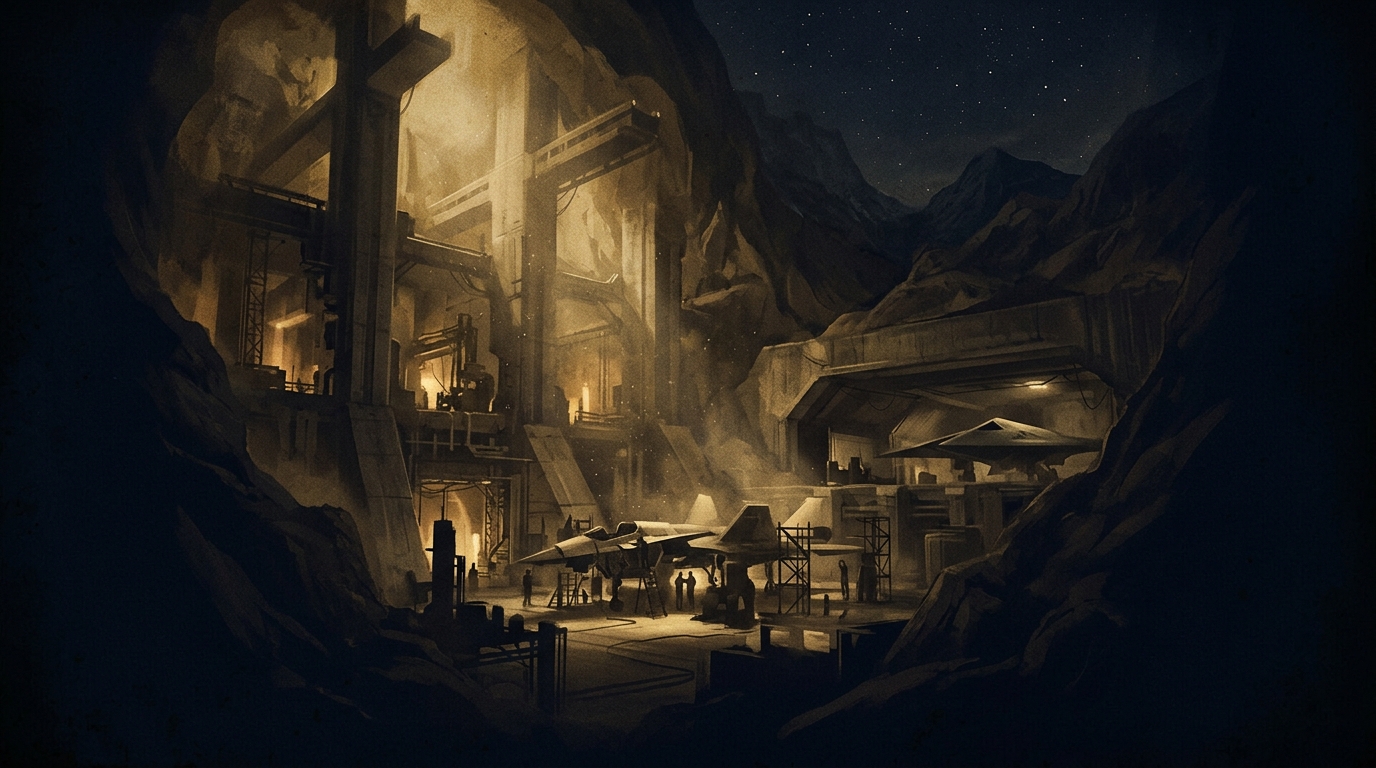
 Codex Illustration
Black Projects
Behind the publicly acknowledged apparatus of government lies a shadowed world of classified programs—'black projects'—funded through secret budgets, shielded from congressional oversight, and occasionally glimpsed only through declassified documents, whistleblower testimony, and the wreckage of history. These programs range from the demonstrably real and eventually declassified to the deeply speculative, forming the contested frontier between national security necessity and democratic accountability.
Overview
The term 'black project' refers to any classified government program whose existence, budget, and operational details are concealed from the general public and, often, from most of Congress. Such programs are funded through what is commonly called the 'black budget'—a portion of discretionary spending whose line items are redacted or aggregated under misleading headings in official appropriations. The U.S. government formally acknowledged the existence of a classified budget only in 1997, when the total figure (approximately $26.6 billion) was briefly disclosed. Subsequent estimates by the Federation of American Scientists and other watchdog organizations have placed annual black budget expenditures well above $50 billion in recent decades. The legal framework enabling such secrecy includes the National Security Act of 1947, various executive orders, and the Central Intelligence Agency Act of 1949, which permitted the CIA to conceal budget figures from public accounting.
The historical record of declassified black projects demonstrates that many seemingly fantastical government programs were entirely real. The U-2 and SR-71 reconnaissance aircraft programs, developed at the classified Groom Lake facility in Nevada (popularly known as Area 51), remained secret for years, generating numerous UFO sightings that the government quietly encouraged as a disinformation buffer. Project OXCART, Project CORONA (the first successful spy satellite program), and the Stealth fighter program (F-117 Nighthawk) all operated for years or decades before acknowledgment. The Senate Church Committee hearings of the mid-1970s exposed a sweeping array of covert domestic and foreign operations—including assassination plots, illegal surveillance (COINTELPRO), and the mind-control experiments of Project MKUltra—demonstrating that government secrecy could conceal not merely military technology but profoundly illegal activity.
Beyond the documented record, a vast landscape of speculation surrounds programs that remain classified or whose existence is claimed only by anonymous sources and unofficial testimony. These alleged programs include advanced propulsion research supposedly derived from recovered non-human technology, human genetic experimentation, underground base construction, and liaisons with non-human intelligences. The 2017 revelation of the Advanced Aerospace Threat Identification Program (AATIP) and the subsequent UAP disclosure process initiated by Congress lent renewed credibility to the idea that programs exist whose scope and nature exceed public understanding. Whistleblowers such as David Grusch, who testified before Congress in 2023, have alleged the existence of a multi-decade program to retrieve and reverse-engineer non-human craft—claims that remain unverified but were treated with unusual seriousness by legislators and intelligence officials.
The epistemological challenge posed by black projects is acute: by their very nature, the absence of evidence cannot be taken as evidence of absence. Researchers must navigate between credulous acceptance of every classified program claim and reflexive dismissal of all unofficial testimony. Historians of intelligence, such as Tim Weiner and Annie Jacobsen, have done important work reconstructing the documented record from declassified FOIA releases and oral histories, providing a rigorous baseline against which more extraordinary claims can be measured. The phenomenon of black projects intersects with questions about the nature of democratic governance, the ethics of scientific research conducted without public consent, and—at its speculative margins—with longstanding human questions about the nature of consciousness, non-human intelligence, and humanity's place in a larger cosmic order.
Timeline
Evidence
Multiple Perspectives
Biblical Lens
Scripture Threads
Sources & Further Study
Questions to Explore
Follow the Thread
Continue the Investigation
You’ve reached the Full Archive portion of this Case File.
Ask the Archivist
about this fileSign in to ask the Archivist
Create a free account to ask the Archivist 1 grounded question each day, cited straight from the CODEX case files.
Discussion
0Share findings, questions, and evidence with fellow Seekers. Be respectful and cite sources where you can.
No comments yet. Be the first to open this thread.