
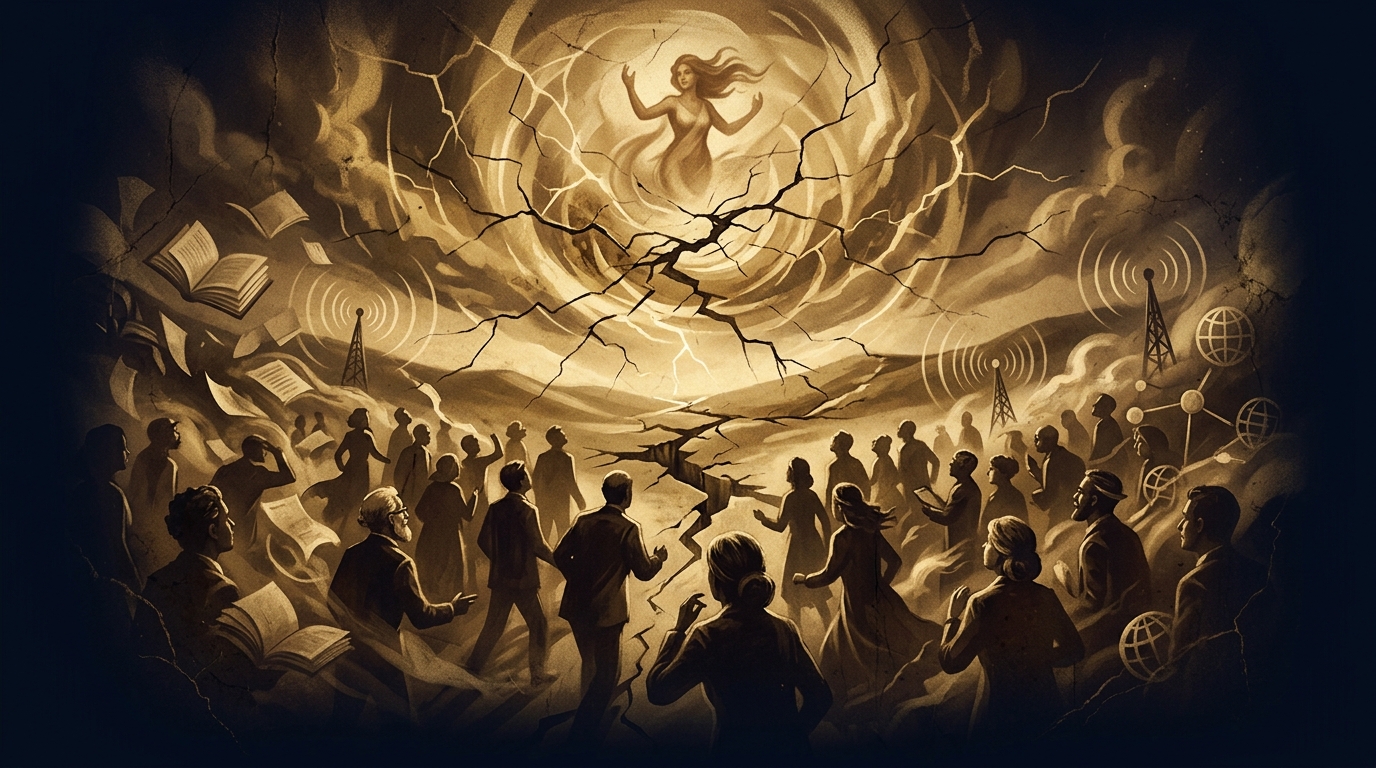
 Codex Illustration
Boobquake and Viral Skepticism
In April 2010, a tongue-in-cheek blog post by an American student scientist ignited a global internet phenomenon that briefly tested whether immodest dress causes earthquakes — exposing, in the process, how quickly satire, mass media, and popular skepticism can collide in the digital age.
Overview
On April 16, 2010, Hojatoleslam Kazem Sedighi, a senior Iranian cleric, made a claim during a Friday sermon that was reported widely in the international press: that women who dress immodestly cause earthquakes by spreading sin and leading young men astray, which in turn provokes divine punishment in the form of seismic events. The statement was not unusual in form — religious leaders across many traditions have historically linked natural disasters to moral behavior — but its entry into the 24-hour news cycle gave it extraordinary reach. Sedighi's remarks were translated, excerpted, and distributed by wire services within days, reaching audiences far beyond his original congregation.
The response that catalyzed the event now known as 'Boobquake' came from Jennifer McCreight, then a Purdue University student and blogger who wrote under the pen 'Blag Hag.' On April 19, 2010, she published a deliberately humorous post proposing that women worldwide dress provocatively on a single day — April 26 — to empirically test whether doing so would increase seismic activity. McCreight was explicit that the exercise was satirical and framed it in the language of popular scientific skepticism: if the cleric's claim were true, the experiment should produce measurable results. The post was not intended as a serious controlled study; McCreight herself acknowledged its obvious methodological limitations from the outset.
What no one anticipated was the velocity of the post's viral spread. Within 48 hours, Boobquake had accumulated tens of thousands of participants via Facebook, drawn international media coverage from outlets including BBC News, The Guardian, and CNN, and prompted responses from geologists, feminist scholars, and religious commentators alike. On the designated day, a magnitude 6.5 earthquake did occur near the Taiwan Strait — a coincidence that Internet commentators gleefully and ironically claimed as either confirmation or refutation of the hypothesis, depending on their preferred conclusion. Seismologists quickly noted that earthquakes of this magnitude occur dozens of times each year globally, rendering the single data point statistically meaningless.
Boobquake endures in the archive of internet culture as a case study in several intersecting phenomena: the mechanics of viral amplification; the role of humor in skeptical activism; the challenges of communicating scientific reasoning to mass audiences; and the tendency of both believers and skeptics to declare victory from identical ambiguous data. McCreight herself later reflected that the event's media framing frequently stripped away its satirical character, reducing a nuanced critique of unfalsifiable religious claims into a spectacle. Scholars of digital folklore and internet culture have since cited Boobquake as an early, unusually well-documented example of 'viral skepticism' — the deployment of popular internet culture as a vehicle for epistemological challenge.
Key Claims
Timeline
Evidence
Multiple Perspectives
Biblical Lens
Scripture Threads
Sources & Further Study
Questions to Explore
Go Deeper Path
Follow the Thread
Continue the Investigation
You’ve reached the Full Archive portion of this Case File.
Ask the Archivist
about this fileSign in to ask the Archivist
Create a free account to ask the Archivist 1 grounded question each day, cited straight from the CODEX case files.
Discussion
0Share findings, questions, and evidence with fellow Seekers. Be respectful and cite sources where you can.
No comments yet. Be the first to open this thread.