
 Codex Illustration
Cardiff Giant Hoax
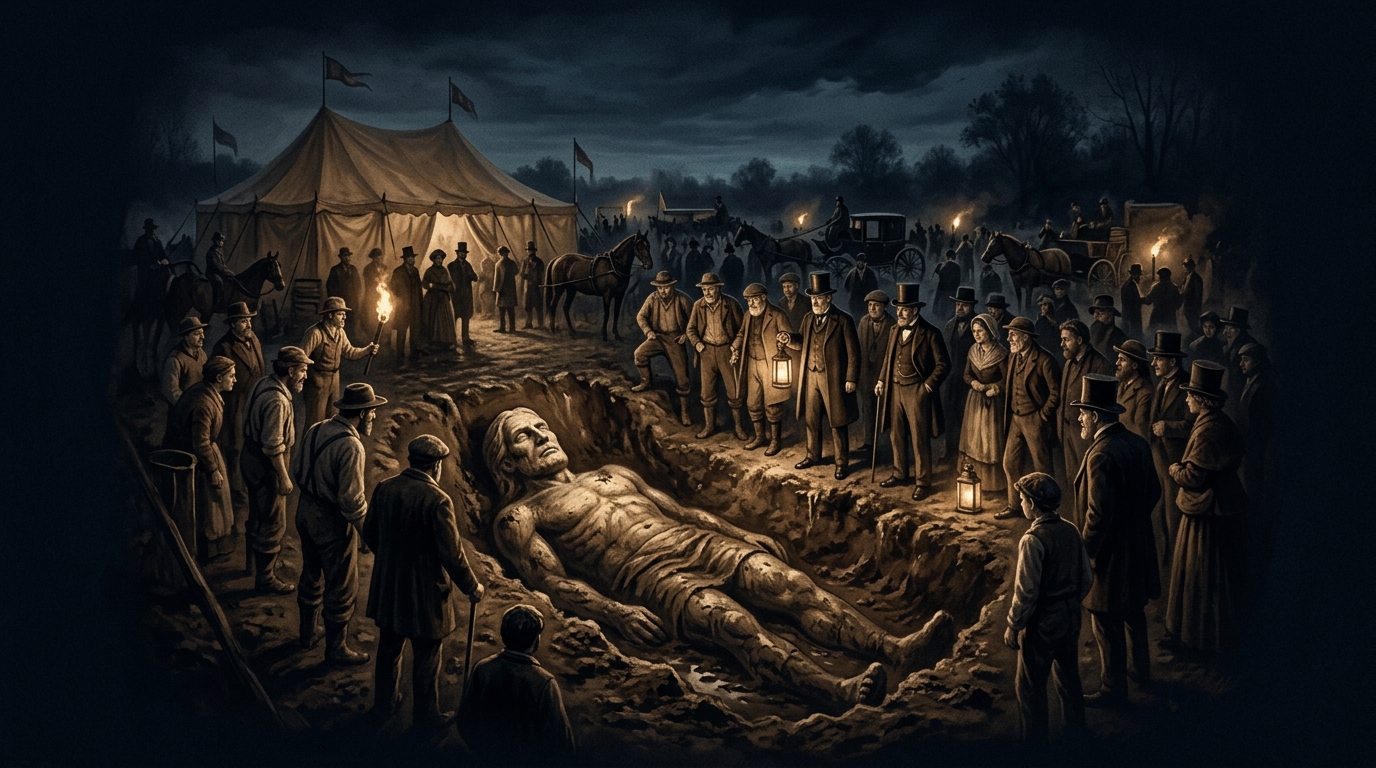
In 1869, a ten-foot carved gypsum figure was 'discovered' buried on a farm in Cardiff, New York — briefly convincing thousands that they were gazing upon a genuine petrified giant, and generating a carnival of credulity, commerce, and controversy that has never entirely faded.
Overview
In the autumn of 1869, workers digging a well on William Newell's farm near Cardiff, New York, struck something hard roughly three feet below the surface. What emerged was a colossal humanoid figure — ten feet four inches in length, carved from gypsum and stained to simulate ancient encrustation — that would become one of the most celebrated and thoroughly documented hoaxes in American history. Crowds paid fifty cents apiece to view the figure in Newell's tent, newspapers debated its authenticity with breathless urgency, and a syndicate of businessmen from Syracuse purchased a majority share for $30,000 within weeks of the discovery. The climate was perfectly prepared: post-Civil War America harbored a deep appetite for wonder, a lively popular theology shaped by the King James Bible's references to giants, and a nascent but credulous press corps with no reliable forensic methodology to consult.
The architect of the deception was George Hull, a cigar manufacturer from Binghamton, New York, and a self-described atheist who claimed the idea arose from an argument with a Methodist revivalist minister over the literal existence of giants as described in the Bible. Hull traveled to Fort Dodge, Iowa, in 1868, commissioned a five-ton block of gypite gypsum under the pretense of monument-making, and then transported it in secrecy to a Chicago stonecutting firm operated by Edward Burghardt. There, skilled carvers spent several weeks shaping the figure, after which Hull and collaborators aged the surface using acids, sand, and water, and created pore-like indentations with darning needles embedded in a board. The finished figure was shipped to Cardiff and buried on the Newell farm — Hull's cousin's property — where it lay for nearly a year before the staged excavation. The entire operation reportedly cost Hull approximately $2,600, a considerable sum that he recouped many times over.
The hoax unraveled with remarkable speed once serious investigators arrived. Othniel Charles Marsh, the Yale paleontologist who would later become one of the most famous fossil hunters of the Gilded Age, examined the figure in November 1869 and declared it a recent carved sculpture, noting the absence of any mineral infiltration one would expect in genuine fossilization and the clearly artificial tool marks. Andrew Dixon White, co-founder of Cornell University, was similarly dismissive. The New York State Museum's paleontologists concurred. Hull eventually confessed to the deception in 1870 after a competing carved copy — commissioned by P.T. Barnum after the syndicate refused to sell him the original — drew equal or greater crowds, prompting Hull to sue Barnum for fraud, a legal action that forced the original scheme into public record. Barnum, characteristically, continued displaying his acknowledged copy while the public continued to pay for the privilege of seeing it.
The Cardiff Giant endures as a case study far beyond mere trickery. Historians of American religion, science, and popular culture have returned to it repeatedly as a lens through which to examine the collision of biblical literalism, scientific credentialism, commercial spectacle, and democratic gullibility in the Gilded Age. The episode also illuminates how powerfully the idea of physical giants resonates in Western imagination: anchored in biblical passages, amplified by folklore, and periodically revived by modern internet claims that the Smithsonian Institution suppresses evidence of giant skeletons. The original Cardiff Giant is currently on display at The Farmers' Museum in Cooperstown, New York, where it rests as a documented artifact of American credulity and ingenuity in equal measure.
Key Claims
Timeline
Evidence
Multiple Perspectives
Biblical Lens
Scripture Threads
Sources & Further Study
Questions to Explore
Go Deeper Path
Follow the Thread
Continue the Investigation
You’ve reached the Full Archive portion of this Case File.
Ask the Archivist
about this fileSign in to ask the Archivist
Create a free account to ask the Archivist 1 grounded question each day, cited straight from the CODEX case files.
Discussion
0Share findings, questions, and evidence with fellow Seekers. Be respectful and cite sources where you can.
No comments yet. Be the first to open this thread.