
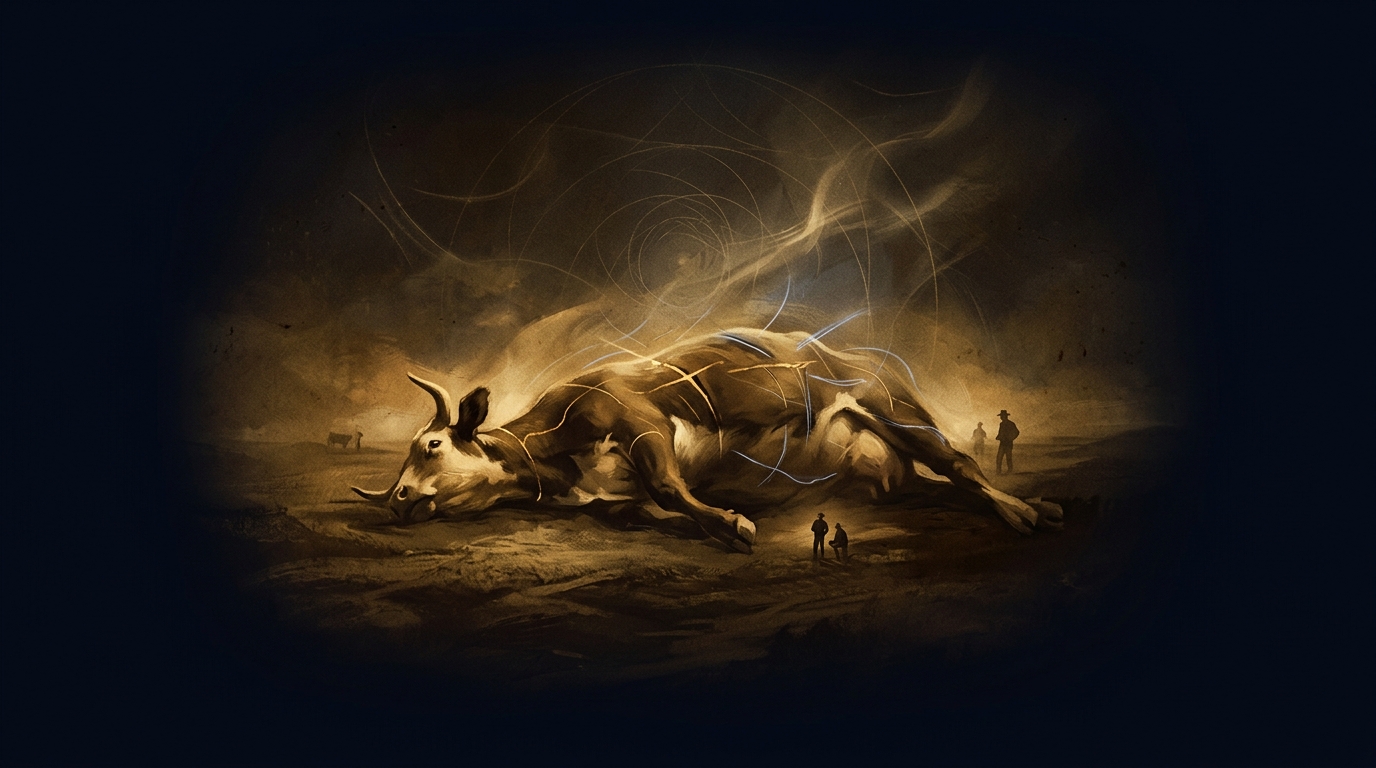
 Codex Illustration
Cattle Mutilations
Since at least the mid-1960s, ranchers across North America and beyond have discovered livestock — most famously cattle — dead with precise, bloodless wounds and missing organs in patterns that have defied easy explanation, generating one of the most persistent and genuinely documented mysteries at the intersection of veterinary science, government investigation, and paranormal culture.
Overview
The phenomenon now known as cattle mutilation entered public consciousness dramatically in September 1967 when a horse named Lady (sometimes called Snippy) was found dead near Alamosa, Colorado, with its flesh stripped from the skull and neck in a manner that struck its owner and local press as disturbingly precise. Though individual cases of unexplained livestock deaths had been noted in rural America for years, Lady's death catalyzed widespread media attention and established the interpretive vocabulary — surgical incisions, missing organs (particularly eyes, tongues, genitals, and rectums), apparent absence of blood, and no visible predator tracks — that would define thousands of subsequent reports. By the 1970s, cattlemen from Nebraska to New Mexico were filing police reports describing strikingly similar scenes, and the cases accumulated enough consistency to draw the attention of federal authorities.
In 1979, the FBI officially entered the investigation at the request of Senator Harrison Schmitt of New Mexico, commissioning former Bernalillo County District Attorney Kenneth Rommel to conduct a systematic inquiry. The resulting 1980 Rommel Report — formally titled 'Operation Animal Mutilation' — ran to nearly 300 pages and concluded, after examining 25 cases in depth, that the overwhelming majority of reported mutilations were the work of natural predators and scavengers operating on carcasses in the early stages of decomposition. Rommel argued that soft tissue (eyes, lips, tongues, genitalia, rectal tissue) is precisely the tissue that decomposition and small scavengers such as blowflies, coyotes, ravens, and vultures consume first, producing smooth, seemingly incised edges. The report also observed that ranchers, distressed and primed by media coverage, were interpreting ordinary deaths through an extraordinary framework. The Rommel Report remains the single most substantive government investigation of the phenomenon and is the baseline of the skeptical scientific consensus.
Yet the phenomenon has not been fully contained by the Rommel Report's conclusions. A minority of cases — documented in the files of local sheriffs, state police, and investigators such as Linda Moulton Howe — include details that have strained purely mundane explanations: apparent surgical precision attributed by some veterinary observers to cutting instruments rather than gnawing, the reported absence of blood both on and around the carcasses in cases where decomposition alone would not account for it, and — most provocatively — the recurrent appearance of unidentified aircraft (often described as silent, black helicopters) in the vicinity of affected ranches around the time of deaths. These 'black helicopter' reports, documented across multiple states in the 1970s and documented separately in military and law enforcement files, introduced a distinct layer of possible government or covert-program involvement that investigators like Howe pursued seriously. Whether these aircraft were connected to the animal deaths, monitoring them, or represented entirely unrelated activity remains unresolved.
The cultural and interpretive weight placed on cattle mutilations has proven as remarkable as the physical evidence. The phenomenon has been variously attributed to extraterrestrial biological sampling, secret government bioweapons monitoring programs (testing for radiation fallout or prion disease in the food chain), satanic cult activity, and exotic predators. Each interpretation reflects anxieties of its era: Cold War fear of covert government programs, the rise of UFO culture following Roswell, and rural America's sense of vulnerability to forces beyond its understanding or control. Investigators of genuine scholarly seriousness — Howe's 1989 book 'An Alien Harvest' represents the most thorough pro-anomaly investigation — have preserved detailed case files, photographs, and witness testimony that resist complete dismissal. What remains documented is that something has killed livestock under circumstances sufficiently unusual to generate decades of official and unofficial inquiry; what killed them, and why, is a question the evidence as a whole does not yet resolve.
Key Claims
Timeline
Evidence
Multiple Perspectives
Biblical Lens
Scripture Threads
Sources & Further Study
Questions to Explore
Go Deeper Path
Follow the Thread
Continue the Investigation
You’ve reached the Full Archive portion of this Case File.
Ask the Archivist
about this fileSign in to ask the Archivist
Create a free account to ask the Archivist 1 grounded question each day, cited straight from the CODEX case files.
Discussion
0Share findings, questions, and evidence with fellow Seekers. Be respectful and cite sources where you can.
No comments yet. Be the first to open this thread.