
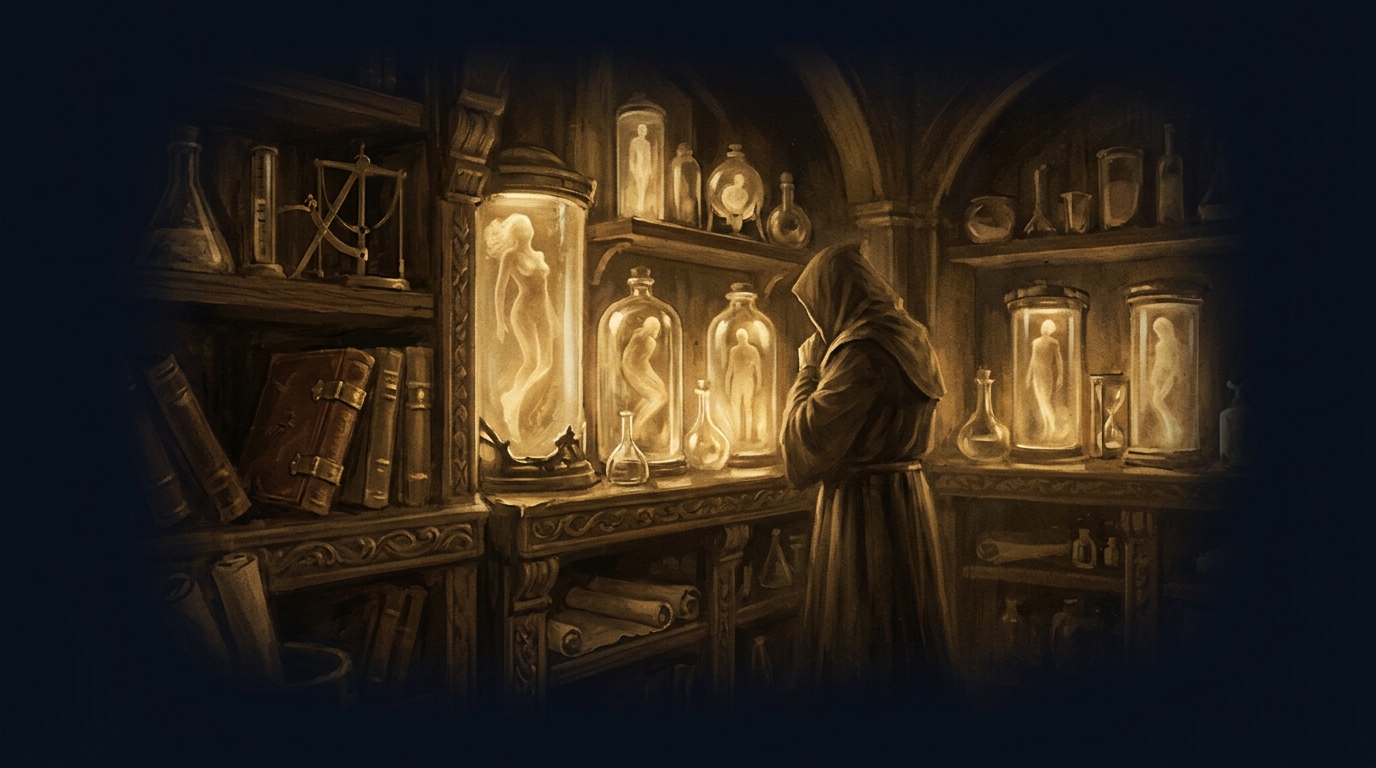
 Codex Illustration
Celebrity Clone Theories
A recurring strand of internet folklore holds that certain famous individuals — pop stars, politicians, actors — have been secretly replaced by clones, body doubles, or synthetic humanoids; though entirely unsupported by scientific or documentary evidence, the phenomenon reveals something genuinely interesting about pattern-seeking cognition, media anxiety, and modern fears surrounding identity and authenticity.
Overview
Celebrity clone theories occupy a peculiar stratum of contemporary folklore: too recent to acquire the patina of mythology, too persistent to dismiss as mere noise. The central narrative is deceptively simple — a beloved or powerful public figure dies, deteriorates, or is somehow 'gotten to,' and an identical replacement is installed in their place. Variants range from the relatively modest claim that a specific celebrity uses a trained body double for certain appearances, to the maximalist position that an elite cabal maintains a warehouse of synthetic humanoids, grown to order and deployed whenever inconvenient truths demand a living proxy. The targets of these theories have included pop musicians such as Beyoncé, Paul McCartney (the older 'Paul is Dead' legend being the most famous antecedent), and Avril Lavigne, as well as politicians, tech billionaires, and members of royal families. In nearly every case, the proposed 'evidence' consists of photographs analyzed for facial asymmetries, alleged inconsistencies in behavior or vocal timbre, and patterns discerned from interviews — all of which are then stitched together through conspiratorial reasoning rather than controlled investigation.
The genealogy of this genre is longer than its internet incarnation suggests. The 'Paul is Dead' rumor — the claim that Beatles member Paul McCartney died in a 1966 automobile accident and was replaced by a look-alike named 'William Campbell' — circulated in earnest from 1969 onward, disseminated through radio call-ins and fan publications before the internet existed. The 'Avril is Dead / Melissa Vandella' variant emerged in the mid-2000s, initially on Brazilian fan forums, and was subsequently laundered through English-language social media as though it were investigative journalism. These stories share a recognizable deep structure: the 'true' individual was too pure, too talented, or too dangerous to the powerful, and so was eliminated and replaced. The replacement is never quite right — subtle tells betray the imposture to the sufficiently alert observer. This narrative arc maps almost precisely onto classical folklore motifs of the changeling, the doppelgänger, and the fetch: supernatural substitutes that wear a human's face while hollowing out what made them real.
From a cognitive and social-psychological standpoint, the persistence of clone theories can be accounted for without recourse to any actual conspiracy. Human beings are exquisitely sensitive to facial recognition and subtle behavioral cues — so sensitive, in fact, that we routinely generate false positives. Psychologists studying 'agency detection' (associated with work by scholars such as Jesse Bering and Pascal Boyer) note that the mind is tuned to find intentional agents behind ambiguous events: it is evolutionarily cheaper to mistake a shadow for a predator than to mistake a predator for a shadow. When this tendency is applied to high-resolution photographs of a celebrity taken years apart, under different lighting conditions, with different stylists, after aging or cosmetic procedures, perceived discrepancies are inevitable. The conspiratorial framework then provides a satisfying explanatory schema: the discrepancies are not noise, they are signal. Additionally, scholars of media and celebrity culture — including P. David Marshall, whose work on celebrity and power is widely cited in media studies — have noted that the parasocial intimacy audiences feel toward celebrities generates a proprietary anxiety; the sense that something 'essential' has been lost when a star changes, reinvents, or simply ages is a real emotional experience that clone narratives literalize and externalize.
The scientific dimension of clone theories deserves direct assessment. Human reproductive cloning — producing a genetically identical individual from a single donor's DNA — remains, as of the mid-2020s, a capability demonstrated only speculatively or in limited forms with non-human mammals (Dolly the sheep, cloned in 1996 by Ian Wilmut and colleagues at the Roslin Institute, remains the most celebrated case). Growing a clone to adulthood, training it to replicate a specific individual's voice, mannerisms, and memories, and deploying it in the full glare of the modern media environment within a plausible timeline is not merely technologically impossible at present — it would require capabilities so far beyond known science as to constitute a category error. The more modest 'body double' variant is, by contrast, historically documented: both Adolf Hitler and Saddam Hussein are credibly believed to have employed lookalike decoys for security purposes, a practice with precedent in ancient and medieval courts. This documented use of doubles — mundane and security-motivated — is typically the factual kernel around which much larger, unfalsifiable elaborations accrete in internet folklore.
Key Claims
Timeline
Evidence
Multiple Perspectives
Biblical Lens
Scripture Threads
Sources & Further Study
Questions to Explore
Go Deeper Path
Follow the Thread
Continue the Investigation
You’ve reached the Full Archive portion of this Case File.
Ask the Archivist
about this fileSign in to ask the Archivist
Create a free account to ask the Archivist 1 grounded question each day, cited straight from the CODEX case files.
Discussion
0Share findings, questions, and evidence with fellow Seekers. Be respectful and cite sources where you can.
No comments yet. Be the first to open this thread.