
 Codex Illustration
CERN and the Large Hadron Collider
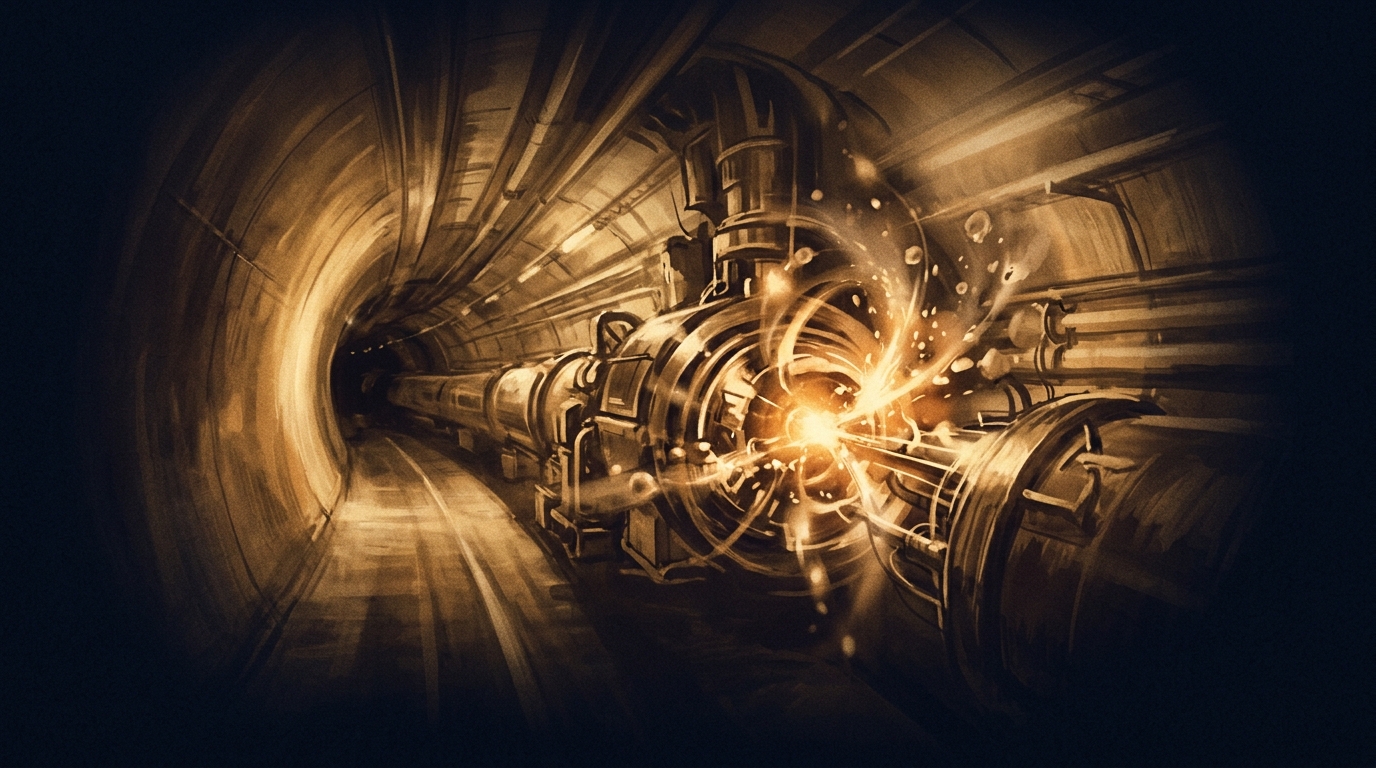
Buried beneath the Franco-Swiss border, the Large Hadron Collider is humanity's most powerful machine — a 27-kilometer ring where protons collide at near-light speed in pursuit of the universe's deepest secrets. Its ambitions, its symbolism, and its probing of the fabric of reality have made it both a triumph of scientific collaboration and a lightning rod for theological and conspiratorial speculation.
Overview
The European Organization for Nuclear Research, known by its French acronym CERN, was founded in 1954 as a postwar collaborative effort to rebuild European science and provide peaceful applications for atomic research. Its headquarters sit astride the French-Swiss border near Geneva, Switzerland. Over seven decades, CERN has grown into the world's largest particle physics laboratory, home to thousands of scientists from over one hundred nations. Its crown achievement, the Large Hadron Collider (LHC), was inaugurated in 2008 after more than a decade of construction and an investment exceeding six billion euros. The LHC accelerates protons and heavy ions to approximately 99.9999991% of the speed of light within a circular tunnel 27 kilometers in circumference, buried roughly 100 meters underground. When beams collide inside four major detectors — ATLAS, CMS, ALICE, and LHCb — the resulting debris is analyzed for signatures of particles and forces that governed the early universe.
The scientific achievements of CERN are substantial and well-documented. The laboratory's earlier work confirmed the existence of the W and Z bosons in the 1980s, validating key predictions of the Standard Model of particle physics. The LHC's most celebrated discovery came on July 4, 2012, when the ATLAS and CMS experiments jointly announced the detection of a particle consistent with the long-theorized Higgs boson, sometimes called the 'God particle' — a label physicists generally find misleading, borrowed from Leon Lederman's 1993 popular science book. The Higgs field is understood to be the mechanism by which fundamental particles acquire mass. The discovery earned physicists Peter Higgs and François Englert the 2013 Nobel Prize in Physics. Ongoing LHC runs continue to probe questions about dark matter, antimatter asymmetry, and whether physics beyond the Standard Model exists at higher energies.
Beyond its scientific mandate, CERN has become a focal point for philosophical, theological, and conspiratorial reflection. The laboratory's campus famously hosts a bronze statue of the Hindu deity Shiva Nataraja — the Lord of the Dance — a gift from the Indian government in 2004. The statue was installed to honor the metaphorical parallel between Shiva's cosmic dance of creation and destruction and the high-energy collisions studied at CERN. Physicist Fritjof Capra, in his 1975 book 'The Tao of Physics,' had earlier drawn connections between quantum physics and Eastern cosmological imagery. This symbolic presence, combined with CERN's role in what some call 'probing the void,' has inspired a range of theological interpretations and popular anxieties about scientists 'playing God' or tampering with forces beyond human comprehension.
Internet culture and certain religious communities have layered additional narratives onto CERN, including claims that the LHC is designed to open dimensional portals, summon dark entities, or destabilize reality itself. These claims are not supported by scientific evidence and reflect a conflation of speculative metaphysics with experimental particle physics. Nonetheless, they raise genuine philosophical questions worth examining: What are the ethical limits of scientific inquiry? Does the materialist framework underlying particle physics conflict with theistic cosmologies? And does the sheer scale of humanity's attempt to deconstruct the building blocks of existence carry spiritual significance, whatever one's worldview? These are questions CODEX treats with the seriousness they deserve, clearly distinguished from the documented science.
Timeline
Evidence
Multiple Perspectives
Biblical Lens
Scripture Threads
Sources & Further Study
Questions to Explore
Follow the Thread
Continue the Investigation
You’ve reached the Full Archive portion of this Case File.
Ask the Archivist
about this fileSign in to ask the Archivist
Create a free account to ask the Archivist 1 grounded question each day, cited straight from the CODEX case files.
Discussion
0Share findings, questions, and evidence with fellow Seekers. Be respectful and cite sources where you can.
No comments yet. Be the first to open this thread.