
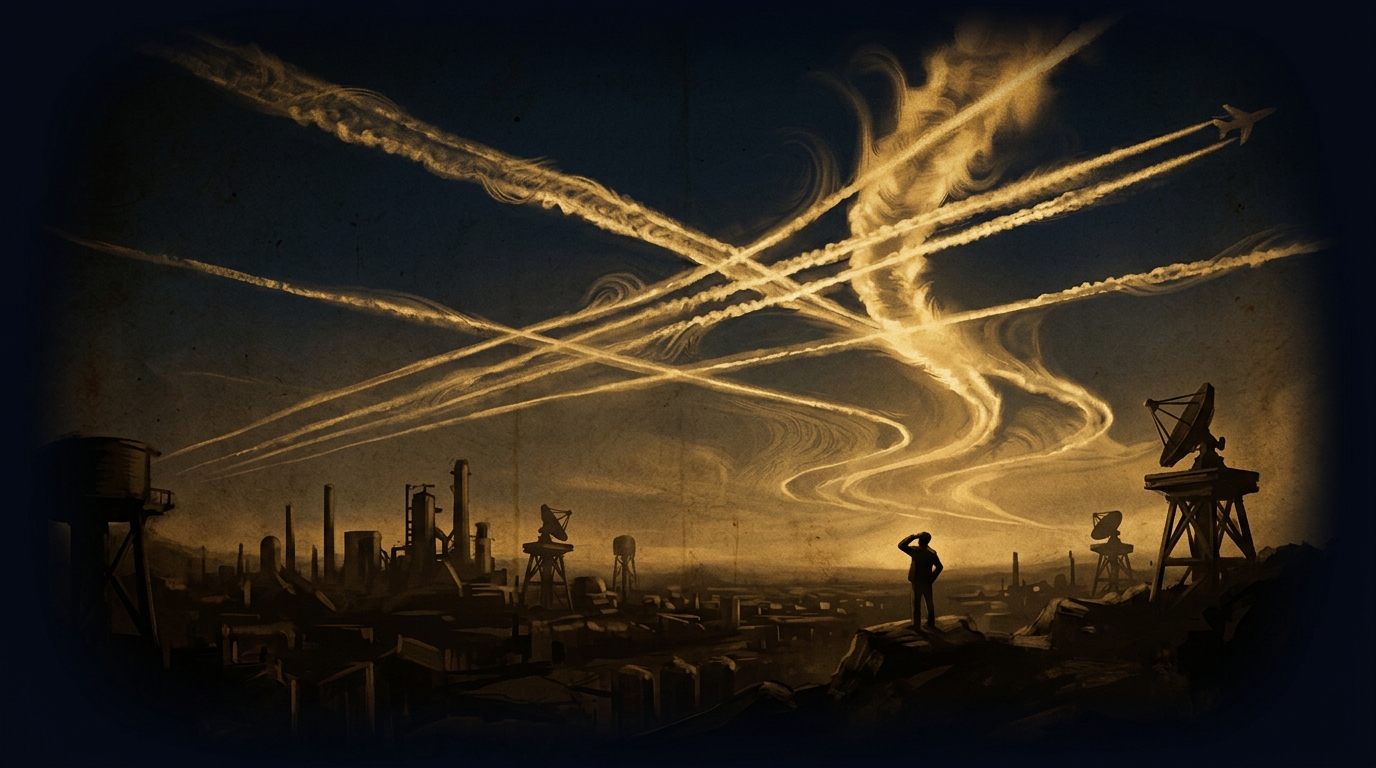
 Codex Illustration
Chemtrails
Since the late 1990s, a persistent popular theory has held that the white trails left by high-altitude aircraft are not ordinary ice-crystal condensation trails but covert chemical or biological agents deliberately dispersed over civilian populations — a claim that atmospheric science firmly rejects, even as legitimate geoengineering research and a documented history of secret government aerosol experiments continue to lend the theory a measure of emotional plausibility.
Overview
On any clear day, white streaks draw slow arcs across the sky behind commercial and military aircraft. To atmospheric scientists, these are contrails — condensation trails formed when hot, humid engine exhaust meets the cold, low-pressure air of the upper troposphere, producing ice crystals that behave, in all measurable respects, as artificially seeded cirrus clouds. Their persistence, spreading, and coverage are well-understood functions of ambient humidity, temperature, and wind shear. Yet beginning roughly in the late 1990s, a counter-narrative emerged and spread rapidly through early internet communities and shortwave radio culture: that some or all of these trails are something else entirely — chemical or biological agents deliberately aerosolized by government or corporate actors for purposes ranging from population control and immunosuppression to weather weaponization and even mass neurological manipulation. Proponents coined the portmanteau 'chemtrails' to distinguish what they perceived as anomalously persistent or grid-patterned trails from ordinary contrails. The belief remains widespread: a 2011 survey cited by researchers found that a significant minority of Americans gave credence to some version of the claim.
The scientific consensus is unambiguous. A 2016 study published in Environmental Research Letters, led by atmospheric scientist Ken Caldeira of the Carnegie Institution for Science, surveyed 77 atmospheric scientists and contrail experts: 77 of them — 98.7 percent — concluded that the evidence cited by chemtrail proponents was consistent with known contrail physics, and found no credible evidence of a secret large-scale atmospheric spraying program. Independent air and soil sampling conducted by believers has consistently failed to reveal chemical signatures inconsistent with normal aviation exhaust, industrial fallout, or background mineral dust. The persistence of trails on certain days versus their rapid dissipation on others — a key piece of evidence for believers — is entirely explained by relative humidity at altitude: in supersaturated air, ice crystals linger and spread; in drier air, they sublimate within seconds.
What makes the chemtrail narrative genuinely difficult to dismiss without honest engagement is that it does not emerge in a factual vacuum. The history of covert government aerosol testing on civilian populations is real, documented, and disturbing. Operation Sea-Spray (San Francisco, 1950) involved the U.S. Navy spraying Serratia marcescens bacteria over the city to simulate a biological attack — an experiment linked by some historians to subsequent pneumonia deaths, though causation remains debated. The Edgewood Arsenal human experiments subjected thousands of U.S. military personnel to chemical and biological agents without fully informed consent. Project MKUltra demonstrated that institutional willingness to secretly experiment on populations without their knowledge was not a paranoid fantasy but a documented reality. These precedents, combined with visible sky changes, institutional distrust, and the genuine (if openly discussed) scientific debate over proposed stratospheric aerosol injection as a climate intervention, provide the psychological and historical scaffolding on which the chemtrail theory rests.
It is critical, however, to separate the chemtrail conspiracy theory from the legitimate scientific conversation about geoengineering. Stratospheric aerosol injection — the deliberate introduction of reflective particles such as sulfur dioxide into the stratosphere to reduce solar radiation — is a real, openly debated, and not-yet-deployed proposal studied by researchers at Harvard, Oxford, and other institutions. The Stratospheric Controlled Perturbation Experiment (SCoPEx) and similar initiatives are conducted transparently, with published papers, ethical reviews, and public debate. They represent humanity's tentative, anxious encounter with planetary-scale intervention — a genuinely consequential frontier — but they are emphatically not secret programs, and they are not the same as the chemtrail hypothesis. The conflation of these two things — covert poisoning and open geoengineering research — is itself a significant feature of the conspiracy ecosystem, one that has complicated public understanding of legitimate atmospheric science.
Key Claims
Timeline
Evidence
Multiple Perspectives
Biblical Lens
Scripture Threads
Sources & Further Study
Questions to Explore
Go Deeper Path
Follow the Thread
Continue the Investigation
You’ve reached the Full Archive portion of this Case File.
Ask the Archivist
about this fileSign in to ask the Archivist
Create a free account to ask the Archivist 1 grounded question each day, cited straight from the CODEX case files.
Discussion
0Share findings, questions, and evidence with fellow Seekers. Be respectful and cite sources where you can.
No comments yet. Be the first to open this thread.