
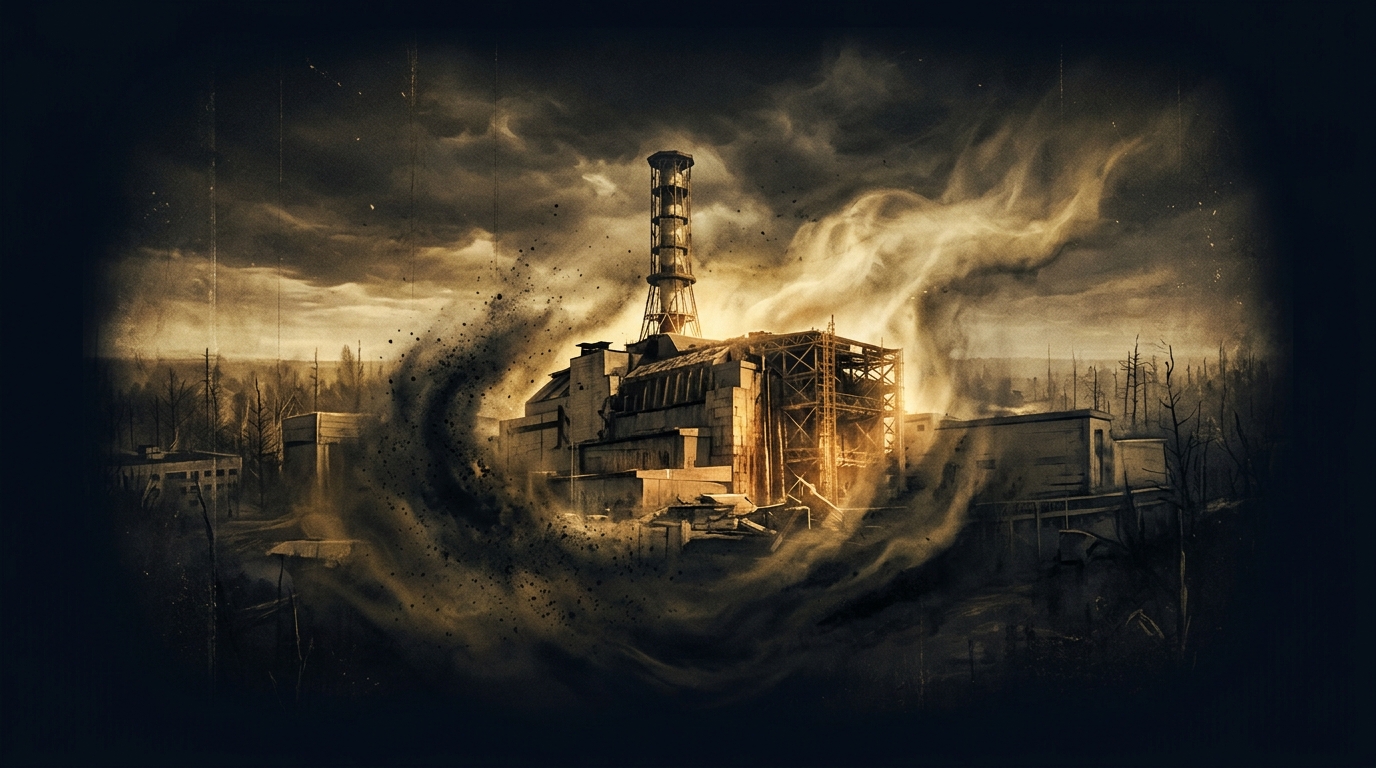
 Codex Illustration
Chernobyl
On April 26, 1986, Reactor No. 4 at the Chernobyl Nuclear Power Plant near Pripyat, Soviet Ukraine, suffered a catastrophic explosion during a botched safety test — releasing a radioactive cloud across Europe and triggering one of the most consequential cover-ups in modern history. The disaster became a mirror held up to the Soviet system itself: its costs measured not only in rads and cancers but in decades of official silence, disputed science, and the slow collapse of an empire that could not acknowledge what it had done.
Overview
In the pre-dawn hours of April 26, 1986, engineers at the Vladimir Ilyich Lenin Nuclear Power Station ran a flawed low-power safety test on Reactor No. 4. The test, already delayed by a shift in grid demand, was conducted under conditions that violated established protocol and required operators to disable several safety systems. At 1:23 a.m. local time, a runaway power surge combined with the reactor's known design flaw — the positive void coefficient of the RBMK-1000, which causes reactivity to increase as coolant water turns to steam — produced a steam explosion followed moments later by what investigators believe was a prompt criticality excursion. The reactor's graphite moderator ignited. The resulting open-air graphite fire burned for ten days, releasing an estimated 400 times the radioactivity of the Hiroshima bomb across large portions of Europe. These are documented facts, supported by Soviet state records, IAEA investigations, and the testimony of hundreds of surviving engineers, firefighters, and plant workers.
The Soviet government's initial response was a case study in institutional concealment. Pripyat's 49,000 residents were not evacuated until thirty-six hours after the explosion, and only after radiation levels at the Swedish Forsmark Nuclear Power Plant — nearly 1,100 kilometers away — triggered international alarm on April 28, forcing Moscow's hand. Officials initially reported two deaths; the full mobilization of some 600,000 so-called 'liquidators' — soldiers, miners, and civilian workers tasked with containment, decontamination, and the construction of the concrete sarcophagus — was presented to the Soviet public as a controlled, heroic response rather than a desperate improvisation. The 31 deaths directly and acutely attributed to the disaster in the official Soviet and early international record represented only acute radiation syndrome fatalities and trauma deaths among first responders. This figure has never been seriously contested as a floor, but it has always been understood — including by Soviet officials — to be incomplete.
The long-running scientific dispute over the ultimate death toll is perhaps the disaster's most consequential unresolved question, and it is important to distinguish the different categories of claim. The 2005 Chernobyl Forum report — a joint study by the IAEA, WHO, UNDP, and seven other UN agencies — estimated that perhaps 4,000 additional deaths from radiation-induced cancer might eventually be attributable to the disaster among the most heavily exposed populations. A 2006 TORCH report commissioned by the European Greens, authored by independent scientists Ian Fairlie and David Summerville, argued for a figure closer to 30,000 to 60,000 additional cancer deaths across Europe. The activist organization Greenpeace and some Eastern European public health researchers have cited figures in the hundreds of thousands, drawing on broader all-cause mortality data from the affected regions. These divergences reflect genuine methodological disputes — over radiation dose reconstruction, baseline cancer rates, the linear no-threshold model of radiation risk, and the difficulty of separating Chernobyl's effects from post-Soviet economic collapse and lifestyle changes. None of the higher estimates has achieved mainstream scientific consensus, but neither has the lower range been adopted without criticism.
Beyond the epidemiological debates, the disaster left an indelible mark on the political landscape of the twentieth century. Mikhail Gorbachev later wrote that Chernobyl was 'perhaps the real cause of the collapse of the Soviet Union,' stripping the system of its capacity to maintain the fiction of socialist competence. The 2,600-square-kilometer Exclusion Zone around the plant has become one of the world's most paradoxical spaces: an involuntary nature reserve where wildlife flourishes in the absence of human activity, yet where radiation-contaminated soil, groundwater, and forest litter continue to pose documented long-term hazards. The 2019 HBO television series brought renewed international attention to the disaster, sparking fresh debate over the balance between dramatic fidelity and historical accuracy — a reminder that the line between documented catastrophe and cultural mythology is rarely as clean as either side prefers.
Key Claims
Timeline
Evidence
Multiple Perspectives
Biblical Lens
Scripture Threads
Sources & Further Study
Questions to Explore
Go Deeper Path
Follow the Thread
Continue the Investigation
You’ve reached the Full Archive portion of this Case File.
Ask the Archivist
about this fileSign in to ask the Archivist
Create a free account to ask the Archivist 1 grounded question each day, cited straight from the CODEX case files.
Discussion
0Share findings, questions, and evidence with fellow Seekers. Be respectful and cite sources where you can.
No comments yet. Be the first to open this thread.