
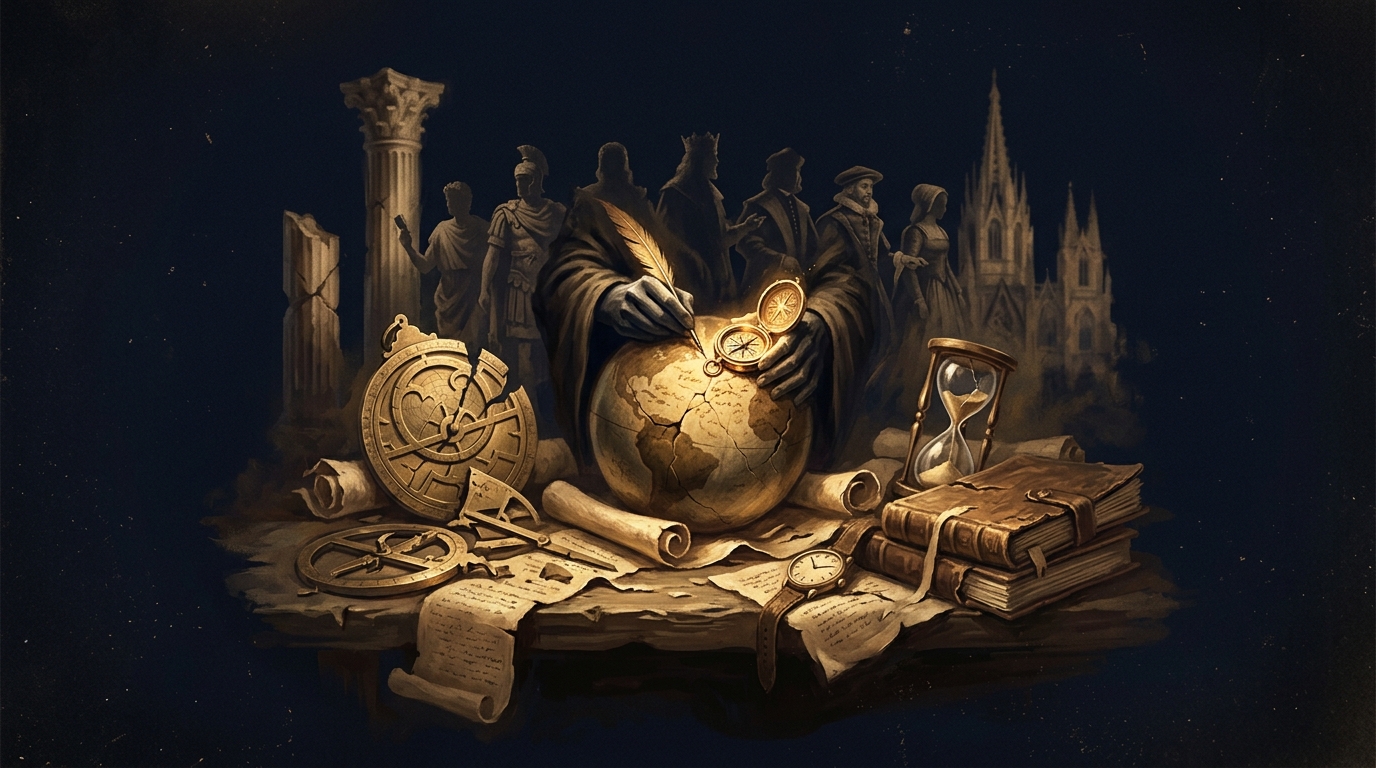
 Codex Illustration
Chronology Conspiracy Theories
A cluster of heterodox claims — most prominently Anatoly Fomenko's 'New Chronology' and Heribert Illig's 'Phantom Time Hypothesis' — assert that the conventional timeline of human history has been systematically falsified, abbreviated, or invented, placing entire centuries and civilizations in the wrong order or erasing them altogether. These theories attract passionate followings while being rejected by the overwhelming consensus of historians, archaeologists, astronomers, and dendrochronologists.
Overview
At the outer edge of historical revisionism stands a family of claims united by a single audacious premise: that the chronological scaffolding on which all of recorded history rests has been fundamentally miscounted, forged, or deliberately obscured. The most elaborately developed of these is the New Chronology of Russian mathematician Anatoly T. Fomenko, who, beginning in the 1970s and publishing prolifically through the 1990s and 2000s, argued that conventional ancient and medieval history is largely a phantom — a tapestry of duplicated, displaced, and invented events that were systematically projected backward in time by medieval and early-modern chroniclers, scholars, and ecclesiastical authorities. In Fomenko's reconstruction, figures as foundational as ancient Rome, classical Greece, and Old Kingdom Egypt are either late medieval creations or misidentified copies of later dynasties, and the 'real' history of humanity compresses dramatically, beginning no earlier than roughly the ninth or tenth century AD. The German publicist Heribert Illig proposed a narrower but similarly provocative thesis in 1991: that the years AD 614 through 911 — roughly three centuries — never occurred, having been fabricated by the Holy Roman Emperor Otto III, Pope Sylvester II, and the Byzantine Emperor Constantine VII in a joint conspiracy to place Otto's reign at the symbolic millennial year 1000. Both hypotheses belong to a broader genre of alternative chronology that includes, at varying degrees of seriousness, claims about the misidentification of Egyptian dynasties, disputes over the reliability of radiocarbon dating, and popular reinterpretations of astronomical records.
The intellectual ancestry of such revisionism is older than Fomenko or Illig. The seventeenth-century Jesuit scholar Jean Hardouin controversially argued that most classical Latin literature was a medieval forgery. In the late nineteenth and early twentieth centuries, Immanuel Velikovsky proposed catastrophist revisions to Egyptian and Near Eastern chronology in works such as 'Ages in Chaos' (1952), arguing that accepted Egyptian dates were misaligned with Biblical and Mycenaean timelines by several centuries. While Velikovsky's catastrophism attracted serious early attention and sparked genuine scholarly debate, his chronological reconstructions have not been adopted by mainstream Egyptology or ancient Near Eastern studies. More recently, popular writers such as Graham Hancock have argued for a vastly older human civilization, effectively pushing chronology in the opposite direction — deep into a prehistoric past obscured by catastrophe. What unites these otherwise disparate projects is their shared conviction that official or academic history is either institutionally blind or actively suppressing a corrected timeline.
The evidentiary case against alternative chronology theories is, by the standards of historical and natural science, unusually robust. Dendrochronology — the study of tree-ring sequences — provides an independent, year-by-year calendar extending back more than ten thousand years through continuous sequences from European oaks and American bristlecone pines, entirely corroborating conventional Bronze Age, Iron Age, and medieval dates. Ice core records from Greenland and Antarctica preserve annual layers and identifiable volcanic events (such as the Minoan eruption of Thera, circa 1600 BC) that cross-check independently. Radiometric dating, including calibrated radiocarbon methods, has been verified against these dendrochronological sequences with high precision. Astronomical records — eclipse tables, planetary observations, and cometary sightings preserved in Babylonian cuneiform, Chinese dynastic archives, and Ptolemy's 'Almagest' — have been independently computed backward and forward by modern celestial mechanics, yielding dates that align with conventional chronology and decisively refute Fomenko's compression thesis. The Arab world continued to produce datable astronomical, literary, and commercial records during Illig's proposed 'phantom' centuries, and Byzantine archives show unbroken continuity. No mainstream historian, archaeologist, astronomer, or dendrochronologist has endorsed either the New Chronology or the Phantom Time Hypothesis as a credible revision of the historical record.
Nevertheless, the persistence and emotional force of chronology conspiracy theories repays careful analysis. They speak to a genuine human anxiety about institutional authority over the past — about who controls the narrative of history and whether that control has ever been exercised corruptly. They exploit real methodological tensions: radiocarbon dates do carry error margins; ancient scribes did make mistakes; manuscript traditions were sometimes manipulated; and there are genuine, unresolved debates within academic chronology (such as the 'low', 'middle', and 'high' chronologies for the Egyptian New Kingdom) that legitimate scholars continue to contest. The conspiracy framing, however, vastly overreaches what these genuine uncertainties support. The convergence of entirely independent dating systems — astronomical, botanical, geological, chemical, and documentary — across dozens of cultures and languages makes any comprehensive falsification of the historical timeline not merely improbable but logistically inconceivable. That such theories continue to circulate, nonetheless, is itself a datum worth examining: they reveal something about the sociology of distrust, the appeal of hidden-knowledge narratives, and the difficulty of communicating scientific consensus across popular culture.
Key Claims
Timeline
Evidence
Multiple Perspectives
Biblical Lens
Scripture Threads
Sources & Further Study
Questions to Explore
Go Deeper Path
Follow the Thread
Continue the Investigation
You’ve reached the Full Archive portion of this Case File.
Ask the Archivist
about this fileSign in to ask the Archivist
Create a free account to ask the Archivist 1 grounded question each day, cited straight from the CODEX case files.
Discussion
0Share findings, questions, and evidence with fellow Seekers. Be respectful and cite sources where you can.
No comments yet. Be the first to open this thread.