
 Codex Illustration
Chronovisor Legends
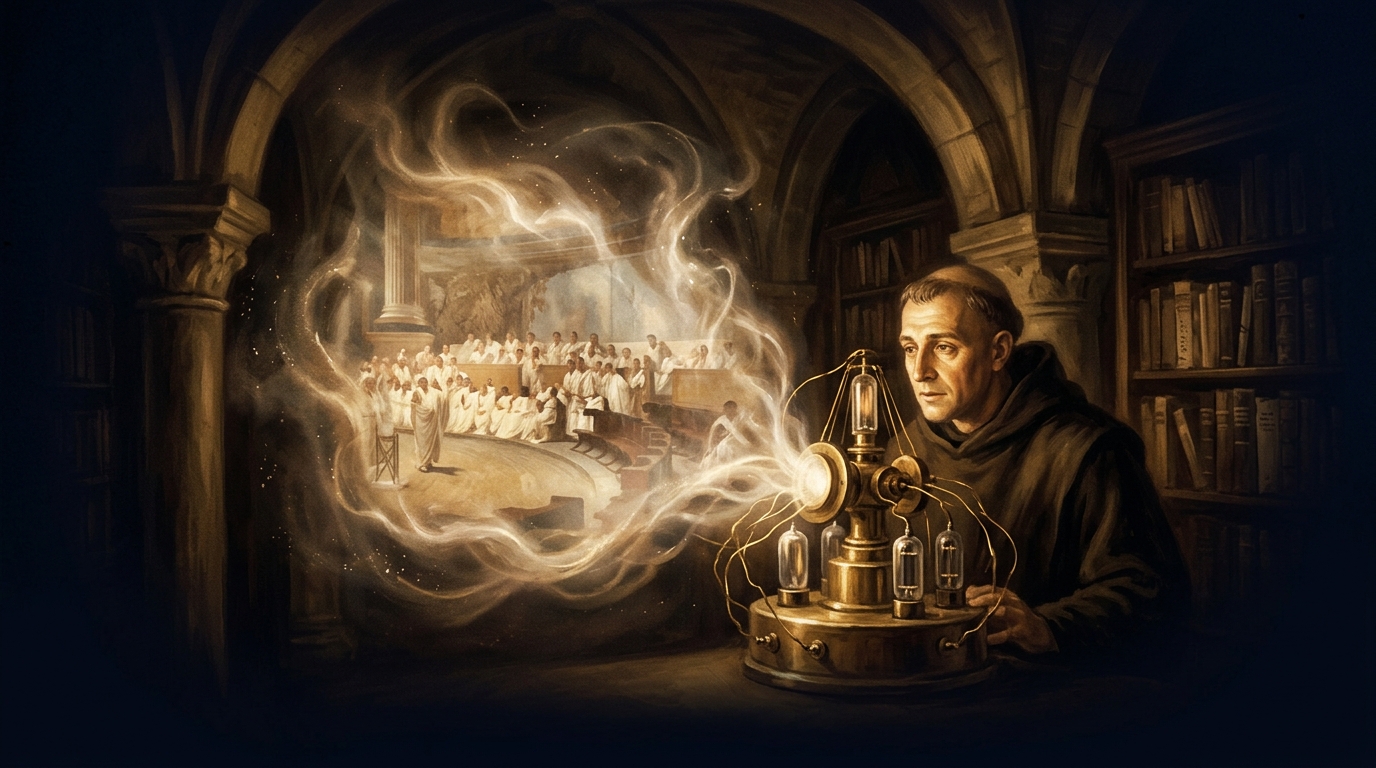
In the mid-twentieth century, a Benedictine monk named Father Pellegrino Ernetti claimed to have participated in the construction of a device capable of viewing scenes from the past — a machine allegedly suppressed by the Vatican and since dismissed by scholars as a pious fabrication, yet one whose legend has proven remarkably durable.
Overview
The chronovisor legend traces its public origin to a 1972 article in the Italian weekly magazine *Domenica del Corriere*, in which journalist Francois Brune reported the claims of Father Pellegrino Ernetti (1925–1994), a Benedictine priest, exorcist, and musicologist at the Monastery of San Giorgio Maggiore in Venice. Ernetti asserted that he had collaborated with a team of scientists — including, he later suggested, figures as celebrated as Enrico Fermi and Wernher von Braun — to construct a device capable of detecting and rendering visible the residual electromagnetic traces left by past events. The theoretical premise, never formalized in any peer-reviewed or verifiable form, was that sound and light waves persist in the universe in some decaying but recoverable form, and that the chronovisor could tune into and reconstruct them. Ernetti claimed the device had allowed him to witness, among other things, a performance of the lost tragedy *Thyestes* by the Roman playwright Quintus Ennius, the crucifixion of Jesus Christ, and the final hours of Mussolini. He reportedly produced a photograph allegedly depicting the face of Christ at the moment of death on the cross.
The claims attracted immediate scrutiny. The photograph of Christ was quickly identified by researchers — most damagingly by art historians — as bearing an unmistakable resemblance to a wooden crucifix carved by the sculptor Lorenzo Ferri and commercially distributed as devotional art. The transcription Ernetti claimed to have recorded from Ennius's lost *Thyestes* was evaluated by classical scholars and found to contain linguistic anachronisms and metrical irregularities inconsistent with archaic Latin — suggesting, to skeptics, that the text was composed rather than recovered. Neither Fermi nor von Braun left any documented testimony corroborating their involvement, and both died before Ernetti's account became public, making them convenient and unchallenged additions to the legend's credibility scaffolding. Ernetti himself, shortly before his death in 1994, reportedly signed a statement — the authenticity and precise wording of which remains disputed — recanting the physical existence of the chronovisor, though some of his defenders have interpreted this as a forced or misrepresented retraction.
The legend did not end with Ernetti's death. Francois Brune continued to write sympathetically about the chronovisor across several books, and the story was popularized further in Peter Krassa's work and in widespread Catholic internet communities that frame the alleged Vatican suppression of the device as consistent with institutional concealment of miraculous or dangerous knowledge. Some commentators have drawn structural parallels between the chronovisor narrative and the older legend of the Akashic Records — a concept from Theosophical tradition suggesting that all events in history are encoded in a non-physical substrate accessible to trained consciousness. Others have noted the story's resonance with mid-century anxieties about the intersection of technology, religion, and secret knowledge, particularly in the postwar Italian Catholic milieu in which Ernetti was embedded. The legend can be understood, regardless of its factual standing, as a culturally revealing artifact: a story that asks whether human or institutional ambition might one day collapse the boundary between the present and the irretrievable past.
From a scholarly perspective, the chronovisor occupies a well-defined category of modern religious legend — what folklorists sometimes call a *mirabilia* narrative adapted for the technological age. It lacks any physical artifact, any corroborating independent witness, any technical documentation, and any scientific framework that survives scrutiny. The secondary literature that has engaged it seriously tends to do so through the lens of religious studies, folklore, or the sociology of belief rather than physics or history. What the legend does illuminate — and here it intersects with genuinely serious questions — is the persistent human desire to access the inaccessible past, to recover what has been lost, and to believe that somewhere, in some archive, the truth is still visible to those with the right instrument.
Key Claims
Timeline
Evidence
Multiple Perspectives
Biblical Lens
Scripture Threads
Sources & Further Study
Questions to Explore
Go Deeper Path
Follow the Thread
Continue the Investigation
You’ve reached the Full Archive portion of this Case File.
Ask the Archivist
about this fileSign in to ask the Archivist
Create a free account to ask the Archivist 1 grounded question each day, cited straight from the CODEX case files.
Discussion
0Share findings, questions, and evidence with fellow Seekers. Be respectful and cite sources where you can.
No comments yet. Be the first to open this thread.