
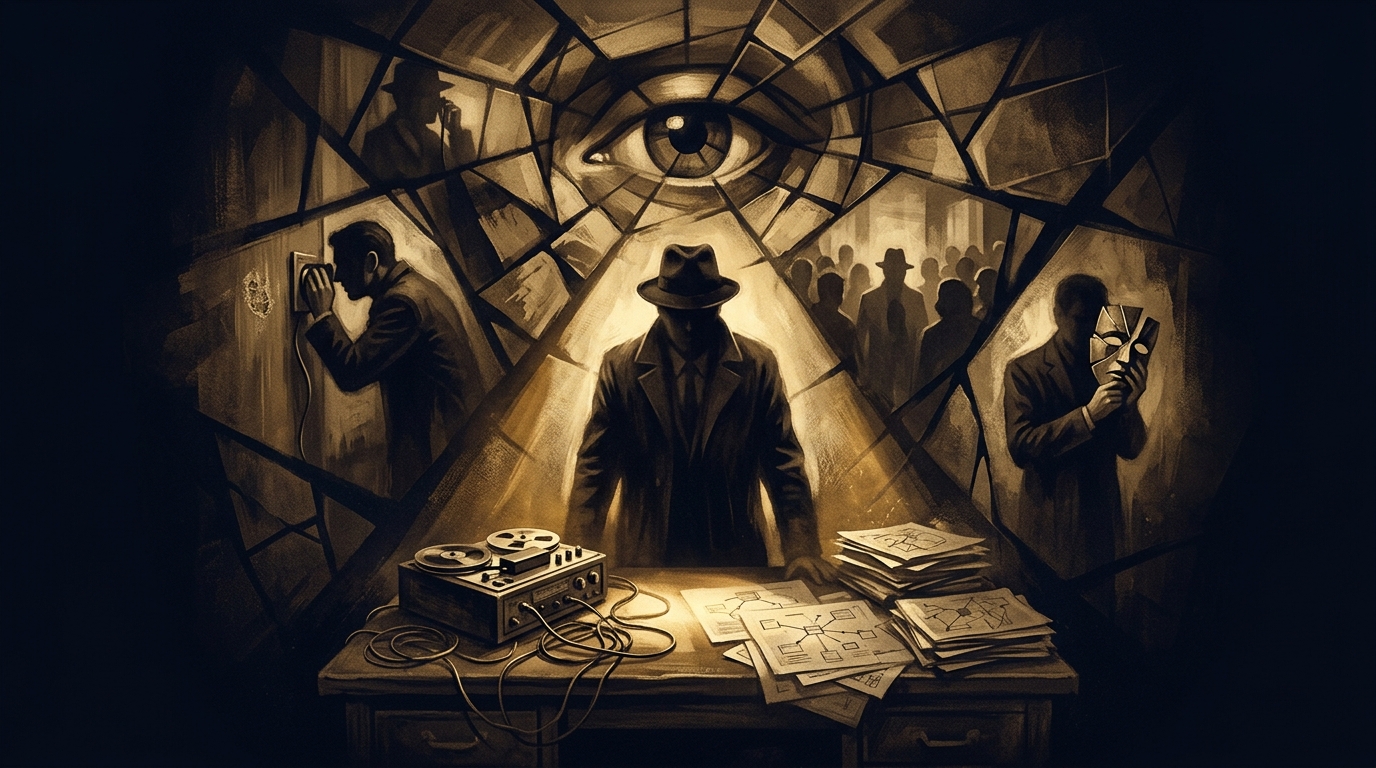
 Codex Illustration
COINTELPRO and Domestic Manipulation
Between 1956 and 1971, the Federal Bureau of Investigation ran a series of covert counter-intelligence programs collectively known as COINTELPRO — operations that used infiltration, disinformation, psychological manipulation, and coordinated legal harassment to neutralize domestic political movements the Bureau deemed subversive. The programs were not rumor or conspiracy theory: they are among the most thoroughly documented abuses of state power in American history.
Overview
COINTELPRO — an acronym for Counter Intelligence Program — was formally initiated by FBI Director J. Edgar Hoover in August 1956, initially targeting the Communist Party USA during the height of Cold War anxieties. What began as surveillance of suspected foreign agents rapidly expanded into something far broader and more troubling: a systematic campaign to monitor, infiltrate, discredit, and functionally destroy a wide range of domestic organizations and individuals whose political views Hoover and the Bureau found threatening. By the time the programs were exposed in 1971, the Bureau had turned its apparatus against civil rights organizations, anti-war groups, socialist and nationalist movements, and even mainstream figures who associated with any of the above. The documented methods were startling in their sophistication and cynicism: forged letters designed to create friction between allies, anonymous tip-offs to employers, orchestrated tax audits, fabricated evidence submitted to local police, and the deliberate cultivation of paranoia within targeted groups through the use of paid informants who sometimes instigated illegal acts.
The exposure of COINTELPRO came not through official government transparency, but through a burglary. On the night of March 8, 1971, a group calling itself the Citizens' Commission to Investigate the FBI broke into the Bureau's resident agency in Media, Pennsylvania, and removed hundreds of internal documents. Those documents, selectively shared with journalists and members of Congress, revealed the existence and scope of the programs. The FBI's internal codename — COINTELPRO — appeared across the files, and subsequent investigative journalism and congressional inquiry widened the aperture considerably. The Church Committee, formally the Senate Select Committee to Study Governmental Operations with Respect to Intelligence Activities, conducted its landmark investigation between 1975 and 1976, producing a multi-volume report that remains the definitive public accounting of these abuses. Senator Frank Church famously warned that the intelligence apparatus represented a potential danger to democratic governance itself.
The human cost of COINTELPRO is difficult to fully quantify, though specific cases are documented with troubling precision. The FBI's campaign against Martin Luther King Jr. is perhaps the most infamous individual operation: Bureau files show that agents wiretapped King's home, hotel rooms, and offices; compiled dossiers on his personal life; sent him an anonymous letter — almost certainly written with Bureau approval — that contained what many researchers interpret as a thinly veiled encouragement toward suicide, accompanied by recordings apparently intended to damage his marriage. The letter was drafted in 1964, the same year King received the Nobel Peace Prize. Separate campaigns targeted the Black Panther Party through disinformation and the deliberate stoking of lethal tensions with rival organizations; the Socialist Workers Party through decades of illegal infiltration; and various Puerto Rican independence movements through sustained harassment. In several documented cases, Bureau informants appear to have played active roles in violence rather than merely observing it.
The legacy of COINTELPRO extends well beyond the programs' formal end in 1971. Scholars of surveillance history such as Athan Theoharis, Brian Glick, and Ward Churchill have argued that the institutional cultures, legal justifications, and operational frameworks that made COINTELPRO possible were never entirely dismantled — they were reformed, re-authorized under different legal instruments, and in some respects expanded by technological advancement. The programs have become a reference point in debates about the proper limits of state intelligence activity, about the relationship between institutional secrecy and democratic accountability, and about which communities bear the heaviest costs when those limits are absent. Understanding COINTELPRO is not merely an exercise in historical grievance; it is an ongoing civic conversation about the architecture of power and the conditions under which it tends toward abuse.
Key Claims
Timeline
Evidence
Multiple Perspectives
Biblical Lens
Scripture Threads
Sources & Further Study
Questions to Explore
Go Deeper Path
Follow the Thread
Continue the Investigation
You’ve reached the Full Archive portion of this Case File.
Ask the Archivist
about this fileSign in to ask the Archivist
Create a free account to ask the Archivist 1 grounded question each day, cited straight from the CODEX case files.
Discussion
0Share findings, questions, and evidence with fellow Seekers. Be respectful and cite sources where you can.
No comments yet. Be the first to open this thread.