
 Codex Illustration
Coral Castle
Between 1923 and 1951, a slight Latvian immigrant named Edward Leedskalnin single-handedly quarried and erected over 1,100 tons of oolitic limestone in rural Florida, producing a structure that has puzzled engineers and inspired decades of speculation about lost mechanical knowledge, magnetism, and forces not yet understood by modern physics.
Overview
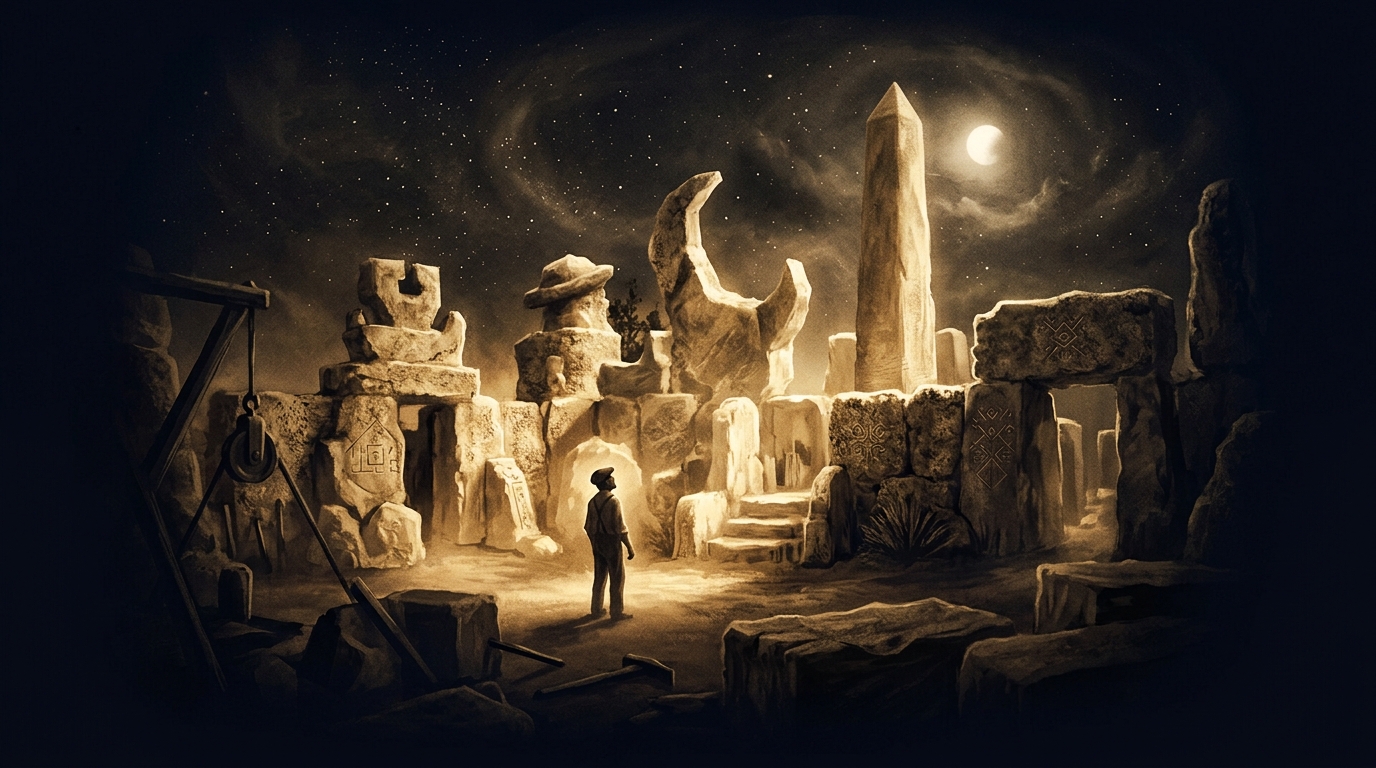
Coral Castle — originally called "Rock Gate Park" by its builder — stands in Homestead, Florida, as one of the most unusual architectural achievements of the twentieth century. Edward Leedskalnin (1887–1951), an uneducated Latvian stonemason of slight build, is documented to have quarried, transported, and erected massive blocks of oolitic limestone largely without assistance, working primarily at night over a period of nearly three decades. The largest single piece weighs an estimated 30 tons; the average block approaches 14 tons. No credible eyewitness account of Leedskalnin working with conventional heavy machinery has been recovered for the full scope of the project, though tools consistent with block-and-tackle, tripods, and chain hoists were found on the property after his death. The structure itself — encompassing a nine-ton gate balanced so precisely that a child could open it with one finger, a Polaris telescope aligned to the North Star, and a sundial accurate to the minute — reflects a meticulous, if eccentric, understanding of mechanics and astronomy.
The documented biographical record is sparse but not mysterious. Leedskalnin was born in Stâmeriena, Latvia, and emigrated to the United States by way of Canada around 1912, reportedly following a broken engagement to a sixteen-year-old girl he called his "Sweet Sixteen." He settled in Florida City in 1923 and began work on what scholars of vernacular architecture describe as an obsessive monument to lost love. In 1936, when a road-widening project threatened the original site, he moved the entire structure — some accounts suggest he hired a truck but loaded and unloaded the blocks himself, at night — approximately ten miles north to its present Homestead location. Neighbors occasionally glimpsed lights and sounds of work but reported seeing no cranes or large machinery, a mystery that Leedskalnin himself cultivated through deliberate secrecy. He sold pamphlets describing his personal theories of "magnetic currents" and "cosmic forces," and reportedly told one visitor that he had "discovered the secrets of the pyramids."
Leedskalnin's own published writings — particularly "Magnetic Current" (1945) and "Mineral, Vegetable and Animal Life" — present a non-standard cosmology rooted in the notion that all matter is composed of individual north and south magnetic currents flowing through the universe. While his theories do not conform to accepted electromagnetic physics, several engineers and physicists have noted that his practical engineering intuitions — particularly regarding mechanical advantage, counterbalancing, and center-of-gravity calculation — appear sound even if his theoretical framework is idiosyncratic. Mechanical engineer Joanne Barnes and others who have examined the tools recovered from the property conclude that skilled application of levers, fulcrums, tripods, and perhaps water-based transport methods could, in principle, account for the movement of the stones — though direct documentation of his precise methods remains absent. The nine-ton revolving gate, which balanced on a single metal shaft and a truck bearing for over sixty years before a repair disrupted its mechanism, suggests exceptional practical engineering, whatever the underlying method.
The popular mythology surrounding Coral Castle has grown substantially since the 1970s, when UFO researchers and alternative history writers began incorporating the site into narratives about anti-gravity technology, suppressed physics, and ancient megalithic knowledge. Some Internet-era claims have gone further, suggesting Leedskalnin possessed a "perpetual motion holder" capable of neutralizing gravity, or that he channeled telluric energy from ley lines running beneath the property. None of these claims is supported by physical or documentary evidence. What remains genuinely documented and genuinely puzzling is the engineering achievement itself: a single, slightly built man, working with rudimentary tools and modest financial resources, produced a monument of stones the moving of which would challenge a modern construction crew. The mystery, carefully examined, is not metaphysical — it is deeply human.
Key Claims
Timeline
Evidence
Multiple Perspectives
Biblical Lens
Scripture Threads
Sources & Further Study
Questions to Explore
Go Deeper Path
Follow the Thread
Continue the Investigation
You’ve reached the Full Archive portion of this Case File.
Ask the Archivist
about this fileSign in to ask the Archivist
Create a free account to ask the Archivist 1 grounded question each day, cited straight from the CODEX case files.
Discussion
0Share findings, questions, and evidence with fellow Seekers. Be respectful and cite sources where you can.
No comments yet. Be the first to open this thread.