
 Codex Illustration
The Council of Nicaea
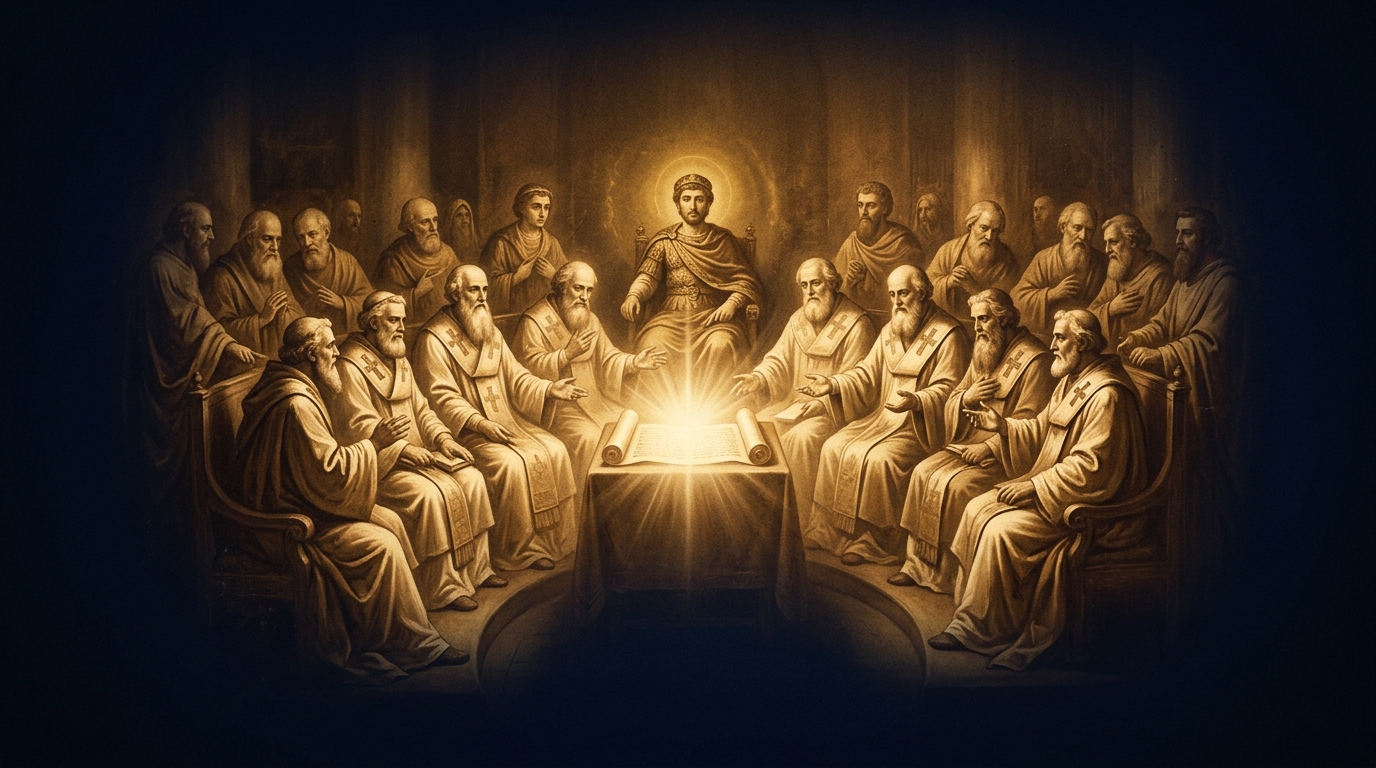
Convened in 325 AD by Emperor Constantine I, the First Council of Nicaea was the earliest ecumenical council of the Christian Church, forging a binding creed on the nature of Christ and reshaping the theological, political, and institutional landscape of Christianity for millennia. Its deliberations — and the legends that have accrued around them — remain among the most scrutinized and misunderstood events in religious history.
Overview
In the spring of 325 AD, roughly 250 to 318 bishops gathered at Nicaea (modern-day İznik, Turkey) at the invitation of Emperor Constantine I, who had recently consolidated his rule over a united Roman Empire. The immediate catalyst was the Arian controversy: the Alexandrian presbyter Arius had taught that the Son of God was a created being — 'there was a time when he was not' — subordinate to and ontologically distinct from the Father. This position had fractured Christian communities across the eastern Empire, and Constantine, eager for theological unity as a foundation for political cohesion, summoned the bishops to resolve the dispute. The council condemned Arianism and produced the original Nicene Creed, affirming the Son to be 'of the same substance' (homoousios) as the Father — a Greek philosophical term whose insertion was theologically decisive and politically contentious.
Beyond Christology, the council addressed a range of ecclesiastical matters: the date of Easter (seeking uniformity against the Quartodeciman practice), the Meletian schism in Egypt, the readmission of lapsed clergy, and various canons regulating church discipline and episcopal jurisdiction. The proceedings were documented in letters and synodal records, and the resulting canons — twenty in number — became foundational legal instruments for both Eastern and Western Christianity. The council did not, as is sometimes claimed, assemble or 'vote on' the biblical canon; that process was far more gradual and decentralized, and no such vote is attested in any primary source from Nicaea.
The historical significance of Nicaea is difficult to overstate. It established a precedent for imperial involvement in church governance, a dynamic that would generate centuries of tension between ecclesiastical and secular authority. It also entrenched the homoousian Christology that would become normative, even though Arianism persisted — and indeed flourished among Germanic tribes — for centuries afterward. The council did not immediately end controversy; the decades following 325 AD saw fierce theological battles, periodic rehabilitations of Arian positions, and the eventual triumph of Nicene orthodoxy consolidated at the Council of Constantinople in 381 AD.
In modern popular culture, Nicaea has become a locus of conspiracy theories, most notably the claim — popularized by Dan Brown's novel 'The Da Vinci Code' (2003) — that Constantine and the bishops invented the divinity of Christ at Nicaea by a close vote, suppressing earlier 'human-only' traditions. This claim is contradicted by extensive documentary evidence: the veneration of Christ as divine predates Nicaea by centuries, attested in Paul's letters (c. 50s AD), the Gospel of John (c. 90s AD), and early liturgical texts such as the Didache and Ignatius of Antioch's letters (c. 107 AD). Scholars of early Christianity uniformly reject the Da Vinci Code narrative as historically untenable.
Timeline
Evidence
Multiple Perspectives
Biblical Lens
Scripture Threads
Sources & Further Study
Questions to Explore
Follow the Thread
Continue the Investigation
You’ve reached the Full Archive portion of this Case File.
Ask the Archivist
about this fileSign in to ask the Archivist
Create a free account to ask the Archivist 1 grounded question each day, cited straight from the CODEX case files.
Discussion
0Share findings, questions, and evidence with fellow Seekers. Be respectful and cite sources where you can.
No comments yet. Be the first to open this thread.