
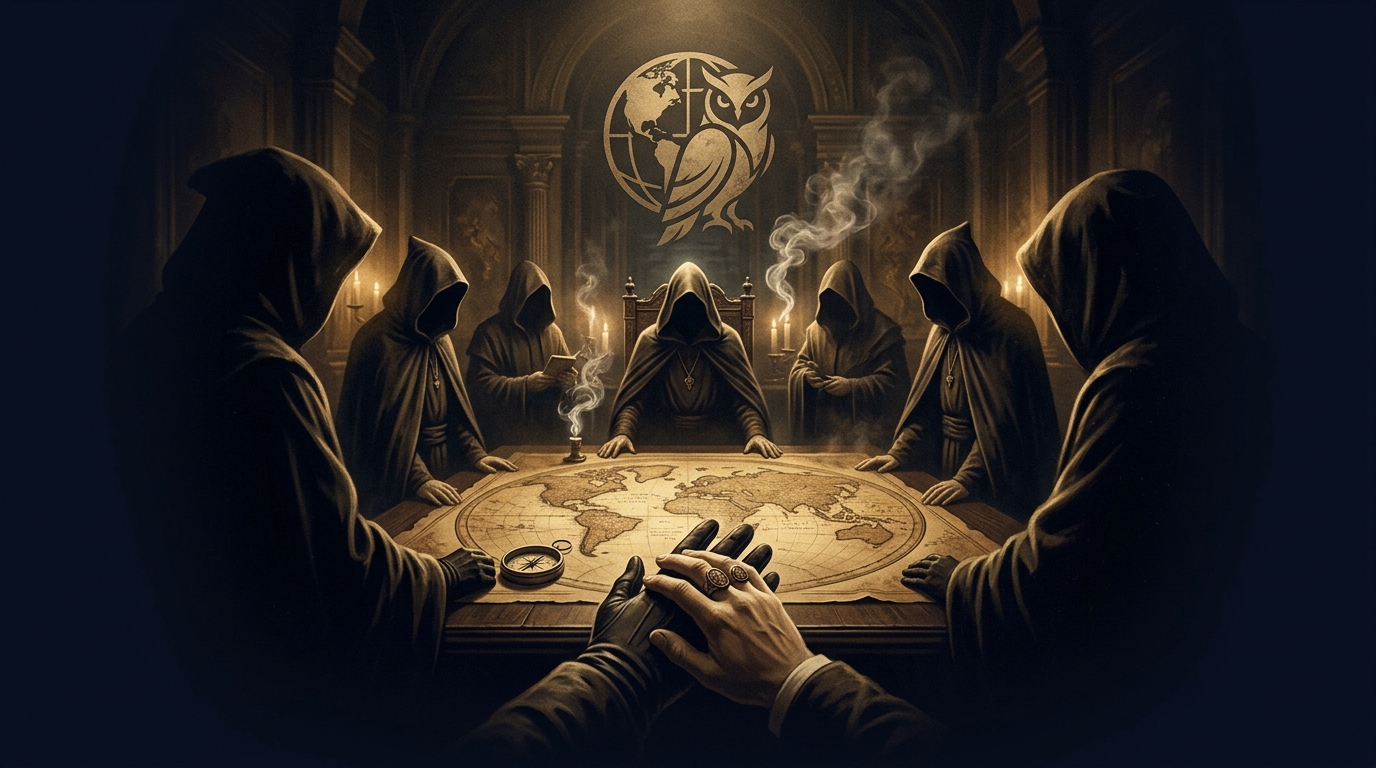
 Codex Illustration
Council on Foreign Relations
Founded in 1921 as a nonpartisan foreign-policy research organization, the Council on Foreign Relations occupies a peculiar space in the American imagination — simultaneously a well-documented institution of elite discourse and a persistent focal point for theories about shadow governance and the quiet engineering of world order.
Overview
The Council on Foreign Relations (CFR) was established in New York City in 1921, growing out of an informal grouping of American diplomats and intellectuals who had attended the Paris Peace Conference of 1919. Its founding was practical in intent: to provide the United States with a permanent, non-governmental forum for serious foreign-policy analysis at a moment when American power was expanding but American institutional expertise in global affairs was thin. The organization quickly attracted members from finance, law, academia, and government, and its journal, Foreign Affairs, founded the same year, became one of the most influential periodicals in American statecraft. These are documented historical facts, verifiable through the organization's own records, congressional testimony, and a vast secondary literature.
For much of the twentieth century, the CFR functioned as what scholars have called a 'foreign-policy establishment' — an interlocking network of individuals who moved between government service, corporate boards, and prestigious think tanks with a frequency that critics would eventually describe as a 'revolving door.' Historical research, including Laurence H. Shoup and William Minter's documented study 'Imperial Brain Trust' (1977) and G. William Domhoff's sociological work on elite power networks, establishes that CFR members have occupied a disproportionate number of senior cabinet, diplomatic, and intelligence positions across administrations of both parties. This represents a documented pattern of elite institutional influence — a subject of legitimate scholarly debate about democratic accountability — rather than evidence of clandestine control.
The organization's actual operations are more transparent than its conspiratorial reputation suggests. It publishes reports, hosts on-the-record and off-the-record meetings (the latter governed by the Chatham House Rule, which permits use of information without attribution to its source), and maintains a publicly accessible membership roster. Its study groups on topics such as nuclear nonproliferation, trade policy, and regional conflicts have influenced the framing of policy debates, and its members have at various times served as architects of major post-war institutions including the United Nations and the Bretton Woods financial order. Whether this influence constitutes wise stewardship, dangerous concentration of power, or something more sinister depends heavily on the analytical framework brought to bear.
The CFR's role in conspiracy culture is a separate matter from its institutional history, and the two deserve careful disentanglement. Beginning in the mid-twentieth century, and accelerating sharply with the rise of internet-era information sharing, the organization became a central node in a broader architecture of claims asserting that it secretly directs American foreign policy toward a 'new world order' or one-world government. These claims draw selectively on real features of CFR history — the density of its alumni in government, its promotion of multilateral institutions, statements by individual members about global governance — and extrapolate from them a coordinated, secret agenda. The evidentiary standard for this extrapolation is invariably weak: quotes are decontextualized, influence is conflated with control, and the open nature of most CFR activity is treated as itself suspicious. Rigorous analysis requires holding both truths simultaneously: the CFR does represent a concentration of elite influence that raises legitimate questions about democratic accountability, and the leap from documented influence to secret world domination is not supported by available evidence.
Key Claims
Timeline
Evidence
Multiple Perspectives
Biblical Lens
Scripture Threads
Sources & Further Study
Questions to Explore
Go Deeper Path
Follow the Thread
Continue the Investigation
You’ve reached the Full Archive portion of this Case File.
Ask the Archivist
about this fileSign in to ask the Archivist
Create a free account to ask the Archivist 1 grounded question each day, cited straight from the CODEX case files.
Discussion
0Share findings, questions, and evidence with fellow Seekers. Be respectful and cite sources where you can.
No comments yet. Be the first to open this thread.