
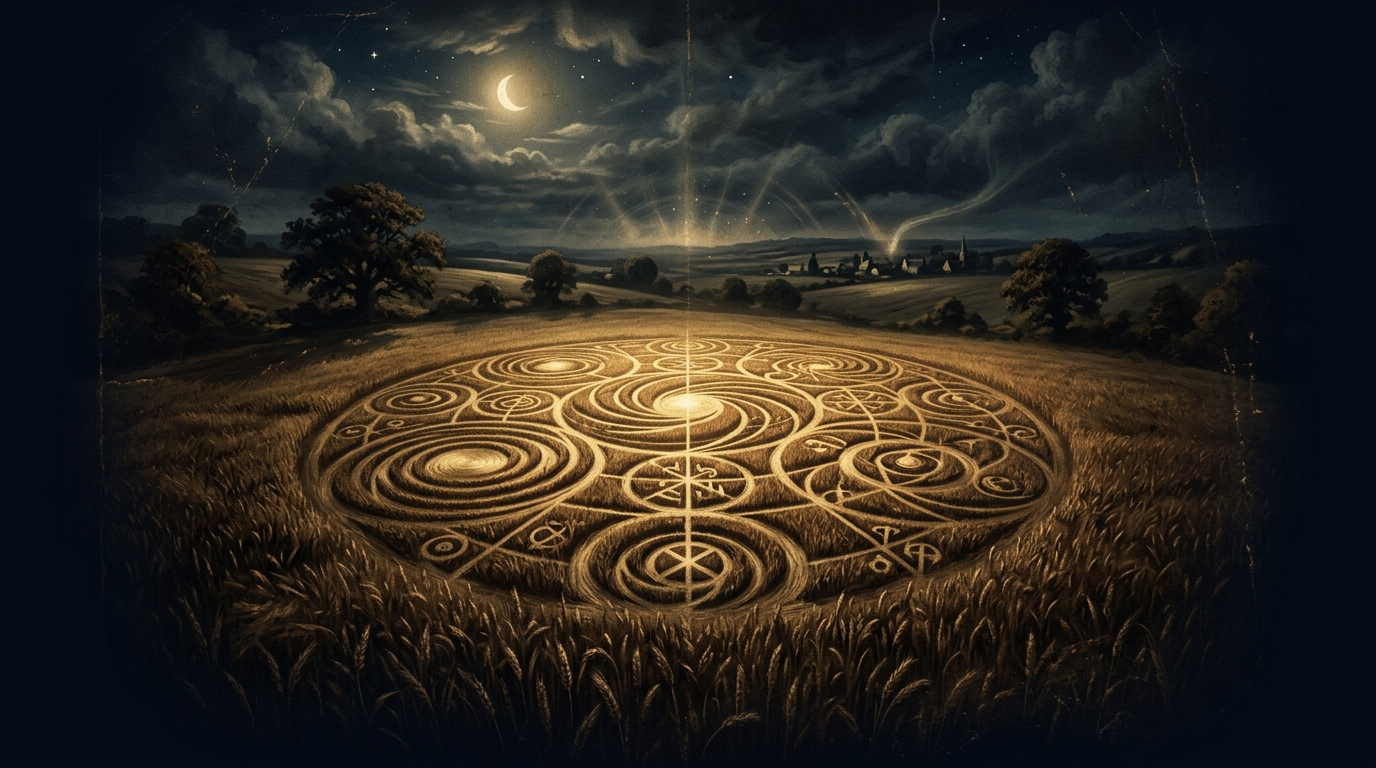
 Codex Illustration
Crop Circles
Appearing overnight in fields across England and dozens of other countries, crop circles — intricate geometric formations pressed into standing grain — have defied simple explanation for decades, generating competing narratives of human artistry, natural forces, and non-human intelligence that illuminate as much about human psychology as about any external mystery.
Overview
The modern crop circle era is generally dated to the late 1970s and early 1980s in the English county of Wiltshire, where simple circular depressions in grain fields first attracted serious press attention. The phenomenon escalated dramatically through the 1980s and 1990s, with formations growing from basic circles into elaborate pictograms encoding Euclidean geometry, fractal patterns, and — in some cases — apparent representations of mathematical sequences and molecular structures. By the mid-1990s, dozens of formations were appearing each summer across southern England alone, with additional reports from Germany, the Netherlands, the United States, Canada, Japan, and Australia. The sheer scale and apparent overnight creation of some formations made them a focal point for researchers, artists, skeptics, and a rapidly developing international subculture sometimes called 'cereology.'
In 1991, a celebrated episode fundamentally altered the public discourse: Doug Bower and Dave Chorley, two English artists, publicly demonstrated and confessed to having created hundreds of formations in Hampshire and Wiltshire beginning in 1978, using simple boards, ropes, and surveying techniques. Their demonstration was widely covered and is well-documented. This confession — and the subsequent proliferation of admitted human 'crop artists' working in organized teams — established beyond reasonable scholarly doubt that a significant proportion, and possibly the vast majority, of crop circle formations are the product of deliberate human construction. Organizations such as the Circlemakers collective have since claimed and documented many elaborate formations, and the techniques are reproducible and teachable.
Yet the debate has not been entirely closed, and a subset of researchers — including some who hold scientific credentials — maintain that a residual category of cases resists purely human explanation. Claims in this camp include reports of anomalous plant-node elongation and expulsion cavities documented by biophysicist W.C. Levengood in peer-reviewed and independent publications, reported electromagnetic disturbances and equipment failures in fresh formations, and the testimony of witnesses who describe unusual lights or sounds in the vicinity of fields prior to the appearance of formations. These claims are contested: Levengood's methodology was critiqued by other researchers, and independent replication has been inconsistent. The 'unexplained residue' argument is genuine enough to warrant careful examination, but it should not be conflated with confirmation of any specific non-human or paranormal cause.
Crop circles occupy a richly layered cultural position. They have been interpreted through frameworks ranging from Jungian archetypes and collective unconscious symbolism to plasma vortex theories proposed by meteorologist Terence Meaden, to extraterrestrial communication, to the work of non-human intelligences of an altogether more ambiguous kind. The formations have inspired significant artistic movements, academic conferences, documentary films, and a dedicated scholarly journal (The Cereologist). More broadly, they serve as a case study in how ambiguous phenomena become cultural and symbolic canvases: the meaning audiences project onto crop circles often reveals more about contemporary anxieties, longings, and epistemological commitments than about the circles themselves. The phenomenon remains, in the archive's considered judgment, a documented cultural and artistic phenomenon with a well-evidenced human-construction explanation for most cases, a small and contested residue of anomalous claims, and an enduring life as a living mythology of the late modern era.
Key Claims
Timeline
Evidence
Multiple Perspectives
Biblical Lens
Scripture Threads
Sources & Further Study
Questions to Explore
Go Deeper Path
Follow the Thread
Continue the Investigation
You’ve reached the Full Archive portion of this Case File.
Ask the Archivist
about this fileSign in to ask the Archivist
Create a free account to ask the Archivist 1 grounded question each day, cited straight from the CODEX case files.
Discussion
0Share findings, questions, and evidence with fellow Seekers. Be respectful and cite sources where you can.
No comments yet. Be the first to open this thread.