
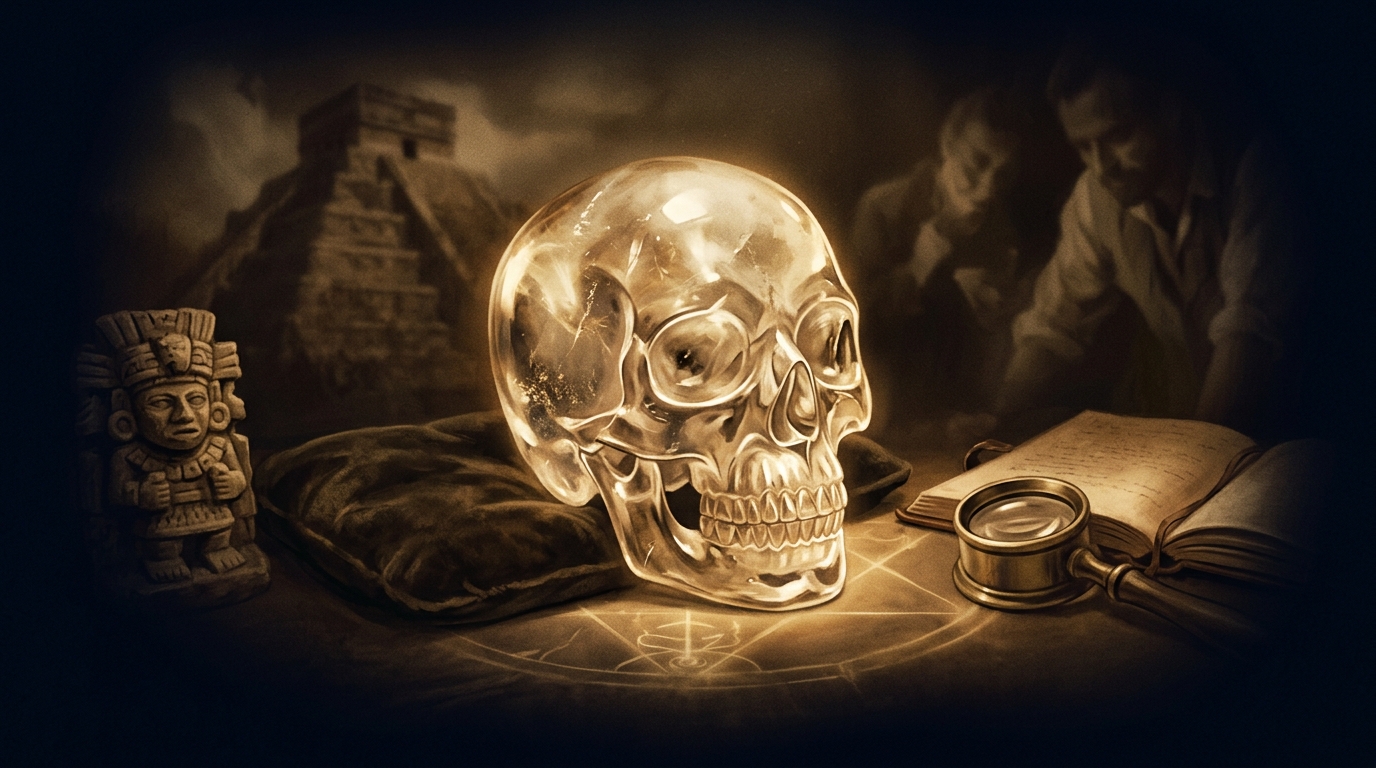
 Codex Illustration
Crystal Skulls
Polished human skulls carved from quartz crystal, claimed variously as Mesoamerican relics of divine power, Atlantean technology, or conduits of occult energy — yet subjected to microscopic analysis revealing, in nearly every examined case, the unmistakable signatures of modern lapidary tools.
Overview
The legend of the crystal skull occupies a peculiar liminal space between genuine archaeological curiosity and demonstrable modern forgery. The most famous specimens — the British Museum skull, the Smithsonian skull, and above all the so-called Mitchell-Hedges skull — entered public consciousness in the late nineteenth and early twentieth centuries, typically through the hands of antique dealers, private collectors, or adventure tourists rather than through controlled archaeological excavations. Their visual impact is undeniable: a human cranium rendered in near-flawless translucent quartz, sometimes with a detachable jaw, projecting an uncanny presence that has inspired decades of mythology about ancient wisdom encoded in stone.
The scholarly record on these objects is, however, unusually clear for a historical mystery. Beginning in 1992, researchers at the British Museum — working in collaboration with materials scientists — subjected several prominent skulls to scanning electron microscopy (SEM) and x-ray crystallography. The results, published formally and discussed in peer-reviewed contexts, revealed rotary wheel-grinding marks inconsistent with any pre-Columbian stone-working technique. Similar findings emerged from analysis conducted by the Smithsonian Institution on its large quartz skull, acquired in 1992 and subsequently tested: the tool marks indicated high-speed rotary equipment of a type unavailable before the nineteenth century. The Mitchell-Hedges skull, perhaps the most mythologized of all, has never been submitted to full independent scientific testing by its custodians, a circumstance that fuels ongoing popular speculation but does not, scholars note, constitute evidence in its favor.
The provenance of these objects is equally instructive. The British Museum skull was purchased in 1897 from the Paris antique dealer Eugène Boban, who is documented as a major conduit for both genuine and spurious Mesoamerican antiquities during the late nineteenth century. Boban's inventory records and the artifact's own physical properties point toward manufacture in Europe — likely by skilled German lapidaries in the Idar-Oberstein gemstone-cutting tradition — rather than in pre-Columbian Mesoamerica. The Mitchell-Hedges skull surfaced publicly only in the 1940s, attributed posthumously to an alleged 1924 excavation at Lubaantun (Belize) by adventurer F.A. Mitchell-Hedges; his daughter Anna claimed to have discovered it beneath a collapsed altar. No contemporary expedition records, photographs, or corroborating witnesses support this discovery narrative, and documentary researcher Joe Nickell and others have traced the skull's actual first appearance to a 1943 London auction at Sotheby's, where Mitchell-Hedges himself purchased it.
Nevertheless, the cultural life of the crystal skull far exceeds what the archaeological record warrants. New Age communities have assigned skulls names, personalities, and healing properties; shamanic practitioners describe receiving transmissions or visions during contact with quartz specimens; a 1988 gathering in Los Angeles reportedly convened thirteen skulls from various private collections for a ceremonial alignment. Indiana Jones and the Kingdom of the Crystal Skull (2008) embedded the mythology firmly in popular entertainment. From a scholarly standpoint, the phenomenon is a fascinating case study in how material objects — even demonstrably modern ones — can accrue ancient authority through narrative, desire, and the genuine human tendency to project mystery onto the uncanny. Small numbers of authentic pre-Columbian quartz carvings do exist in Mesoamerican collections, and minor rock-crystal objects were indeed worked in ancient Mesoamerica, but none resemble the grand skull forms claimed as the centerpieces of the legend.
Key Claims
Timeline
Evidence
Multiple Perspectives
Biblical Lens
Scripture Threads
Sources & Further Study
Questions to Explore
Go Deeper Path
Follow the Thread
Continue the Investigation
You’ve reached the Full Archive portion of this Case File.
Ask the Archivist
about this fileSign in to ask the Archivist
Create a free account to ask the Archivist 1 grounded question each day, cited straight from the CODEX case files.
Discussion
0Share findings, questions, and evidence with fellow Seekers. Be respectful and cite sources where you can.
No comments yet. Be the first to open this thread.