
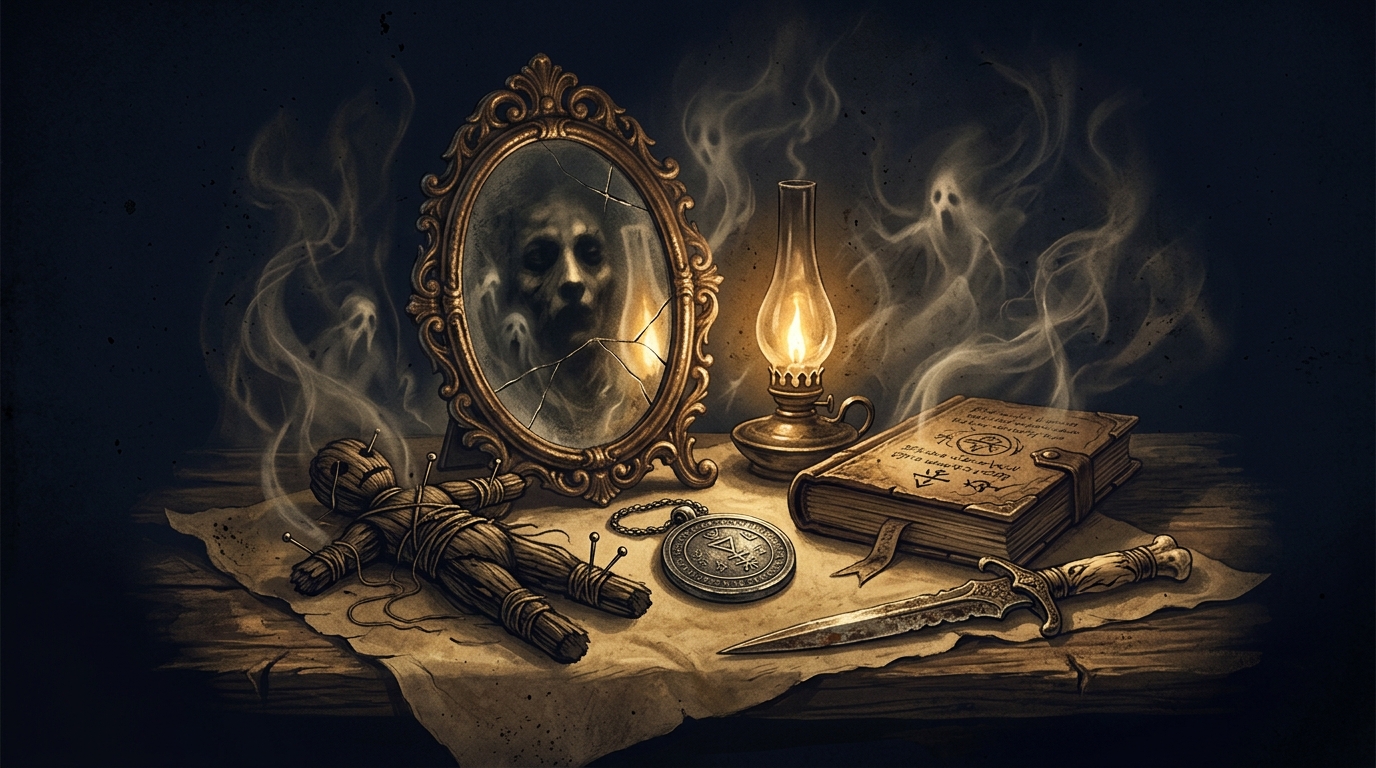
 Codex Illustration
Cursed Objects
Across centuries and cultures, certain objects have accumulated reputations for bringing misfortune, illness, or death to their owners — a tradition that raises genuine questions about the psychology of belief, the mechanics of superstition, and, for some traditions, the possibility of a real unseen dimension to material reality.
Overview
The idea that an object might carry malevolent power is among the oldest and most persistent features of human religious and folk life. Ancient Near Eastern texts describe items ritually consecrated to deities or demons, Mesopotamian incantation bowls were deployed specifically to neutralize malevolent forces believed to reside in objects and spaces, and the Hebrew Bible's concept of cherem — objects devoted to destruction or divine sanction — suggests that the ancient world took seriously the possibility that material things could be spiritually 'charged.' What the modern West calls a 'cursed object' represents a secularized and sensationalized fragment of this much older and more theologically sophisticated tradition.
The most famous contemporary examples — the Hope Diamond, the dybbuk box, and the doll known as Annabelle — share a common structure: a colorful provenance narrative, a string of misfortunes attributed to ownership, and a cultural life amplified enormously by mass media and, later, the internet. The Hope Diamond (a 45.52-carat blue diamond now housed at the Smithsonian Institution) has been associated with tragedy since at least the early twentieth century, though historians such as Richard Kurin, in his book 'Hope Diamond: The Legendary History of a Cursed Gem' (Smithsonian Books, 2006), document that many of the most dramatic misfortune stories were embellishments introduced by newspaper reporting in the 1900s rather than reliable historical records. The diamond's genuine history is remarkable enough without invention; its folkloric curse layer appears to have been largely constructed.
The dybbuk box — a wine cabinet purportedly inhabited by a dybbuk, a restless spirit from Jewish mystical tradition — entered public consciousness via a 2003 eBay listing and subsequent accounts by seller Kevin Mannis, who described escalating physical and psychological disturbances among its owners. The item's journey through multiple hands, each reporting nightmares, illness, and unease, inspired Jason Haxton's book 'The Dibbuk Box' (2011) and eventually the 2012 horror film 'The Possession.' Folklorists and psychologists observe that the case is an almost textbook demonstration of how a compelling narrative, once attached to an object, can generate genuine psychosomatic effects in susceptible individuals — a phenomenon well-documented in the placebo and nocebo research literature. None of this rules out the possibility of something more, but it does establish that the reported effects have a robust naturalistic explanation.
Annabelle, a Raggedy Ann doll allegedly investigated by paranormal researchers Ed and Lorraine Warren in the early 1970s and now housed in their Occult Museum in Monroe, Connecticut, represents a third typology: the cursed object embedded within a broader demonological claim. The Warrens' account — that the doll served as a focus for a demonic entity manipulating its owners — is entirely unverified and exists solely within their own testimony and the popular films it inspired. Serious parapsychological researchers and skeptics alike note the absence of any independent documentation. What these three cases share, however, is the cultural power of the 'contaminated object' archetype: the intuition, apparently deeply wired, that certain things carry the residue of catastrophe, malice, or the sacred.
Key Claims
Timeline
Evidence
Multiple Perspectives
Biblical Lens
Scripture Threads
Sources & Further Study
Questions to Explore
Go Deeper Path
Follow the Thread
Continue the Investigation
You’ve reached the Full Archive portion of this Case File.
Ask the Archivist
about this fileSign in to ask the Archivist
Create a free account to ask the Archivist 1 grounded question each day, cited straight from the CODEX case files.
Discussion
0Share findings, questions, and evidence with fellow Seekers. Be respectful and cite sources where you can.
No comments yet. Be the first to open this thread.