
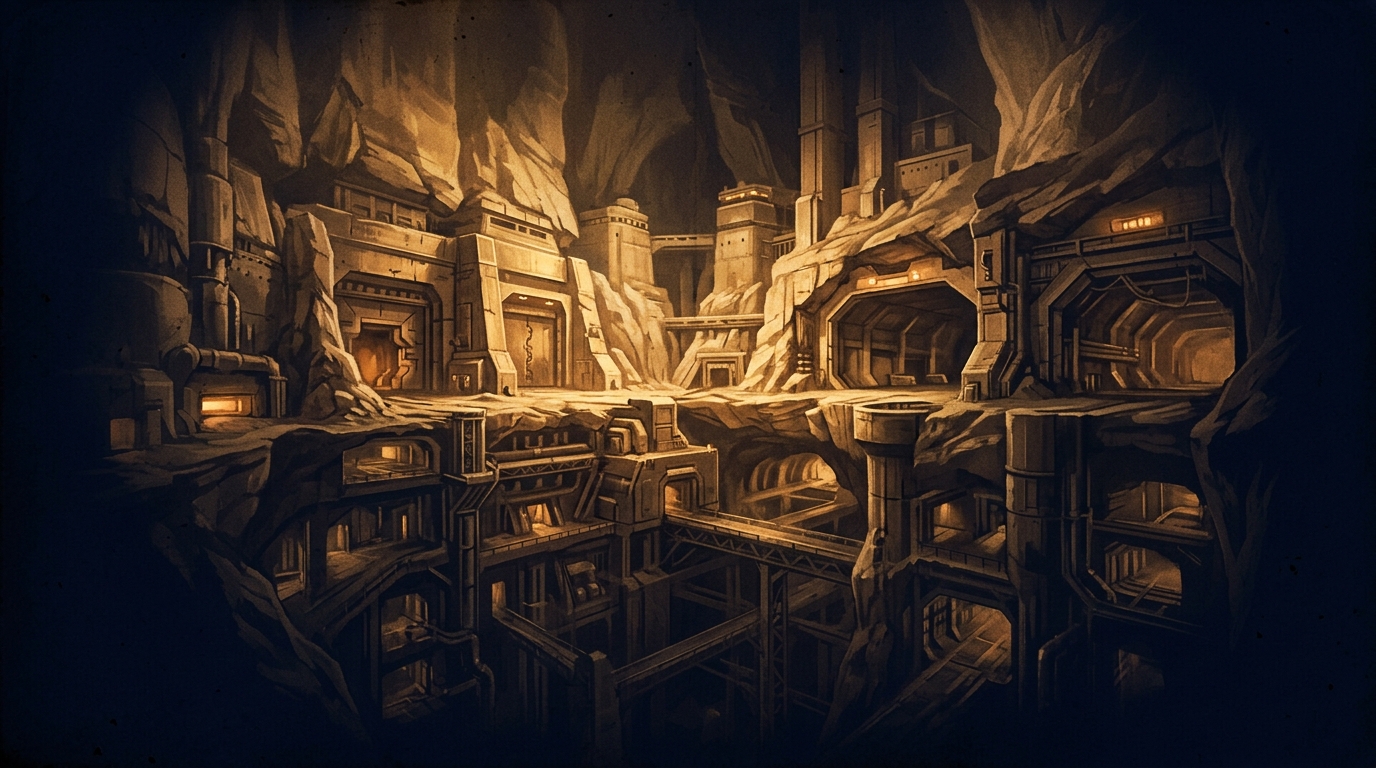
 Codex Illustration
Deep Underground Military Bases
Beneath mountain ranges, desert floors, and urban corridors, governments have constructed vast underground complexes whose documented purposes range from continuity-of-government survival to nuclear command and control — yet the outer boundary of what exists, and what may have been built in secret, remains one of the more credibly contested mysteries of the modern national-security state.
Overview
The existence of deep underground military bases — commonly abbreviated DUMBs in alternative research communities — is not, at its documented core, a fringe claim. During the Cold War, the United States, Soviet Union, and other nuclear powers invested enormous resources in subterranean infrastructure designed to survive nuclear exchange and preserve governmental, military, and communications continuity. The Cheyenne Mountain Complex in Colorado, operational from 1966, stands as perhaps the most publicly acknowledged example: a facility built 2,000 feet inside granite, suspended on enormous shock-absorbing springs, housing NORAD command and control. Raven Rock Mountain Complex (Site R) in Pennsylvania, FEMA's Mount Weather Emergency Operations Center in Virginia, and the Greenbrier Hotel's classified congressional bunker — declassified in 1992 after a Washington Post exposé — represent additional documented cases of substantial underground government infrastructure. These facilities are real, they are expensive, and their construction is a matter of public record, declassified reports, and investigative journalism.
Beyond these documented installations, a substantial body of government contracting records, leaked documents, and whistleblower testimony points to a broader and more classified underground construction program undertaken primarily from the 1980s onward. Investigative journalist Richard Sauder devoted multiple books to cataloguing declassified government patents and contracting records for nuclear-powered tunneling machines — a technology sometimes called the Subterrene — developed at Los Alamos National Laboratory in the 1970s. The existence of these patents is documented; the extent to which the technology was deployed at scale, and for what purposes, is not publicly established. Some researchers, drawing on government procurement documents and congressional testimony about classified 'black budget' expenditures — famously estimated by Catherine Austin Fitts and others at trillions of unaccounted dollars — argue that a network of ultra-deep facilities, connected by high-speed transit tunnels, may have been constructed largely outside congressional oversight.
The claims become progressively more extraordinary — and the evidence correspondingly thinner — as one moves from documented Cold War bunkers into the territory of alleged secret research facilities, underground cities, and claimed extraterrestrial-related programs. Accounts from self-described whistleblowers such as the late Philip Schneider, who claimed to have worked as a geological engineer on underground base construction before dying under disputed circumstances in 1996, allege the existence of dozens of classified facilities at extreme depths, some reportedly housing programs connected to nonhuman intelligence. These claims have circulated widely in alternative research communities and have been cross-referenced with broader narratives about UAP crash retrieval, reverse engineering, and continuity-of-species infrastructure. No documentary evidence has been publicly produced to substantiate the most extraordinary of these claims, and mainstream investigative journalism has not corroborated them. They nonetheless represent a persistent and internally detailed tradition that warrants careful, non-dismissive examination.
The cultural and theological resonances of the DUMB phenomenon are difficult to ignore entirely. The image of powerful institutions constructing vast, secret works beneath the surface of the earth — hidden from public view, sustained by unaccountable funding, and oriented around survival of an elite rather than the general population — activates deep symbolic patterns that recur across ancient literature, biblical prophecy, and political philosophy. Isaiah 2:19 speaks of humanity fleeing into 'the caves of the earth' before divine judgment; Revelation 6:15-16 describes kings and commanders hiding in 'dens and rocks of the mountains.' Whether these passages are understood as predictive, symbolic, or simply as recurring human responses to existential threat, the convergence between ancient imagery and modern documented behavior is a phenomenon worthy of careful reflection, particularly within traditions concerned with the relationship between human ambition, secrecy, and accountability.
Key Claims
Timeline
Evidence
Multiple Perspectives
Biblical Lens
Scripture Threads
Sources & Further Study
Questions to Explore
Go Deeper Path
Follow the Thread
Continue the Investigation
You’ve reached the Full Archive portion of this Case File.
Ask the Archivist
about this fileSign in to ask the Archivist
Create a free account to ask the Archivist 1 grounded question each day, cited straight from the CODEX case files.
Discussion
0Share findings, questions, and evidence with fellow Seekers. Be respectful and cite sources where you can.
No comments yet. Be the first to open this thread.