
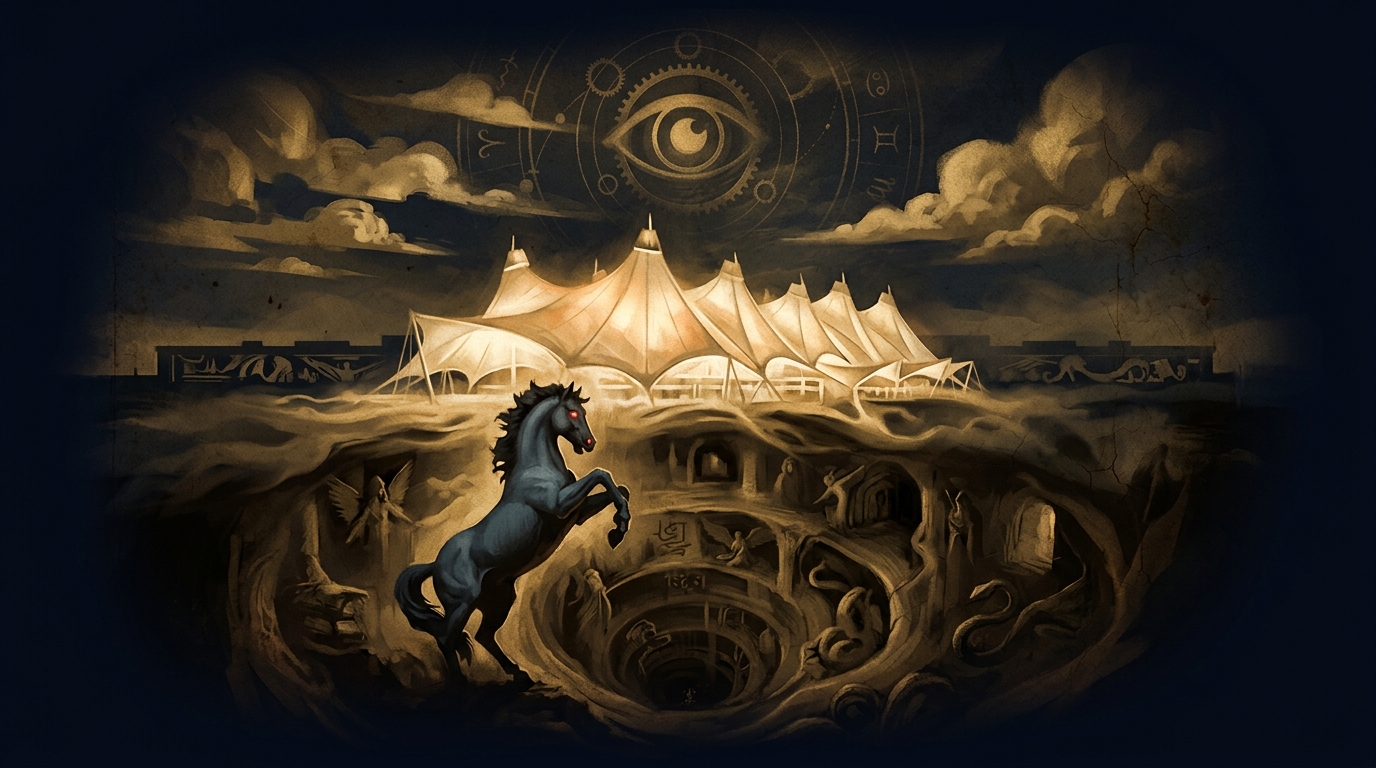
 Codex Illustration
Denver Airport
Denver International Airport, opened in 1995, has accumulated one of the most elaborate bodies of conspiratorial lore surrounding any public infrastructure project in American history — a convergence of genuinely strange art, disputed architectural claims, admitted Freemason involvement, and an underground tunnel network that has fueled speculation ranging from the plausible to the baroque.
Overview
Denver International Airport (DIA) opened on February 28, 1995, after years of delays and cost overruns that pushed its final price tag to approximately $4.8 billion — nearly double original projections. These delays, combined with a notoriously troubled automated baggage system that never fully functioned as designed, gave the project an early atmosphere of institutional opacity and dysfunction that conspiratorial imagination found fertile. The airport is the largest in the United States by land area, situated on 53 square miles of high plains east of Denver, and its design — from Jeppesen Terminal's white tensile roof structures to the commissioning of genuinely provocative public art — established an aesthetic that critics and enthusiasts alike have described as simultaneously visionary and unsettling.
The most documented and publicly acknowledged unusual features of DIA are its murals and sculptures. Colorado artist Leo Tanguma was commissioned to create two large mural cycles: 'Children of the World Dream of Peace' and 'In Peace and Harmony with Nature.' Both works contain arresting imagery — a gas-masked military figure wielding a sword over sleeping children, burning cities, weeping indigenous figures, and scenes of ecological catastrophe — alongside redemptive sequences depicting children dismantling weapons and celebrating multicultural harmony. Tanguma has stated publicly and in numerous interviews that the murals represent the triumph of peace over war and environmental destruction, and that their meaning is straightforwardly humanistic and anti-militarist. This documented artistic intent does not, however, account for the full force of the imagery's effect on an unprepared traveler, and the gap between intent and visual impact has proven to be one of the most productive spaces conspiratorial interpretation has ever occupied. The blue mustang sculpture — a 32-foot fiberglass stallion with glowing red eyes, nicknamed 'Blucifer' by locals — killed its own sculptor, Luis Jiménez, in 2006 when a section of it fell and severed an artery. Jiménez died before its installation, and the work was completed posthumously by his family. The sculpture is documented public art with a documented tragic history; its red eyes and aggressive posture have nonetheless become stock imagery in DIA conspiracy visual culture.
The airport's dedication capstone, installed in 1994 by the Grand Lodge of Masons of Colorado, is a matter of documented historical record. It explicitly names the Freemasons as participants in the cornerstone ceremony — a long-standing American civic tradition dating to the construction of the U.S. Capitol and many other public buildings. The capstone also contains a time capsule intended to be opened in 2094. This verifiable Masonic involvement is routinely cited by conspiracy theorists as evidence of secret society control over the airport's design and alleged underground purpose, though Masonic participation in public cornerstone ceremonies has been standard practice across American civic architecture for over two centuries and carries no evidentiary weight on its own regarding hidden agendas. What has proven genuinely difficult to fully account for is the airport's extensive underground infrastructure: a documented tunnel and train system connects concourses, and construction involved significant subterranean excavation. Claims that these tunnels extend to Deep Underground Military Bases (DUMBs) or serve as shelters for a continuity-of-government elite have circulated since the 1990s and have never been substantiated by physical evidence, engineering documents, or credible insider testimony.
The airport's management has, in an unusual and arguably shrewd move, leaned into its own mythology. In 2018 and 2019, DIA partnered with an advertising agency to install self-referential gargoyle statues in Jeppesen Terminal that addressed passengers with recorded messages acknowledging the conspiracy theories, and erected signage with winking references to lizard people and secret tunnels. A temporary exhibit titled 'Art & Architecture: There Are No Conspiracies Here' was installed in 2018. Whether this represents genuine transparency or sophisticated deflection is itself a matter of debate. What remains is a public infrastructure project that, through a combination of genuine artistic provocation, legitimate but symbolically charged institutional affiliations, cost and delay scandals, and an underground footprint that exceeds what most travelers ever see, has become one of the most symbolically productive sites in American conspiratorial imagination — a modern secular cathedral whose iconography resists simple resolution.
Key Claims
Timeline
Evidence
Multiple Perspectives
Biblical Lens
Scripture Threads
Sources & Further Study
Questions to Explore
Go Deeper Path
Follow the Thread
Continue the Investigation
You’ve reached the Full Archive portion of this Case File.
Ask the Archivist
about this fileSign in to ask the Archivist
Create a free account to ask the Archivist 1 grounded question each day, cited straight from the CODEX case files.
Discussion
0Share findings, questions, and evidence with fellow Seekers. Be respectful and cite sources where you can.
No comments yet. Be the first to open this thread.