
 Codex Illustration
Deuteronomy 32 and the Table of Nations
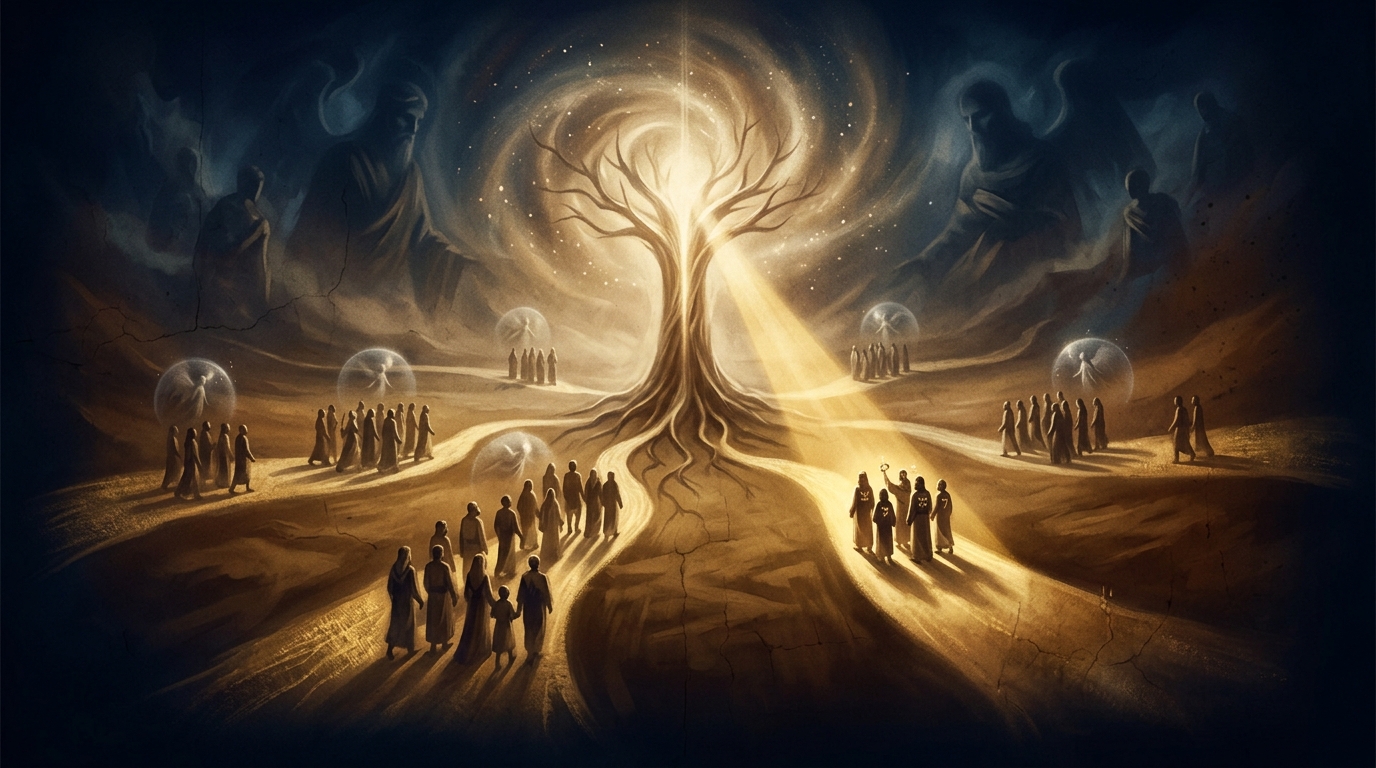
A single verse in the Song of Moses — Deuteronomy 32:8 — contains what many scholars now regard as the theological key to the entire Hebrew Bible's understanding of nations, divine beings, and cosmic rebellion. When read against its ancient manuscript tradition, this text reveals a world in which the nations were divided among supernatural 'sons of God' as a deliberate act of divine judgment following the Tower of Babel.
Overview
Deuteronomy 32:8-9, part of the ancient lyric poem known as the Song of Moses, presents a cosmological claim of extraordinary scope. In the version preserved in the Dead Sea Scrolls (specifically 4QDeutj) and reflected in the Septuagint, the text reads that when the Most High divided the nations, He 'fixed the borders of the peoples according to the number of the sons of God (bene elohim),' reserving Israel as His own personal inheritance. The Masoretic Text, which underlies most modern Protestant translations, reads 'sons of Israel' rather than 'sons of God,' a variant that most text critics now attribute to a later scribal emendation intended to remove the polytheistically resonant language. The Dead Sea Scrolls evidence has given renewed credibility to the 'sons of God' reading, and the NASB, ESV footnotes, and NET Bible all acknowledge this textual variation.
The theological and narrative implications of this passage are vast. Read in conjunction with Genesis 10 — the so-called Table of Nations, which enumerates seventy (or seventy-two) nations descending from Noah's three sons — Deuteronomy 32:8-9 appears to encode a cosmic administrative structure: the God of Israel distributed the seventy nations of the known world to seventy divine beings, retaining Israel alone as His direct domain. This is not, in the view of scholars like Michael Heiser, John Walton, and Daniel Block, an endorsement of polytheism but rather a radical monotheism that acknowledges the existence of lesser divine beings while asserting the supremacy of Yahweh over all of them. The structure is closely analogous to what is known from Ugaritic literature, where the high god El presides over an assembly of divine beings — the bene elim — who are assigned roles in the governance of the cosmos.
The narrative function of this allotment is to explain the spiritual condition of the pagan nations. In the framework of Deuteronomy 32, the divine beings assigned over the nations became objects of worship themselves — the 'gods' of the nations — and Yahweh's judgment of those beings becomes the subtext for passages like Psalm 82, where God stands in the divine assembly and pronounces sentence on corrupt 'elohim' who have failed to execute justice. The redemptive arc of Scripture, in this reading, involves not just the salvation of human beings but the reclamation of the nations from the authority of these fallen divine administrators, culminating in texts like Daniel 10 (the 'prince of Persia'), the Great Commission's language of 'all nations,' and the eschatological vision of Revelation where the nations bring their glory into the New Jerusalem.
This reading, while striking to modern readers, is well-attested in Second Temple Jewish literature. The Book of Jubilees (chapter 15) explicitly connects the Babel event with the allotment of nations to angelic authorities, and 1 Enoch preserves a tradition of supernatural beings assigned governance over the nations. The Dead Sea Scrolls community at Qumran appear to have held a developed version of this theology, and traces appear in the New Testament itself, particularly in Paul's language about 'principalities and powers' and 'the god of this age.' The recovery of this framework, largely suppressed in later Christian tradition, represents one of the more significant shifts in evangelical biblical scholarship in the late twentieth and early twenty-first centuries.
Timeline
Evidence
Multiple Perspectives
Biblical Lens
Scripture Threads
Sources & Further Study
Questions to Explore
Follow the Thread
Continue the Investigation
You’ve reached the Full Archive portion of this Case File.
Ask the Archivist
about this fileSign in to ask the Archivist
Create a free account to ask the Archivist 1 grounded question each day, cited straight from the CODEX case files.
Discussion
0Share findings, questions, and evidence with fellow Seekers. Be respectful and cite sources where you can.
No comments yet. Be the first to open this thread.