
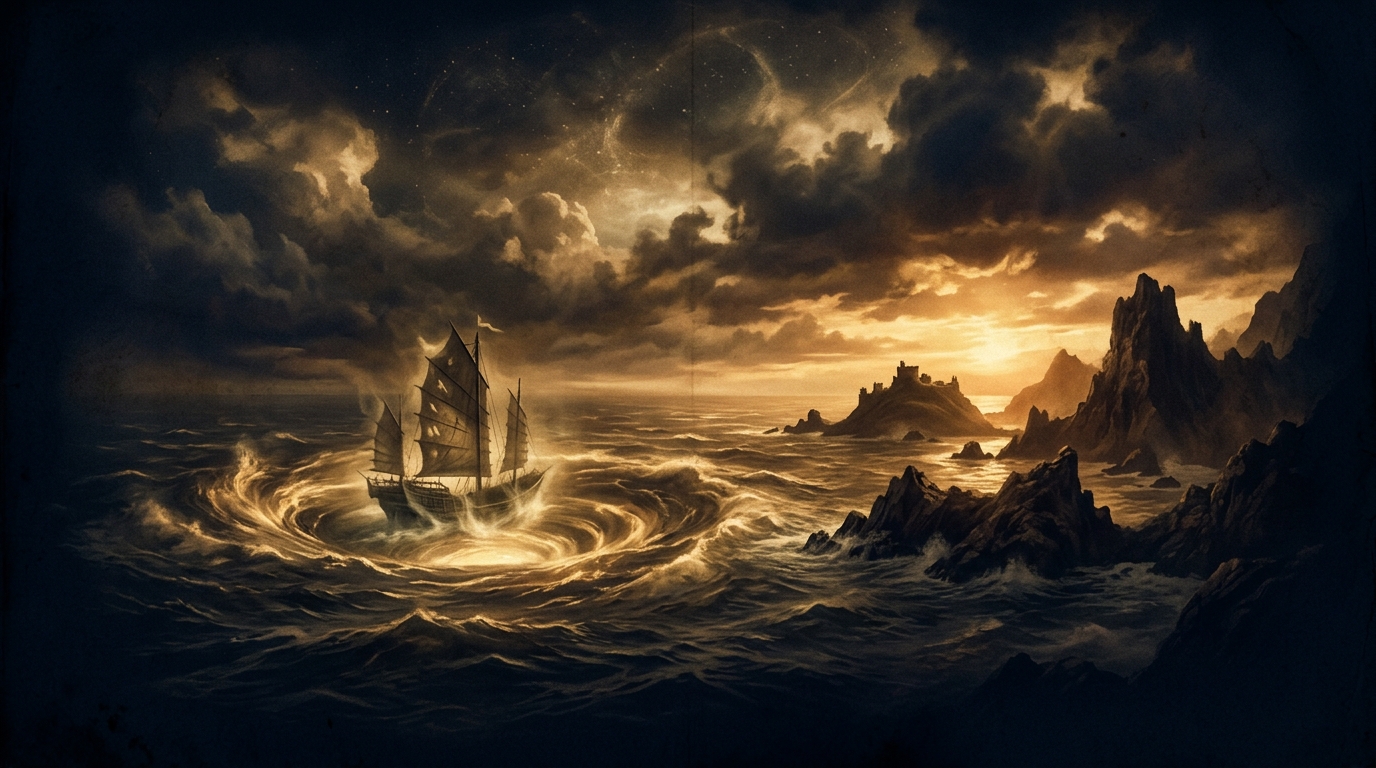
 Codex Illustration
Devil's Sea
A roughly triangular expanse of the western Pacific Ocean south of Japan — sometimes called the Dragon's Triangle — has accumulated centuries of maritime folklore and mid-twentieth-century disappearance claims that sit uneasily between documented geological hazard and elaborated legend.
Overview
The Devil's Sea, known in Japanese as Ma-no Umi (魔の海), designates a loosely defined maritime zone generally bounded by the Japanese archipelago to the north, the Bonin and Mariana Islands to the east, and the Ryukyu chain to the west — a region centered roughly between 25° and 35° N latitude and 130° to 145° E longitude. The area sits atop one of the most geologically active stretches of ocean floor on Earth: the Philippine Sea Plate subducts beneath the Eurasian Plate along the Nankai Trough and Ryukyu Trench, producing frequent seismic events, submarine volcanic eruptions, and the periodic emergence and subsidence of short-lived islets. These documented physical processes create genuine navigational hazards — unpredictable currents, methane venting from the seafloor, and sudden weather generated by the interaction of the Kuroshio Current with Pacific storm systems — that provide a plausible geological baseline for a region with a reputation for danger.
The modern, internationally recognized legend of the Dragon's Triangle is largely a twentieth-century construction, given its most influential popular form by Charles Berlitz in his 1989 book 'The Dragon's Triangle,' which framed the zone as a Pacific analogue to his earlier, heavily criticized treatment of the Bermuda Triangle. Berlitz claimed that a Japanese research vessel, the Kaio Maru No. 5, was sent in 1952 by the Japanese government to investigate a series of disappearances and was itself lost with all hands — a claim that has a genuine documentary kernel (the Kaio Maru No. 5 was indeed lost in September 1952 near the volcanic seamount Myojin-sho), but whose wider context Berlitz significantly embellished. Critically, the vessel's loss coincided with a documented submarine volcanic eruption at Myojin-sho, a fact well attested in Japanese maritime and geological records and offering a straightforward, if tragic, natural explanation.
The broader claim — that an anomalous cluster of ship and aircraft disappearances distinguishes the Devil's Sea from comparable stretches of open ocean — has not survived rigorous scrutiny. Lloyd's of London insurance records, cited by skeptical researchers including Lawrence David Kusche (author of 'The Bermuda Triangle Mystery — Solved'), do not show elevated loss rates in the region relative to other heavily trafficked Pacific sea lanes. Many of the incidents catalogued by Berlitz and subsequent popular writers either lack documentary confirmation, occurred during typhoon season when losses are statistically expected, or involve vessels operating in known volcanic or seismically active subzones. The Japanese Maritime Safety Agency has not, to this author's knowledge, formally designated the Devil's Sea as an anomalous zone in any official capacity — a point frequently elided in popular treatments.
Nevertheless, the region's genuine physical dangers and its deep roots in Japanese and Chinese seafaring tradition make it a legitimate subject of cultural and geological inquiry, separate from the more extravagant paranormal claims layered atop it. Medieval Japanese and Chinese records describe treacherous waters in the general area; Chinese maritime tradition preserves the name Long San Jiao (Dragon's Triangle), associating the region with the legendary sea-dragon (lóng), a creature whose symbolic register is overwhelmingly beneficent in East Asian cosmology — unlike the Western dragon — yet whose domain was understood to be capricious and dangerous. It is this confluence of genuine geological drama, ancient maritime fear, and twentieth-century popular sensationalism that makes the Devil's Sea a case study in how real hazard and cultural imagination reinforce one another, producing legends that outlast any attempt at simple debunking.
Key Claims
Timeline
Evidence
Multiple Perspectives
Biblical Lens
Scripture Threads
Sources & Further Study
Questions to Explore
Go Deeper Path
Follow the Thread
Continue the Investigation
You’ve reached the Full Archive portion of this Case File.
Ask the Archivist
about this fileSign in to ask the Archivist
Create a free account to ask the Archivist 1 grounded question each day, cited straight from the CODEX case files.
Discussion
0Share findings, questions, and evidence with fellow Seekers. Be respectful and cite sources where you can.
No comments yet. Be the first to open this thread.