
 Codex Illustration
Dog Suicide Bridge
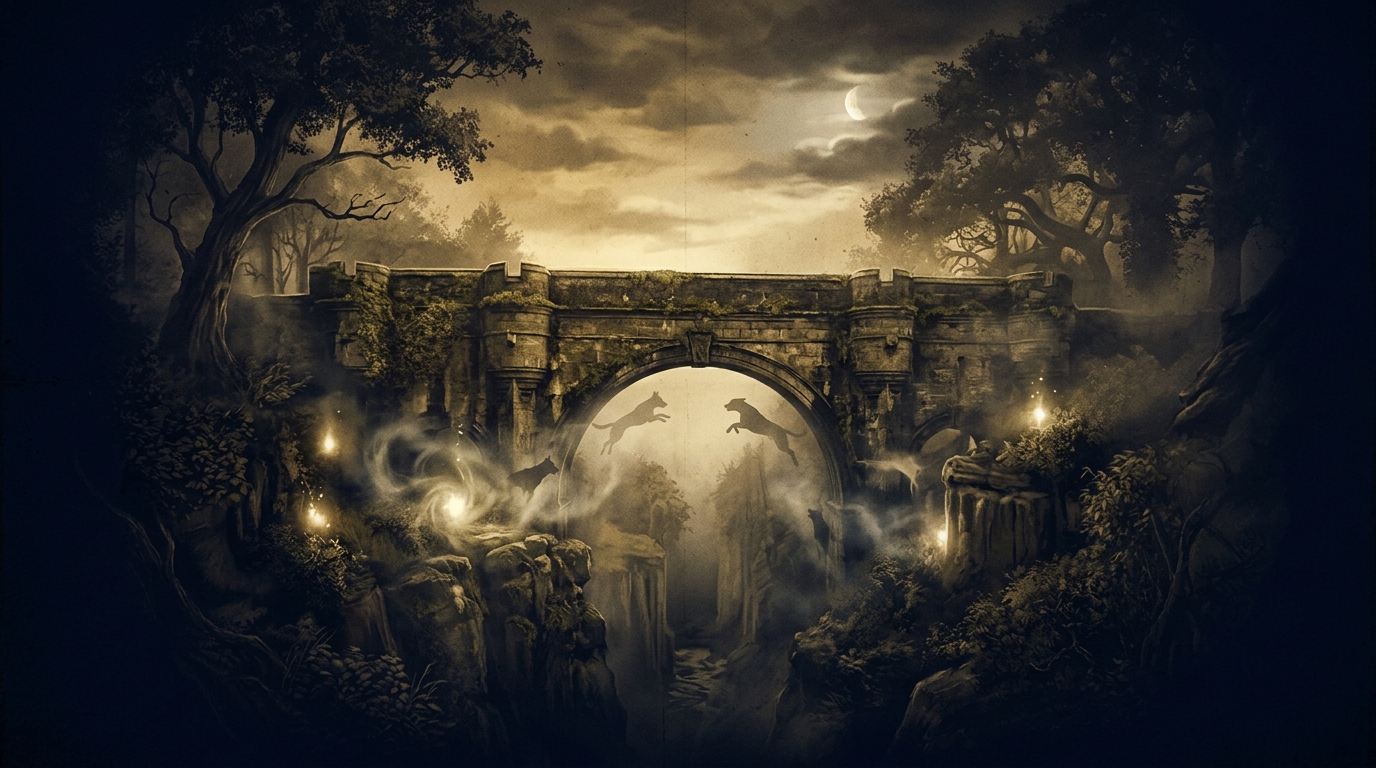
At Overtoun Bridge in Dumbarton, Scotland, dozens of dogs have reportedly leapt from the same narrow parapet over several decades — a phenomenon so consistent and localized that it has drawn scientists, folklorists, and theologians alike into an unresolved debate about animal perception, place-based anomaly, and the boundaries of the explicable.
Overview
Overtoun Bridge, a Victorian-era stone arch spanning the Overtoun Burn in West Dunbartonshire, Scotland, has been the site of a peculiar and distressing phenomenon reported at least since the 1950s and gaining wider public attention in the early 2000s. According to a substantial body of local accounts and journalistic investigation, an unusually high number of dogs — estimates cited in regional press and popular literature range from fifty to over a hundred incidents, with varying fatality rates — have reportedly jumped from the same section of the bridge's parapet wall, almost always from the same side, and frequently in clear weather. The consistency of the location, the species specificity (dogs rather than other animals accompanying their owners), and the apparent absence of an obvious triggering stimulus have made this one of the more genuinely puzzling localized animal behavior anomalies in recent British folklore and popular science discussion. It bears noting at the outset that rigorous, peer-reviewed epidemiological data on the precise number of incidents does not appear to exist in the published scientific literature; most figures circulate through journalism and documentary accounts rather than formal study.
The most widely cited scientific hypothesis, advanced in part through investigative journalism by the Sunday Herald and later examined by animal behaviorist Dr. David Sands, proposes that dogs may be responding to olfactory cues rather than any metaphysical force. The area beneath and around the bridge supports populations of mink, and to a lesser extent, squirrel and field mice — species whose scent-marking compounds, including certain musks and pheromones, could theoretically be powerful enough to override a dog's visual awareness of the drop, particularly breeds with narrow, elevated snouts that direct their nose forward and upward rather than downward. In this framing, the dog's leap is not a death-wish but a predatory lunge, with the animal simply failing to perceive the lethal geometry of the parapet. The specific architectural feature — a solid stone balustrade that obscures the view of the drop until the animal is already in motion — is central to this proposed mechanism. This hypothesis is plausible and internally coherent, though it has not been subjected to controlled experimental verification in peer-reviewed literature, and it remains, formally, an informed working theory rather than an established scientific conclusion.
Paralleling and sometimes intersecting the naturalistic explanations are folkloric and paranormal interpretations that have deep roots in Scottish culture and have been amplified considerably by internet-era storytelling. The Overtoun Estate itself carries a somewhat gothic local history: the Victorian mansion nearby was built by industrialist James White, later became a maternity hospital, and has passed through various uses since, accumulating the kind of layered, discontinuous history that tends to attract legend. Local lore has at times invoked notions of a 'thin place' — a Celtic spiritual concept describing locations where the boundary between the material and spiritual worlds is thought to be unusually permeable — to account for the perceived strangeness. Some accounts, primarily circulating in tabloid and internet contexts, have connected the site to a local man who, in 1994, allegedly threw his infant son from the bridge believing him to be the Antichrist, before attempting suicide himself. This event is documented in Scottish legal records and press coverage of the time, and while it occurred at or near the same structure, researchers caution strongly against treating it as causally related to the dog incidents rather than as a separate, deeply tragic occurrence that has been narratively fused to the bridge's reputation.
The phenomenon resists clean resolution in any single direction. The animal behavior hypothesis is the most empirically grounded available explanation, but it has not been demonstrated to the standard that would permit definitive closure. The folkloric and paranormal interpretations, while culturally rich and psychologically interesting as examples of how human beings narrativize inexplicable animal behavior, lack evidentiary support beyond anecdote and the force of repeated retelling. What the Overtoun Bridge case most clearly illustrates is a convergence of genuine anomaly — dogs do appear to leap from this specific location at a rate that surprises observers — with the human impulse to impose meaning on suffering, and with the difficulty of conducting rigorous behavioral science in the field, on a population of animals whose encounters at a given site are neither controlled nor systematically recorded. It remains, in the most honest scholarly assessment, an unresolved and genuinely curious local mystery.
Key Claims
Timeline
Evidence
Multiple Perspectives
Biblical Lens
Scripture Threads
Sources & Further Study
Questions to Explore
Go Deeper Path
Follow the Thread
Continue the Investigation
You’ve reached the Full Archive portion of this Case File.
Ask the Archivist
about this fileSign in to ask the Archivist
Create a free account to ask the Archivist 1 grounded question each day, cited straight from the CODEX case files.
Discussion
0Share findings, questions, and evidence with fellow Seekers. Be respectful and cite sources where you can.
No comments yet. Be the first to open this thread.