
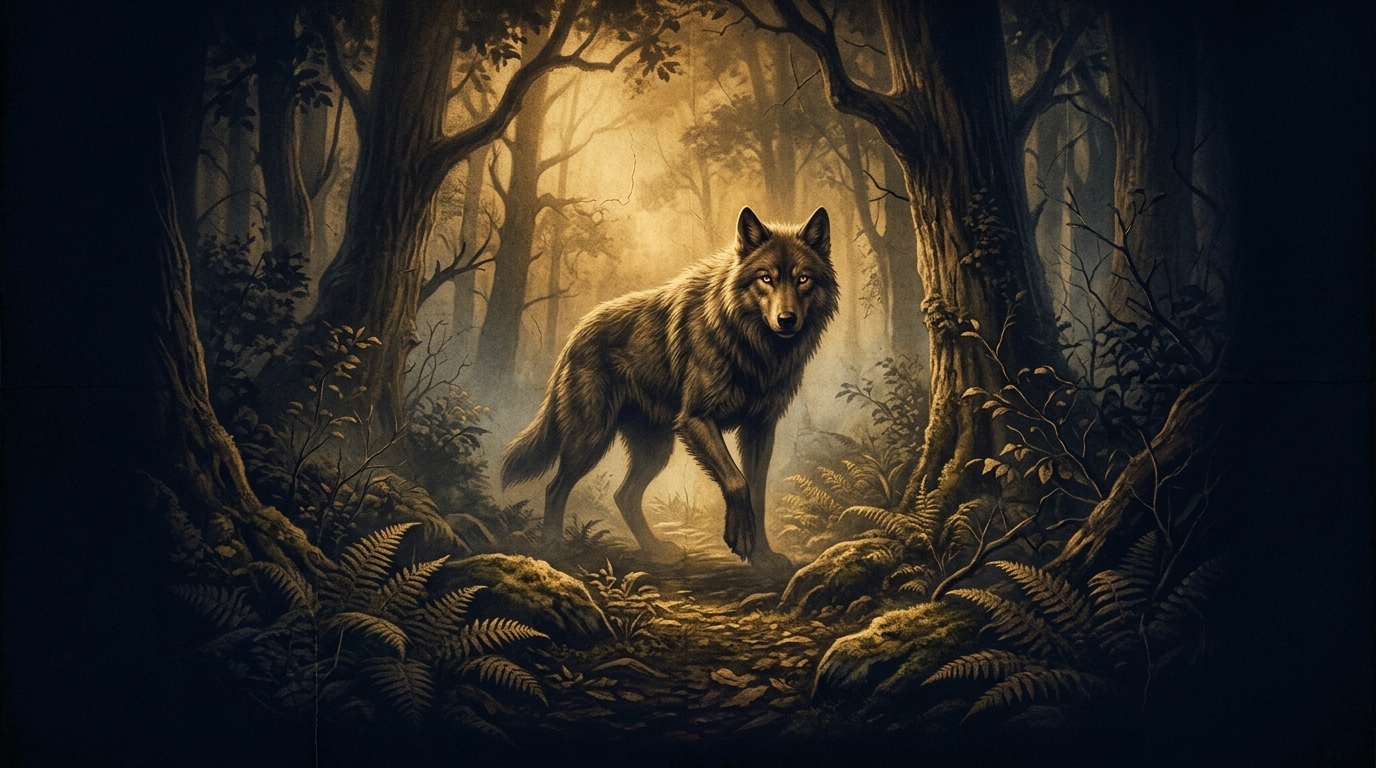
 Codex Illustration
Dogman
Reports of large, bipedal canine creatures — most famously associated with Michigan and Wisconsin — have circulated since the nineteenth century, occupying an unsettling borderland between regional folklore, eyewitness testimony, and the enduring human impulse to populate dark forests with something that should not exist.
Overview
The creature known colloquially as the Dogman first entered durable public consciousness through two overlapping traditions: the Michigan Dogman, centered on the lower peninsula's northwestern counties and popularized in 1987 by radio disc jockey Steve Cook, and the Beast of Bray Road, documented by journalist Linda Godfrey beginning in the late 1980s in Walworth County, Wisconsin. Descriptions across both traditions are strikingly consistent — a creature standing six to seven feet tall when upright, possessing the unmistakable head and muzzle of a large canine, a muscular torso, and the unsettling capacity to walk or run on two legs. Witnesses frequently report an amber or yellowish eye-shine, a rank animal odor, and the creature's apparent indifference to attempts at flight or concealment, as though it regards the human observer with a curious, predatory calm. These accounts, while geographically concentrated in the Great Lakes region, share structural similarities with reports filed across the Appalachians, the Pacific Northwest, and rural Britain, suggesting either a widespread folklore archetype or — as some researchers argue — a genuinely unclassified biological phenomenon operating across broad ecological territories.
The historical record, while thin, is not entirely absent. Indigenous oral traditions from several Algonquian-speaking peoples include accounts of powerful, dangerous beings that blur the boundary between wolf and human form — though it is important not to conflate these culturally specific narratives uncritically with modern cryptid reports. Nineteenth-century newspaper archives from Michigan contain accounts of anomalous canine creatures, though these are difficult to verify and may reflect the sensational journalism of the era. The modern Dogman mythos was substantially shaped by Cook's 1987 novelty song 'The Legend,' broadcast on Traverse City's WTCM-FM as an April Fools' Day piece; Cook himself later acknowledged surprise at the flood of earnest listener responses the broadcast provoked, suggesting either that the song tapped latent existing reports or that it seeded a powerful new narrative in the regional imagination. Linda Godfrey's investigative work, beginning with a 1991 article in The Week newspaper and culminating in multiple published books, attempted to apply journalistic discipline to witness testimony, interviewing dozens of people who claimed encounters with the Bray Road creature.
From a zoological and biological standpoint, the mainstream scientific consensus is clear: no specimen, no verifiable physical evidence — track casts of sufficient quantity, hair samples with confirmed anomalous DNA, or remains — has met the evidentiary standard necessary to establish a new large mammal species in North America. Bears walking bipedally, particularly black bears suffering from sarcoptic mange (which can produce a gaunt, strange-silhouetted appearance), account for a significant proportion of identified misidentifications. Large dogs, wolves, and coyotes glimpsed in low-light conditions are also credible explanatory candidates. That said, serious anomalists such as Chad Arment, who applies rigorous zoological methodology to cryptozoology, note that witness cross-examination often reveals details that resist easy mundane explanation — particularly accounts involving creatures observed at close range in daylight by multiple witnesses simultaneously.
The Dogman occupies a peculiar cultural position: it is neither fully domesticated by popular entertainment nor entirely ignored by serious inquiry. It has generated a substantial subculture of field investigators, a dedicated podcast ecosystem, and a regional tourism economy in northwestern Michigan. More intriguingly, some researchers — notably those working at the intersection of cryptozoology and what is sometimes called 'high strangeness' — note that Dogman reports occasionally cluster with other anomalous phenomena: UFO activity, poltergeist disturbances, and encounters that witnesses describe as possessing a distinctly paranormal rather than biological character. Whether this represents confirmation bias, the contaminating effect of internet cross-pollination between anomalous communities, or something genuinely stranger remains entirely unresolved.
Key Claims
Timeline
Evidence
Multiple Perspectives
Biblical Lens
Scripture Threads
Sources & Further Study
Questions to Explore
Go Deeper Path
Follow the Thread
Continue the Investigation
You’ve reached the Full Archive portion of this Case File.
Ask the Archivist
about this fileSign in to ask the Archivist
Create a free account to ask the Archivist 1 grounded question each day, cited straight from the CODEX case files.
Discussion
0Share findings, questions, and evidence with fellow Seekers. Be respectful and cite sources where you can.
No comments yet. Be the first to open this thread.