
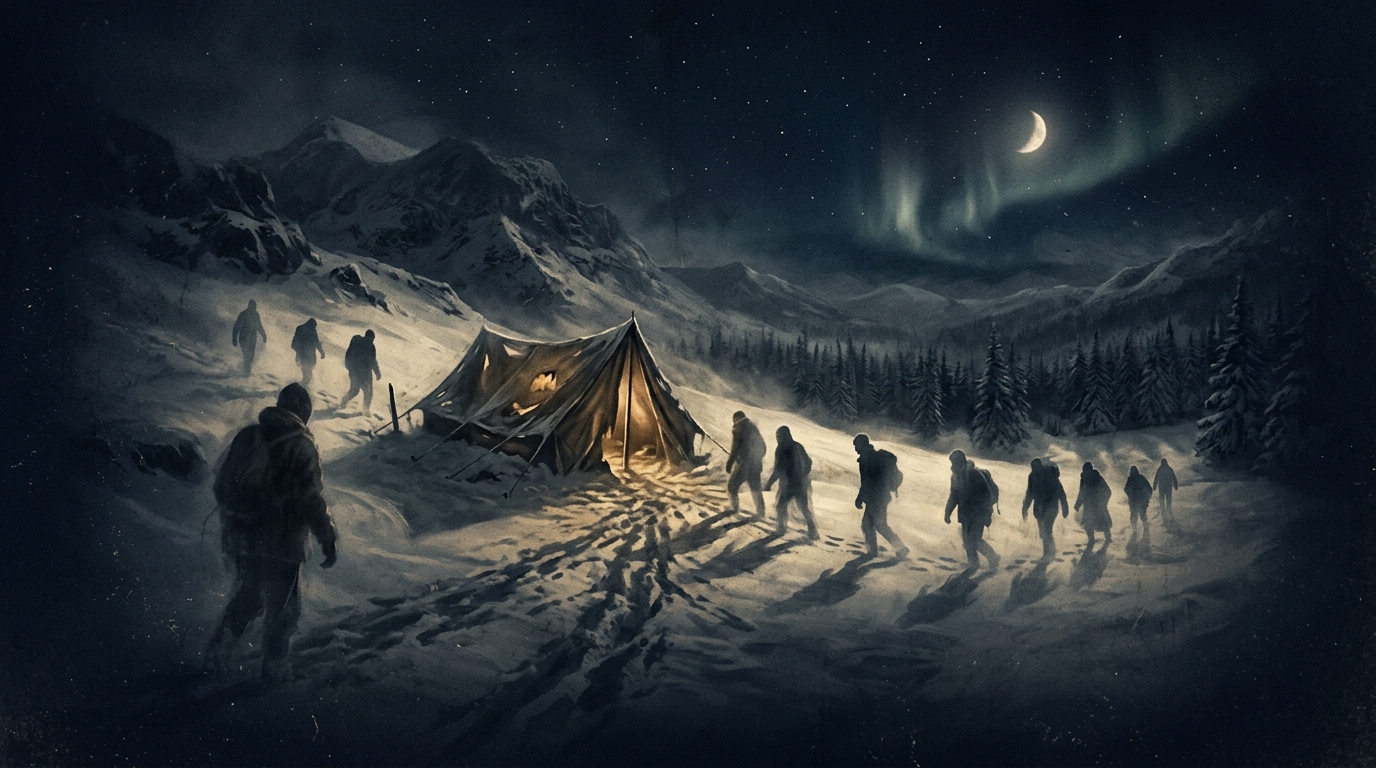
 Codex Illustration
Dyatlov Pass
In February 1959, nine experienced Soviet hikers perished in the northern Ural Mountains under circumstances that remain, despite a 2019 Russian reinvestigation, genuinely contested — their tent slashed open from within, bodies scattered across the snow in states that have resisted any single, universally accepted explanation.
Overview
On the night of 1–2 February 1959, a group of ten ski hikers led by Igor Dyatlov were traversing the eastern slope of Kholat Syakhl — a peak whose name translates from the Mansi language as something approximating 'Mountain of the Dead' — when something compelled them to abandon their tent in temperatures well below freezing. One member, Yuri Yudin, had turned back earlier due to illness and survived to old age. The remaining nine were found dead over the following weeks. The Soviet investigation, conducted hastily and under Cold War pressures for secrecy, concluded the hikers died from an 'unknown compelling force,' a phrase so extraordinary that it has haunted the case ever since. The tent was found cut open from the inside, suggesting a panicked exit rather than an external assault; the hikers were discovered in varying states of undress, spread across a distance of roughly 1.5 kilometers.
The physical evidence is, in part, well-documented: Soviet investigators photographed the scene, recovered bodies, and conducted autopsies. What the evidence does not straightforwardly explain is the pattern of injury. Three of the hikers — Nikolai Thibeaux-Brignolles, Lyudmila Dubinina, and Semyon Zolotarev — suffered severe blunt-force trauma, including fractured ribs and a fractured skull, injuries the medical examiner likened to those produced by a high-velocity impact rather than a human blow. Dubinina's tongue, eyes, and portions of her soft tissue were absent, though forensic investigators have since suggested this is consistent with postmortem decomposition in running water where the body was recovered. These details, amplified over decades, became the scaffold upon which a remarkable variety of theories were constructed.
The Cold War context cannot be overstated. The Ural region was a sensitive military zone; the Plesetsk Cosmodrome was operational, and testing of Soviet missiles over the Urals had been documented in the same period. Witnesses in nearby towns reported strange orange spherical lights in the sky around the time of the incident. The Soviet government sealed the case files until 1990, and even then released an incomplete archive. This institutional opacity, combined with the physical strangeness of the evidence, generated theories ranging from infrasound-induced panic, an avalanche of a specific 'slab' type, secret weapons testing, military involvement, Mansi tribal violence, and — in the more speculative register — extraterrestrial encounter or a physics experiment gone wrong. Each theory resolves some evidence while leaving other data unaccounted for.
In 2019, the Russian Prosecutor General's office reopened the case and, after several months of investigation, concluded that a slab avalanche was the most probable cause — specifically a delayed avalanche triggered by wind-deposited snow overloading a cut made in the snowpack when the hikers erected their tent. This conclusion, supported by computational modeling published in the journal Communications Earth & Environment (Gaume and Puzrin, 2021), provides a plausible mechanical explanation for both the tent evacuation and some of the severe blunt-force injuries. Critics, however, note that no avalanche debris was observed at the scene and that the slope gradient is generally considered too gentle for a spontaneous slab release. The case thus remains, in the precise language of the responsible scientist, a matter of strong hypothesis rather than settled fact — a cold-case dossier in which the most honest answer acknowledges multiple unresolved variables.
Key Claims
Timeline
Evidence
Multiple Perspectives
Biblical Lens
Scripture Threads
Sources & Further Study
Questions to Explore
Go Deeper Path
Follow the Thread
Continue the Investigation
You’ve reached the Full Archive portion of this Case File.
Ask the Archivist
about this fileSign in to ask the Archivist
Create a free account to ask the Archivist 1 grounded question each day, cited straight from the CODEX case files.
Discussion
0Share findings, questions, and evidence with fellow Seekers. Be respectful and cite sources where you can.
No comments yet. Be the first to open this thread.