
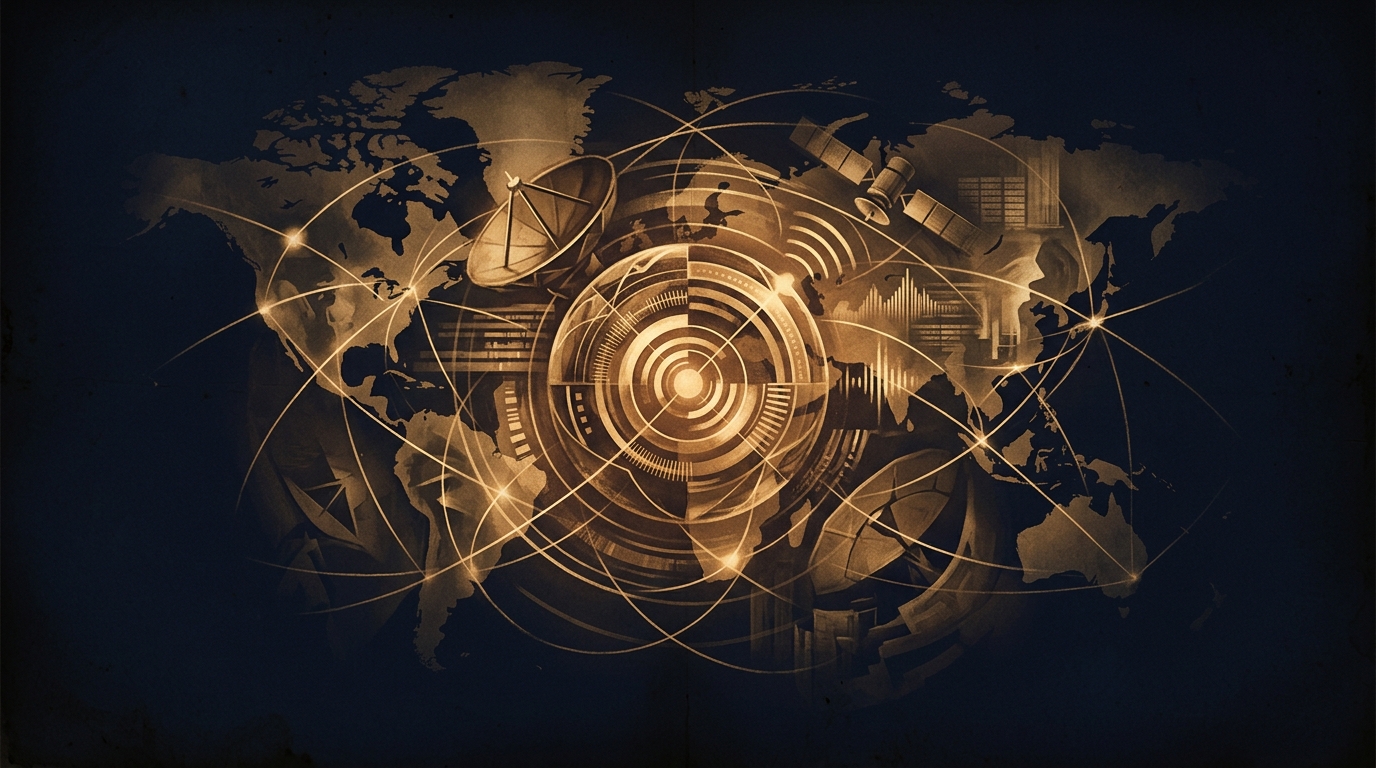
 Codex Illustration
ECHELON Surveillance Network
ECHELON is a documented global signals-intelligence collection and analysis system developed by the UKUSA alliance — a network capable of intercepting vast streams of civilian and governmental communications, whose full scope remained officially denied for decades before partial declassification confirmed its existence.
Overview
For much of the late twentieth century, ECHELON occupied an unusual position: simultaneously one of the most consequential intelligence architectures in history and one of the most thoroughly denied. Developed under the UKUSA Agreement — a signals-intelligence (SIGINT) compact originally signed between the United States and the United Kingdom in 1946, later expanded to include Canada, Australia, and New Zealand (the so-called Five Eyes) — ECHELON evolved from wartime code-breaking partnerships into a globe-spanning network of satellite ground stations, undersea cable intercept points, and listening posts capable of vacuuming up telephone calls, faxes, telexes, email traffic, and eventually internet data on an almost incomprehensible scale. Ground stations at Menwith Hill in North Yorkshire, Pine Gap in Australia's Northern Territory, Waihopai in New Zealand, and Leitrim in Canada formed the physical backbone of a system that, by credible journalistic and parliamentary accounts, processed millions of intercepted signals daily through automated keyword-filtering software.
The architecture of ECHELON, as reconstructed by investigative journalists and later confirmed in broad outline by official European inquiries, was not merely passive eavesdropping. A 2001 report commissioned by the European Parliament — formally titled 'Development of Surveillance Technology and Risk of Abuse of Economic Power' and produced under rapporteur Gerhard Schmid — concluded with high confidence that ECHELON existed as a global interception system and that it had been used, among other purposes, for commercial and economic espionage benefiting American and British corporations. The report named specific alleged cases in which intelligence derived from intercepted communications was forwarded to private companies, including defense contractors. Critically, this was not fringe journalism: it was a formal finding of a legislative body of the European Union, grounded in testimony, open-source SIGINT research, and the work of researchers such as Duncan Campbell and Nicky Hager.
The technological lineage of ECHELON traces back to the SIGINT cooperation frameworks of World War II, particularly the collaboration between Bletchley Park and American cryptanalysts that cracked Axis codes and produced the intelligence product known as ULTRA. After the war, the UKUSA Agreement institutionalized that partnership, creating a permanent architecture for signals sharing. Over subsequent decades — through the Cold War intercept of Soviet military communications, the targeting of commercial satellite traffic via INTELSAT, and eventually the mass collection of internet backbone traffic — the system expanded in both scope and sophistication. By the 1990s, the combination of keyword-dictionary systems, voice recognition, and optical character recognition allowed near-automated triage of intercepted material at a scale no human workforce could accomplish manually. Documents released by NSA whistleblower Edward Snowden in 2013, while not specifically describing ECHELON by name, revealed successor programs — PRISM, MUSCULAR, TEMPORA — that operated on the same foundational logic: collect broadly, filter algorithmically, retain selectively.
What remains genuinely contested is the precise operational scope: which allied governments were surveilled without their knowledge, which private citizens were targeted, and to what degree the keyword-dictionary system produced meaningful intelligence versus oceans of irrelevant data. Skeptics within the intelligence community have argued that the system's practical value was frequently overstated by critics, and that the signal-to-noise challenge of mass collection made ECHELON less omniscient than its most alarmed portrayals suggested. Nonetheless, the fundamental fact of a coordinated, globe-spanning interception infrastructure operated by anglophone democracies — for decades without meaningful public oversight or judicial constraint — is no longer seriously disputed by any credible scholarly or governmental source. ECHELON passed from conspiracy theory into documented history, a transition that itself carries considerable weight for students of government transparency and civil liberties.
Key Claims
Timeline
Evidence
Multiple Perspectives
Biblical Lens
Scripture Threads
Sources & Further Study
Questions to Explore
Go Deeper Path
Follow the Thread
Continue the Investigation
You’ve reached the Full Archive portion of this Case File.
Ask the Archivist
about this fileSign in to ask the Archivist
Create a free account to ask the Archivist 1 grounded question each day, cited straight from the CODEX case files.
Discussion
0Share findings, questions, and evidence with fellow Seekers. Be respectful and cite sources where you can.
No comments yet. Be the first to open this thread.