
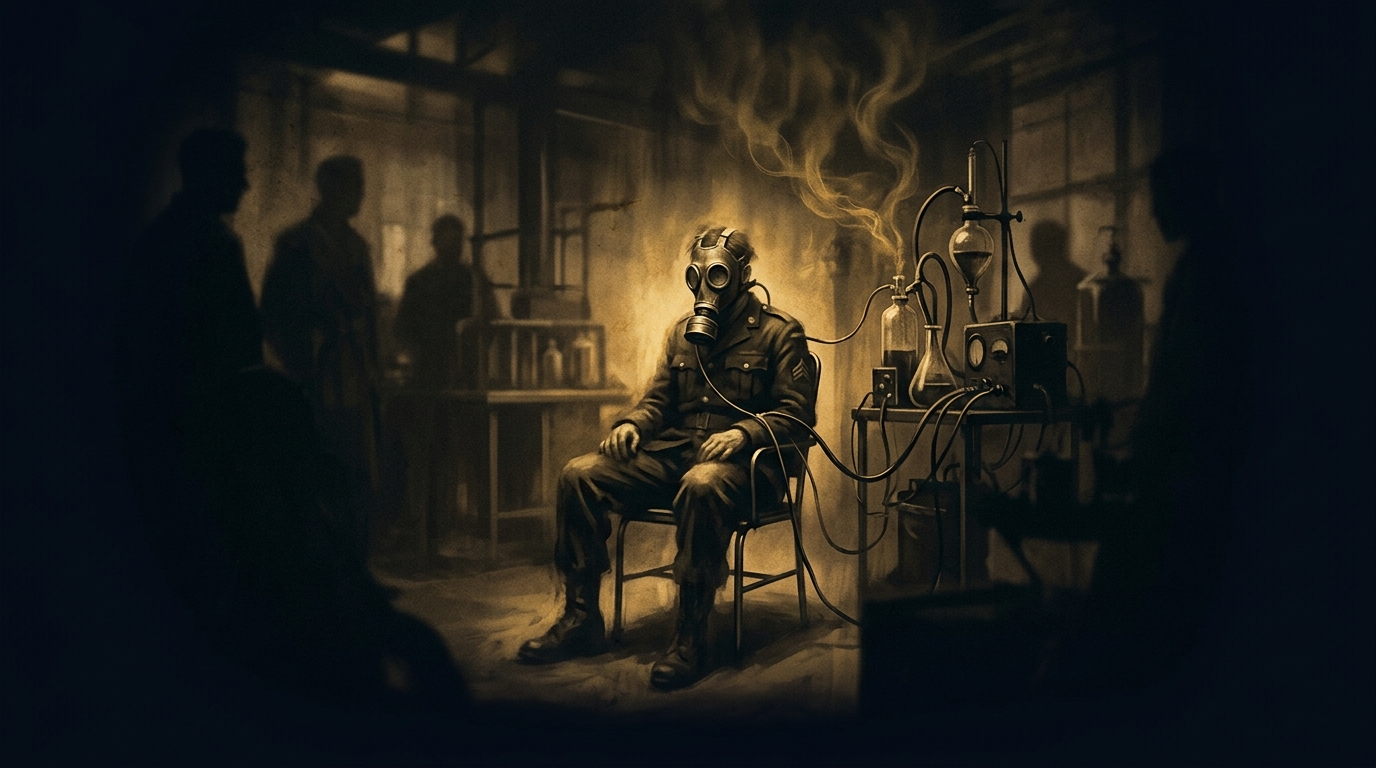
 Codex Illustration
Edgewood Arsenal Human Experiments
Between roughly 1948 and 1975, the United States Army conducted classified chemical and pharmacological experiments on thousands of American military personnel at Edgewood Arsenal, Maryland — a documented chapter of Cold War history that raises enduring questions about state power, informed consent, and the limits of human dignity.
Overview
Edgewood Arsenal, situated on a sprawling military installation along the Chesapeake Bay in Maryland, served for decades as the primary research center for the U.S. Army's Chemical Corps. What took place within its secure perimeter during the Cold War era was, by any measure, extraordinary: between approximately 1948 and 1975, an estimated 6,700 to 7,000 American military volunteers — and, by some accounts, a small number of non-volunteers — were exposed to a range of chemical warfare agents and psychoactive substances under controlled experimental conditions. The agents tested included nerve agents such as sarin and VX, incapacitating chemicals such as BZ (3-quinuclidinyl benzilate), psychedelics including LSD, and a variety of sedatives, stimulants, and anticholinergic compounds. The program's stated purpose was defensive: to understand the physiological and psychological effects of potential chemical weapons so that American forces could develop effective countermeasures, protective equipment, and antidotes. This rationale was genuine in part, but the experimental framework within which it operated remained hidden from public scrutiny for years.
The experiments were conducted under the auspices of the Army's Chemical and Biological Warfare Laboratories, which collaborated at various points with the CIA — most notably in programs that overlapped in methodology and personnel with Project MKUltra, the CIA's parallel and notorious mind-control research initiative. Documents declassified in the 1970s and obtained through congressional investigation and Freedom of Information Act requests revealed that many participants received little or no meaningful informed consent, that follow-up medical monitoring was inconsistent or absent, and that some veterans reported lasting psychological and physical harm. A pivotal 1975 Senate subcommittee investigation, led in part by Senator Edward Kennedy's staff in the aftermath of the Church Committee hearings, brought substantial documentation into the public record. The Army, to its credit, cooperated with portions of this investigation, though critics argued that the full scope of the program was never comprehensively disclosed.
The long-term health consequences for participants remain genuinely contested in the scientific literature. A series of follow-up studies conducted by the National Academy of Sciences — most notably a comprehensive report published in 1982 and revised in subsequent decades — attempted to assess whether veterans who participated in the experiments had suffered elevated rates of neurological disorders, cancers, or psychiatric conditions. The findings were mixed and methodologically complicated by the passage of time, incomplete records, and the difficulty of isolating variables in a population exposed to multiple agents. A significant 2003 follow-up study, commissioned by the Department of Veterans Affairs and conducted through the National Academy of Sciences, found some evidence of elevated health risks in certain subgroups but stopped short of definitive causal conclusions. Veterans who sought benefits related to their participation faced a bureaucratic landscape that many described as obstructive, and legal efforts to compel the Army to notify former test subjects of their specific exposures extended into the 2000s.
Edgewood Arsenal represents one of the more thoroughly documented cases of state-sanctioned experimentation on its own citizens during the Cold War — a period in which the perceived existential threat of Soviet chemical and psychological warfare capabilities generated institutional pressures that eroded conventional ethical guardrails. The program predates the formalization of federal human subjects research regulations (which emerged significantly from the 1979 Belmont Report), and its architects operated within a regulatory vacuum that, in retrospect, permitted serious abuses. Alongside MKUltra, the Tuskegee Syphilis Study, and Operation Sea-Spray (atmospheric biological agent testing over San Francisco), Edgewood Arsenal occupies a specific and sobering place in the history of covert government science — not a conspiracy theory, but a documented institutional failure with real human costs.
Key Claims
Timeline
Evidence
Multiple Perspectives
Biblical Lens
Scripture Threads
Sources & Further Study
Questions to Explore
Go Deeper Path
Follow the Thread
Continue the Investigation
You’ve reached the Full Archive portion of this Case File.
Ask the Archivist
about this fileSign in to ask the Archivist
Create a free account to ask the Archivist 1 grounded question each day, cited straight from the CODEX case files.
Discussion
0Share findings, questions, and evidence with fellow Seekers. Be respectful and cite sources where you can.
No comments yet. Be the first to open this thread.