
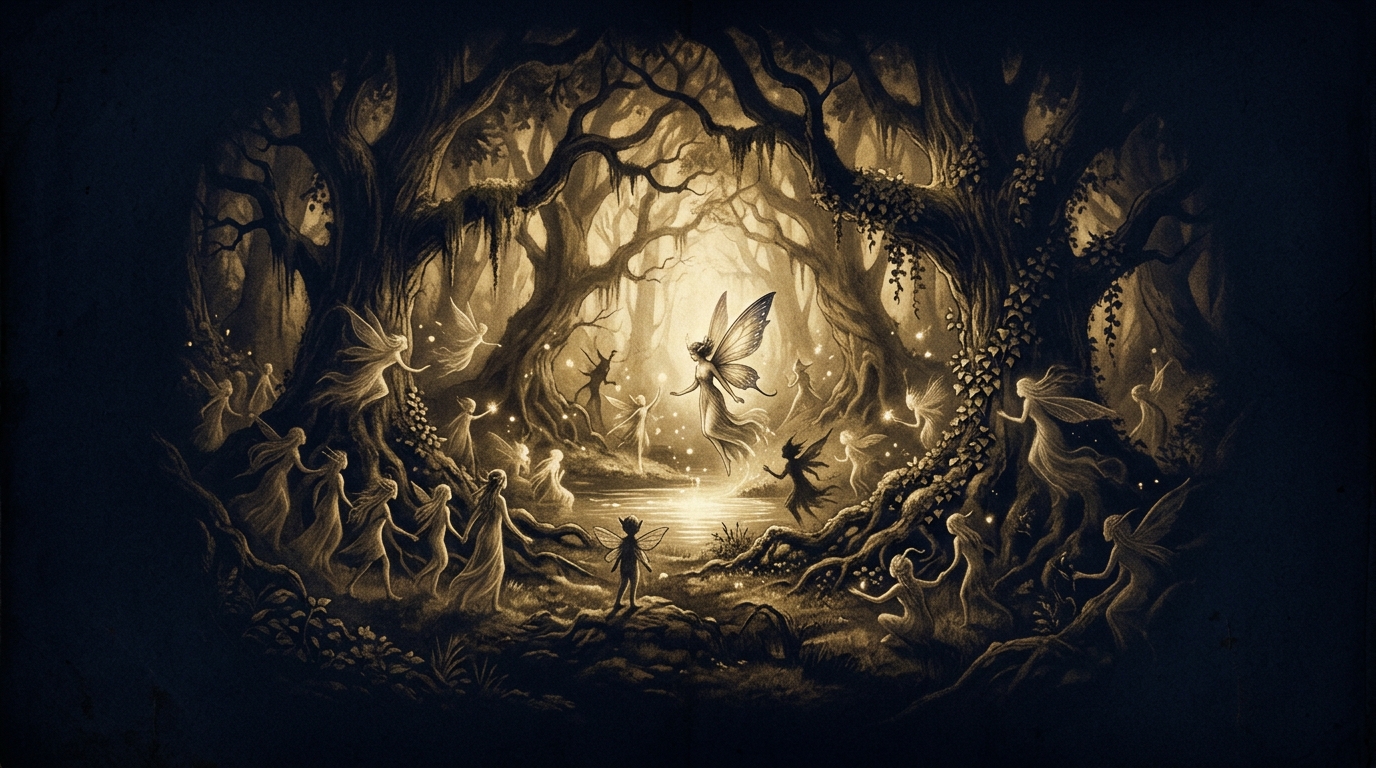
 Codex Illustration
Fairies and the Fae
Across Celtic, Germanic, and broader Indo-European traditions, the Fae—ethereal, capricious beings inhabiting a liminal realm between the human and the divine—occupy a peculiar space in the history of the supernatural, too persistent to dismiss as mere fancy and too ambiguous to classify with theological precision. Their stories encode deep human anxieties about unseen powers, stolen children, forbidden places, and the dangerous allure of an Other world just beyond ordinary perception.
Overview
The belief in fairy-like beings is among the most widespread and enduring in recorded folklore, appearing in the Celtic traditions of Ireland, Scotland, Wales, and Brittany, in Norse mythology as the álfar (elves) and huldufólk (hidden people), in German legends of the Wichtelmänner, and in cognate traditions stretching across Slavic, Scandinavian, and even Near Eastern cultures. The word 'fairy' itself derives ultimately from the Latin 'fata' (the Fates), passing through Old French 'faerie' to denote both the beings and the enchanted state they induce. Medieval and early modern Europeans did not generally regard these entities as fictional: they were treated with practical caution, propitiated with offerings of milk or cream, and blamed for very real misfortunes including illness, crop failure, and the substitution of human infants with 'changelings.'
Scholars have proposed numerous frameworks for understanding fairy belief. The euhemerist tradition, popularized by figures such as David MacRitchie in 'The Testimony of Tradition' (1890), argued that fairy legends preserve garbled memories of a displaced pre-Celtic or Neolithic people who retreated underground or into remote areas. Folklorists such as Katharine Briggs catalogued the extraordinary diversity of fairy typology—from the majestic Tuatha Dé Danann of Irish mythology to the malevolent Each-Uisge (water horse)—demonstrating that 'fairy' is an umbrella term covering beings of vastly different character and cosmological status. More recently, scholars of religion such as Emma Wilby have argued, in 'Cunning Folk and Familiar Spirits' (2005), that fairy encounters reported in early modern witch trials carry the internal consistency of genuine altered-state experiences, raising questions about shamanic contact with non-human intelligences.
The ontological question—what, if anything, fairies actually are—has attracted serious thinkers well beyond the boundaries of folklore studies. C. S. Lewis and J. R. R. Tolkien both engaged fairy-lore as a vehicle for theological and philosophical reflection. Tolkien's essay 'On Fairy-Stories' (1947) argued that fairy tales participate in a 'eucatastrophic' structure that points toward deeper metaphysical realities. The ufologist and computer scientist Jacques Vallée proposed in 'Passport to Magonia' (1969) that fairy encounter narratives share structural and phenomenological features with modern UFO abduction accounts—including missing time, physical marks on the body, and the return of abductees bearing strange gifts or afflictions—suggesting both may represent contact with the same class of non-human intelligences operating across different cultural vocabularies.
Within the biblical and theological tradition, fairies occupy an ambiguous position. They are neither angels nor demons in any straightforward sense, yet early Christian missionaries in the British Isles consistently identified them with fallen angels, demons, or the spirits of the unbaptized dead. Some Irish traditions explicitly equate the Tuatha Dé Danann—the divine or semi-divine beings who preceded human inhabitants of Ireland—with fallen angels who were cast from heaven but did not fall as far as Satan, occupying an intermediate realm. This conceptual zone of 'intermediate beings' resonates with the broader ancient Near Eastern and Second Temple Jewish cosmology of a graded spiritual hierarchy, which scholars like Michael Heiser have illuminated through engagement with texts from Ugarit, the Dead Sea Scrolls, and the Book of Enoch.
Timeline
Evidence
Multiple Perspectives
Biblical Lens
Scripture Threads
Sources & Further Study
Questions to Explore
Follow the Thread
Continue the Investigation
You’ve reached the Full Archive portion of this Case File.
Ask the Archivist
about this fileSign in to ask the Archivist
Create a free account to ask the Archivist 1 grounded question each day, cited straight from the CODEX case files.
Discussion
0Share findings, questions, and evidence with fellow Seekers. Be respectful and cite sources where you can.
No comments yet. Be the first to open this thread.