
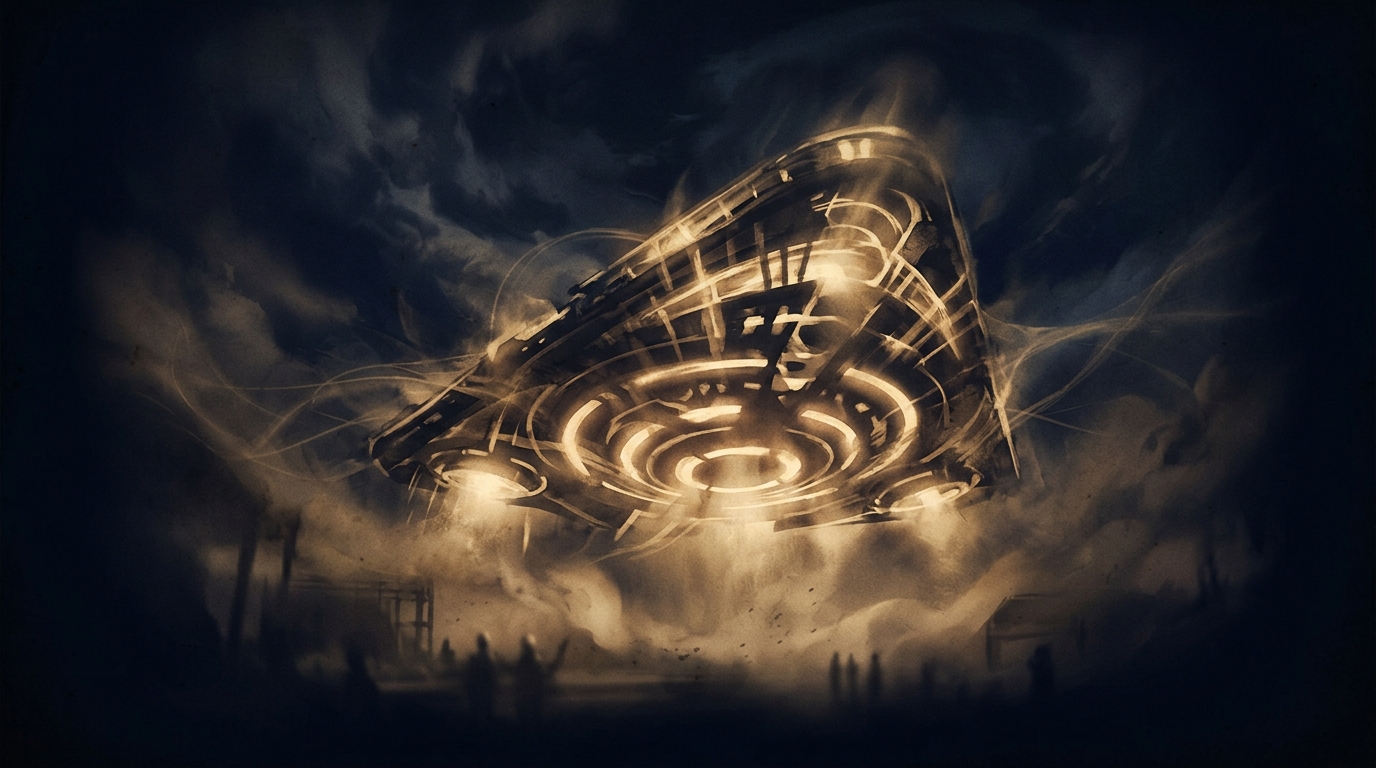
 Codex Illustration
Fluxliner Anti-Gravity Craft
The Fluxliner — also called the Alien Reproduction Vehicle (ARV) — is a claimed reverse-engineered anti-gravity craft described by aerospace industry insider Mark McCandlish, who alleged he received a detailed eyewitness account of three such craft displayed at Norton Air Force Base in 1988. Whether testimony of genuine black-program technology or an elaborate confabulation, the Fluxliner sits at the intersection of Cold War secrecy, exotic propulsion research, and enduring questions about what governments may quietly know.
Overview
In December 1988, an airshow reportedly held at Norton Air Force Base in California allegedly featured a classified exhibit accessible only to individuals with the highest security clearances. According to aerospace illustrator and designer Mark McCandlish, his colleague Brad Sorensen attended this event and described witnessing three disc-shaped craft — two resting on the floor and one hovering silently above the hangar deck — alongside a congressman and officials McCandlish would not name. McCandlish subsequently produced remarkably detailed technical illustrations of what he called the Alien Reproduction Vehicle, or ARV, arguing the craft derived its propulsion from high-voltage electromagnetic fields generating a Biefeld-Brown-type effect — a controversial phenomenon in which high-voltage asymmetric capacitors appear to produce thrust in a direction that some researchers have characterized, with significant dispute, as a form of electrokinetic propulsion or ionic wind rather than true anti-gravity.
The claimed design is specific enough to be striking: a central column housing a mercury plasma vortex, layered capacitor rings arranged in concentric tiers, and a superconductive outer hull intended to trap and amplify an internal electromagnetic field. McCandlish alleged that the technology was not extraterrestrial in origin but rather reverse-engineered from recovered non-human craft — a hypothesis he associated with the broader classified aerospace community and with figures such as physicist and controversial whistleblower Bob Lazar, who separately claimed to have worked on recovered craft at a site near Area 51. These claims exist entirely outside peer-reviewed scientific literature, and no independent corroboration of the Norton hangar display has ever surfaced through declassified documents or verified witness testimony beyond McCandlish's account of Sorensen's description.
The scientific literature on related propulsion concepts is modest but real. The Biefeld-Brown effect was documented to some degree by Thomas Townsend Brown beginning in the 1920s, and NASA and various aerospace laboratories have studied electrokinetic lifters and ionic thrusters in subsequent decades. A 2004 study by NASA's Glenn Research Center and papers published in peer-reviewed journals have generally concluded that observed thrust effects in Biefeld-Brown-type experiments are accounted for by ionic wind — the movement of ionized air molecules — rather than any coupling with gravitational fields. True anti-gravity, in the sense of a technology that modulates or cancels gravitational force, has no established empirical basis in accepted physics, though the theoretical possibility of gravitomagnetic fields described by general relativity remains an area of legitimate fringe inquiry.
What makes the Fluxliner narrative culturally durable is the institutional context into which it fits. The existence of genuine black programs — aircraft and technologies developed in complete secrecy, sometimes for decades, before partial acknowledgment — is a documented historical reality. The U-2, the SR-71 Blackbird, the B-2 Spirit, and the F-117 Nighthawk were all highly classified for extended periods, and their development generated genuine UFO reports when test flights were misidentified. This documented pattern of secret aviation programs creates a rational background condition that makes extraordinary claims about undisclosed propulsion research at least superficially plausible to careful observers, even when those claims far exceed anything the evidentiary record can support. McCandlish himself testified before informal congressional briefings on UAP and appeared in significant documentary productions before his death in 2021, ensuring the Fluxliner narrative remains embedded in the broader modern UAP disclosure conversation.
Key Claims
Timeline
Evidence
Multiple Perspectives
Biblical Lens
Scripture Threads
Sources & Further Study
Questions to Explore
Go Deeper Path
Follow the Thread
Continue the Investigation
You’ve reached the Full Archive portion of this Case File.
Ask the Archivist
about this fileSign in to ask the Archivist
Create a free account to ask the Archivist 1 grounded question each day, cited straight from the CODEX case files.
Discussion
0Share findings, questions, and evidence with fellow Seekers. Be respectful and cite sources where you can.
No comments yet. Be the first to open this thread.