
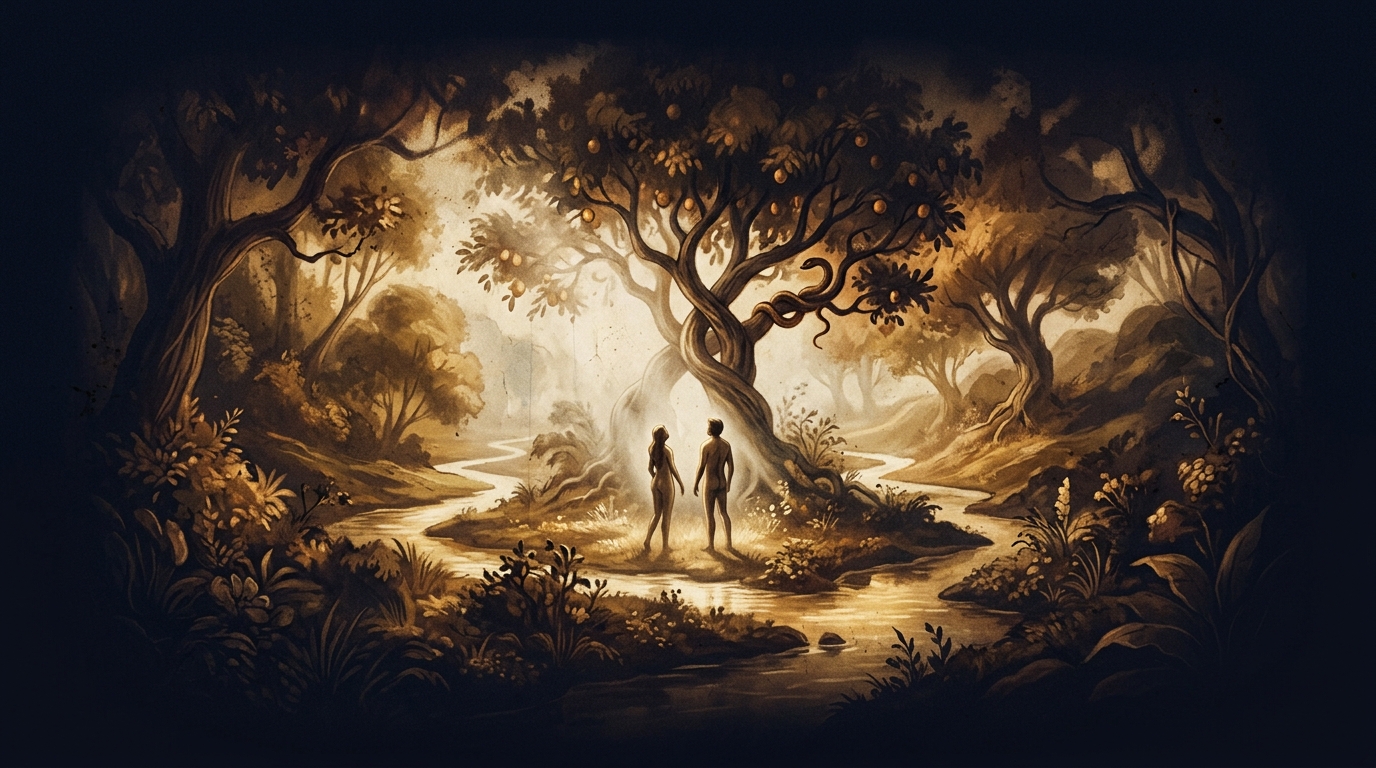
 Codex Illustration
Garden of Eden
The Garden of Eden stands at the threshold of recorded memory — a primordial paradise described in Genesis 2-3 as humanity's first home, whose precise location has eluded geographers, theologians, and archaeologists for millennia, generating competing theories ranging from drowned Persian Gulf oases to Armenian highlands to purely symbolic cosmic space.
Overview
Genesis 2 situates the Garden of Eden with apparent geographical precision, naming four rivers — the Pishon, Gihon, Hiddekel (Tigris), and Euphrates — that flow from a single source within a region called Eden. Two of those rivers are historically identifiable: the Tigris and Euphrates drain the Mesopotamian heartland, anchoring the text within a recognizable Near Eastern landscape. The Pishon and Gihon, however, resist straightforward identification. Ancient interpreters proposed candidates ranging from the Nile and the Ganges to now-vanished waterways, and the ambiguity has never been resolved to scholarly consensus. This geographical puzzle is not incidental to the narrative — it appears deliberately precise, inviting the reader to locate Eden within the real world even as the location defies confident recovery.
Among the most discussed modern proposals is the theory advanced by archaeologist and biblical scholar Juris Zarins in the 1980s and popularized further by scholars engaging remote-sensing data: that Eden may correspond to a now-submerged landscape at the head of the Persian Gulf. During the last Ice Age, sea levels were substantially lower, and satellite imagery has revealed a broad alluvial plain with ancient river channels — potentially the Pishon and Gihon — draining into what is now the northern Gulf. Zarins argued this drowned oasis, situated precisely where the Tigris, Euphrates, and two now-dry riverbeds converge, fits the Genesis description more closely than any surface-level candidate. This hypothesis remains limited rather than confirmed: it is geologically plausible and cartographically suggestive, but not archaeologically verified. A separate tradition, drawing on the associations of Eden with elevated terrain and the Hebrew word for 'delight' or 'luxury,' places the garden in the Armenian highlands near the headwaters of the Tigris and Euphrates — a tradition reflected in some early church fathers and later Eastern Christian geography.
Beyond the geographical debate, a growing body of biblical scholarship reads Eden not primarily as a historical coordinate but as a cosmic-theological category. Old Testament scholars such as Gregory Beale, John Walton, and Michael Heiser have each, from different angles, highlighted the garden's function as an archetypal sacred space — a place where heaven and earth intersect, where God walks with humanity, and where the divine presence is locally manifest. Beale's work in particular traces the garden's architectural and symbolic features — eastward orientation, cherubim guardians, the tree of life at the center — and argues that the tabernacle and later the Jerusalem temple were deliberately designed as Eden-replicas, carrying forward the theological logic of the original sacred space. In this reading, Eden is not merely a lost garden but the first temple, the prototype of every subsequent dwelling place of God among his people.
The narrative of Eden's loss — the serpent's deception, the forbidden tree, the expulsion, and the cherubim set as guardians of the way to the tree of life — carries profound theological weight that has occupied interpreters from the earliest Jewish commentary through patristic Christianity and into contemporary biblical theology. The serpent of Genesis 3, read through the lens of Michael Heiser's Divine Council framework, is understood not merely as a clever animal but as a supernatural being of the divine council, a member of the heavenly assembly who opposes God's purposes on earth. The cherubim stationed at the garden's entrance echo the same heavenly-council imagery found throughout the ancient Near East, where winged guardian figures flank sacred thresholds. Eden's story, on this reading, is the opening chapter of a cosmic conflict that runs through the entire canon — a conflict between the divine administration of creation and those who would subvert it, and a conflict whose resolution is traced through Israel's history toward the eschatological restoration of all things.
Key Claims
Timeline
Evidence
Multiple Perspectives
Biblical Lens
Scripture Threads
Sources & Further Study
Questions to Explore
Go Deeper Path
Follow the Thread
Continue the Investigation
You’ve reached the Full Archive portion of this Case File.
Ask the Archivist
about this fileSign in to ask the Archivist
Create a free account to ask the Archivist 1 grounded question each day, cited straight from the CODEX case files.
Discussion
0Share findings, questions, and evidence with fellow Seekers. Be respectful and cite sources where you can.
No comments yet. Be the first to open this thread.