
 Codex Illustration
Ghost Lights
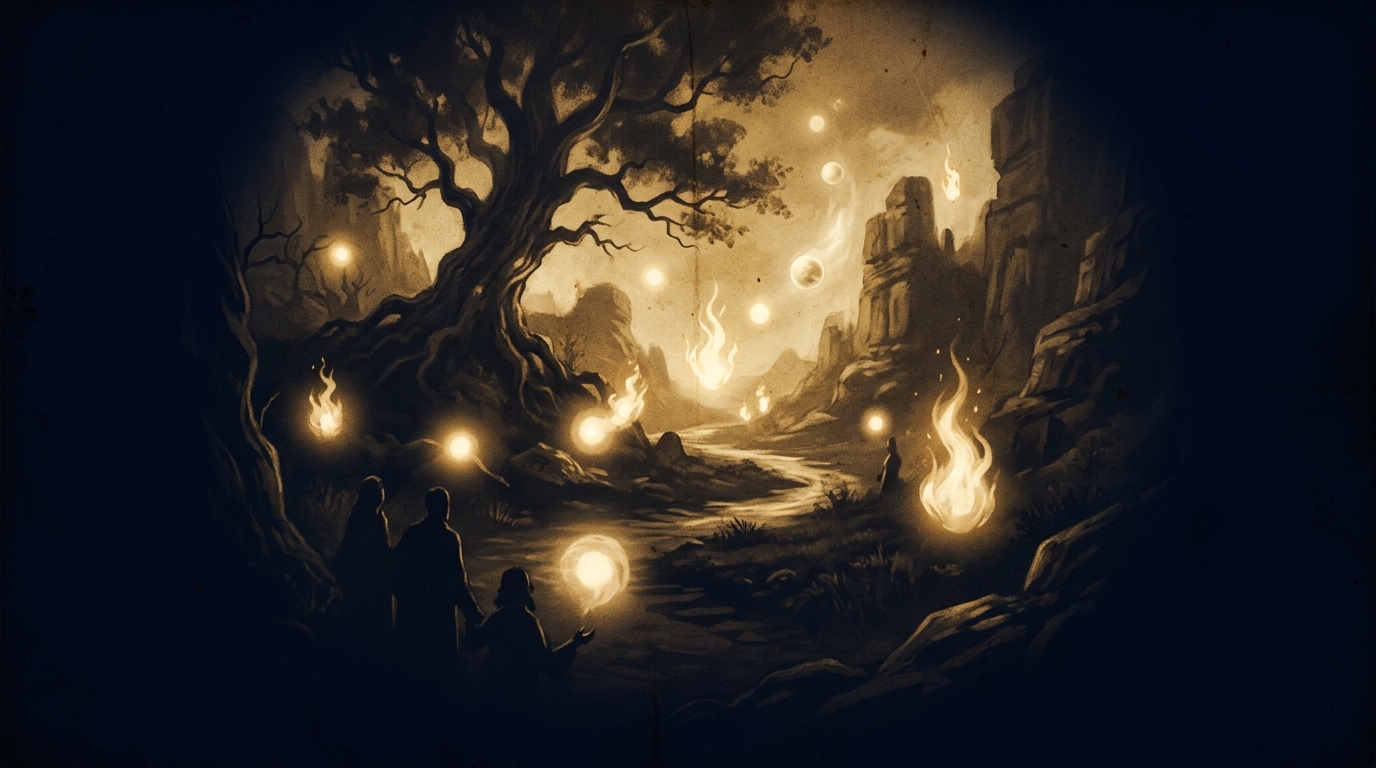
Across every inhabited continent, witnesses have reported mysterious luminous phenomena hovering near the ground — glowing orbs, dancing flames, and drifting spheres that have no universally accepted scientific explanation, yet stubbornly persist in both the historical record and modern instrumentation.
Overview
Ghost lights — known by regional names including will-o'-the-wisps, foo fighters, min min lights, marfa lights, and ignis fatuus — represent one of the most persistent and cross-cultural anomalous phenomena in human history. Unlike many paranormal claims anchored exclusively in eyewitness testimony, ghost lights have been photographed, filmed, and in some cases detected by scientific instruments, lending them an evidentiary weight that elevates them above pure folklore. They are not, however, fully explained. Multiple competing hypotheses — geological, atmospheric, biological, electromagnetic, and psychosocial — each account for some cases while leaving others unresolved. This ambiguity is itself noteworthy: the phenomenon resists tidy categorization, which is part of what has sustained serious scientific interest alongside popular fascination.
The historical record of ghost lights is extraordinarily deep. European literature from the early medieval period onward documents the ignis fatuus, a flickering light observed over marshlands and bogs that was widely interpreted as a spirit of the dead, a demonic lure, or a fairy lantern. In British folklore the phenomenon was personified as 'Jack o' Lantern,' a trickster who led night travelers off safe paths and into bogs or cliffs. Similar traditions appear independently in Scandinavia, West Africa, South and Southeast Asia, and among numerous Indigenous North American nations, suggesting either a universal imaginative response to a real stimulus or a genuinely widespread physical phenomenon — or both. The Australian min min lights, documented by European settlers from the nineteenth century and embedded in Aboriginal oral tradition long before that, share structural similarities with lights reported on the opposite side of the globe, an intercultural consistency that serious researchers have found striking.
In the twentieth century, ghost lights attracted the attention not only of folklorists but of physicists and geologists. Paul Devereux, a British researcher working within the field he helped establish as 'earth lights,' argued in his 1982 book of the same name that certain recurring light phenomena are causally linked to tectonic stress — piezoelectric or plasma-luminescence effects produced by geological strain along fault lines. This hypothesis, while not mainstream within academic geology, has been explored by researchers including Michael Persinger, a neuroscientist at Laurentian University, whose work on electromagnetic fields and their effects on human perception added a neurological dimension: some ghost light sightings, Persinger proposed, may involve genuine electromagnetic events that simultaneously induce altered perceptual states in nearby observers. Persinger's laboratory work using transcranial magnetic stimulation to induce 'sensed presence' experiences has been disputed and partially replicated, making his broader earth-lights model an area of genuine scientific controversy rather than settled science.
Perhaps the most rigorously documented modern case is the Marfa Lights of the Chihuahuan Desert in west Texas. These lights have been observed near Marfa since at least the 1880s, have been featured in peer-reviewed geophysical literature, and are the subject of an ongoing University of Texas study as well as a permanent state-funded observation platform. A 2004 analysis by physics student Karl Stephan, published in the journal *Society of Physics Students*, proposed a mirage-based explanation involving atmospheric temperature inversion and refracted automobile headlights — a hypothesis that accounts for many sightings but struggles to explain historical reports predating motorized vehicles. A separate study by researchers at Sul Ross State University found that some light behavior was consistent with neither simple refraction nor hoaxing, leaving the phenomenon partially open. Ghost lights thus sit at an unusual intersection: documented enough to attract serious inquiry, elusive enough to have defeated definitive explanation.
Key Claims
Timeline
Evidence
Multiple Perspectives
Biblical Lens
Scripture Threads
Sources & Further Study
Questions to Explore
Go Deeper Path
Follow the Thread
Continue the Investigation
You’ve reached the Full Archive portion of this Case File.
Ask the Archivist
about this fileSign in to ask the Archivist
Create a free account to ask the Archivist 1 grounded question each day, cited straight from the CODEX case files.
Discussion
0Share findings, questions, and evidence with fellow Seekers. Be respectful and cite sources where you can.
No comments yet. Be the first to open this thread.