
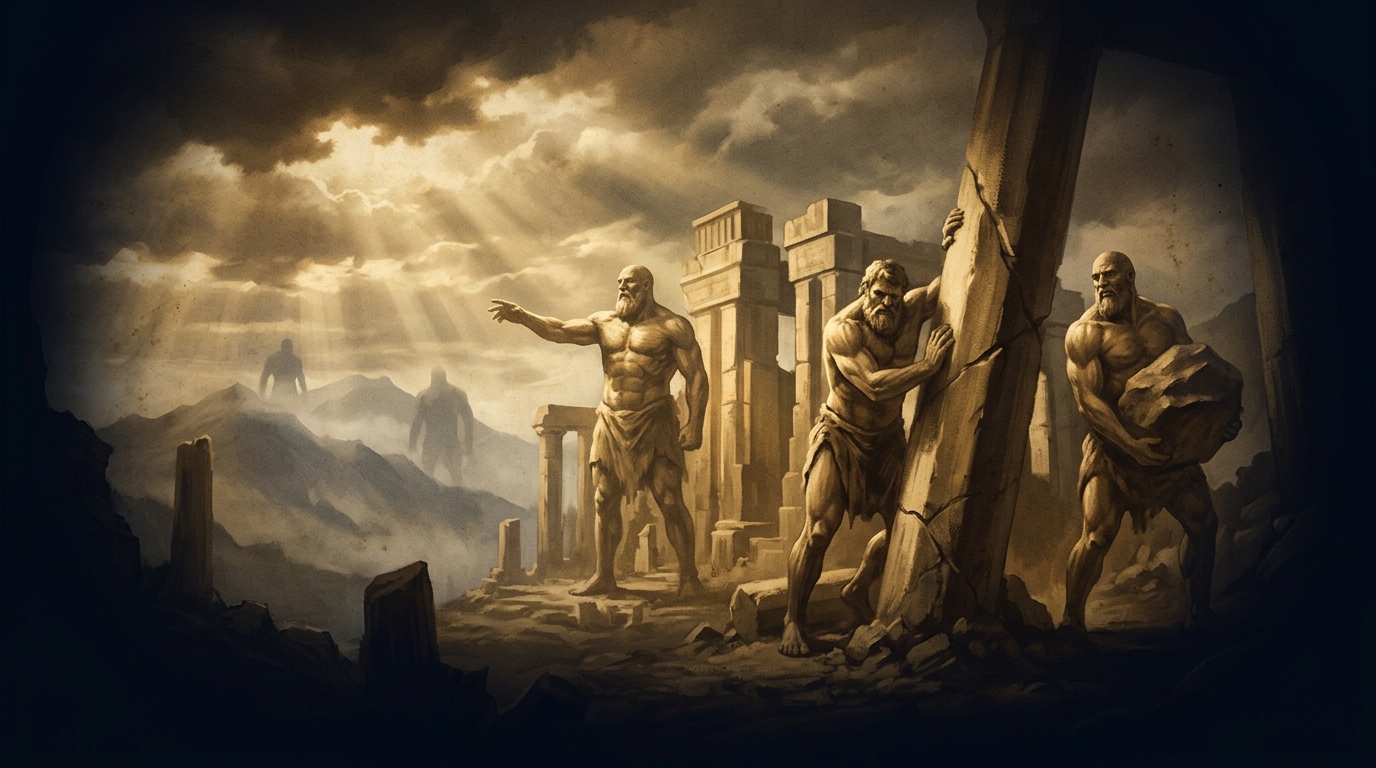
 Codex Illustration
Giants in Antiquity
Across cultures spanning millennia, traditions of giant humans—extraordinary in stature, strength, and sometimes malevolence—appear with striking consistency in scripture, mythology, and archaeology. Whether understood as corrupted divine-human hybrids, folkloric memory of extinct megafauna handlers, or symbolic literary figures, the phenomenon demands serious cross-disciplinary examination.
Overview
The presence of giant-like beings in the ancient record is one of the most persistent and cross-cultural phenomena in the study of antiquity. The Hebrew Bible references several distinct groups: the Nephilim of Genesis 6, the Rephaim of Canaan and Transjordan, the Anakim encountered by the Israelite spies, the Emim, the Zamzummim, and the towering warriors of Philistia slain by David's champions. These are not presented as mythological allegory within the texts themselves but as historical actors encountered by historical peoples. The Deuteronomistic literature in particular treats the giant clans of Canaan as a political and military reality, a fact noted by both confessional and secular biblical scholars.
Beyond the Hebrew tradition, cognate narratives appear across the ancient world. Sumerian king lists assign reigns of tens of thousands of years to pre-flood monarchs, implying a qualitative difference between antediluvian and post-diluvian humanity. The Epic of Gilgamesh presents its hero as two-thirds divine and of exceptional physical scale. Greek tradition preserves the Titans and Gigantomachy—wars between Olympian gods and primordial giant beings—while Celtic, Norse, and Hindu mythologies each contain elaborate cosmologies in which giant races predate or coexist uneasily with both gods and ordinary humans. The near-universal character of these traditions has prompted scholars of comparative mythology, from Georges Dumézil to Calvert Watkins, to treat giant mythology as a genuine archaic stratum of Indo-European and Semitic religious thought.
On the archaeological and physical anthropology side, the evidence is considerably more constrained. No verified skeletal remains of anatomically modern humans exceeding roughly seven feet in height have been confirmed through peer-reviewed physical anthropology as belonging to an ancient giant race. Various excavations in the nineteenth and early twentieth centuries produced claims of oversized skeletons—many republished on the internet as proof of suppressed archaeological discovery—but virtually all traceable examples are misidentified, misreported, or outright fabricated. The Smithsonian Institution has been a particular target of conspiracy claims; careful investigation of these allegations has produced no credible evidence of a cover-up. What genuine physical anthropology does confirm is that ancient populations included individuals of remarkable stature within normal biological variation, and that certain skeletal pathologies (acromegaly, gigantism caused by pituitary adenoma) would have produced exceptionally tall individuals capable of inspiring legendary traditions.
The most intellectually honest approach to giants in antiquity holds several positions simultaneously: that the biblical and ancient Near Eastern textual traditions are serious literary-theological documents whose claims deserve careful contextual analysis; that comparative mythology reveals genuine shared cultural memory of some kind, though the precise historical referent remains debated; that the physical evidence for a distinct giant race of humans is currently absent from mainstream archaeology; and that popular internet claims of suppressed giant skeletons fail rigorous sourcing standards. The mystery lies not in manufactured conspiracies but in the genuine convergence of ancient traditions that have not yet been fully explained by any single scholarly framework.
Timeline
Evidence
Multiple Perspectives
Biblical Lens
Scripture Threads
Sources & Further Study
Questions to Explore
Follow the Thread
Continue the Investigation
You’ve reached the Full Archive portion of this Case File.
Ask the Archivist
about this fileSign in to ask the Archivist
Create a free account to ask the Archivist 1 grounded question each day, cited straight from the CODEX case files.
Discussion
0Share findings, questions, and evidence with fellow Seekers. Be respectful and cite sources where you can.
No comments yet. Be the first to open this thread.