
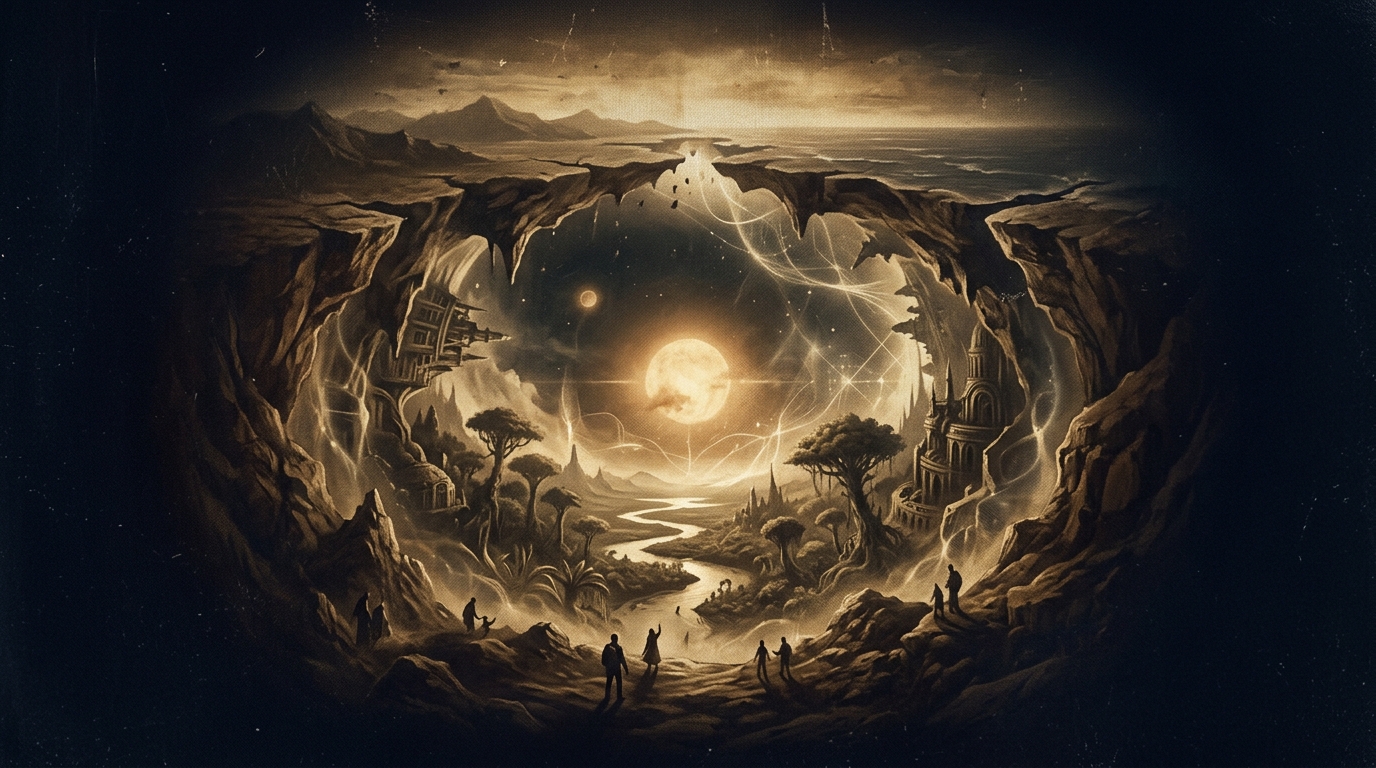
 Codex Illustration
Hollow Earth
For three centuries, a constellation of scientists, mystics, military officers, and fiction writers have proposed that the Earth's interior is not a sphere of molten rock but a habitable — perhaps inhabited — space; seismology has decisively refuted every mechanistic version of the idea, yet the cultural mythology of a world beneath the world shows no sign of fading.
Overview
The proposition that the Earth conceals a hollow or habitable interior is one of the most durable ideas in Western speculative cosmology, tracing a winding path from respected Enlightenment science through Victorian romanticism, early-twentieth-century occultism, Cold War conspiracy culture, and contemporary internet mythology. Its endurance is not merely a testament to credulity; it speaks to something deeply rooted in human imagination — the intuition that the world visible to us is a surface, and that beneath that surface lies another order of reality. What is remarkable is how often this intuition has been dressed in the language of rigorous inquiry, from Edmond Halley's concentric-shell model presented to the Royal Society in 1692, to John Cleves Symmes Jr.'s impassioned petitions to the United States Congress in the 1820s, to the elaborate esoteric geography of Agartha that circulated through Theosophical and early-twentieth-century occult networks.
Edmund Halley — the astronomer of comet fame — proposed, as a documented historical fact, that he submitted to the Royal Society a model in which the Earth consisted of several nested spherical shells, each potentially bearing its own atmosphere, separated by luminous gas that might account for the aurora borealis. Halley did not present this as fiction; it was a genuine, if now thoroughly refuted, scientific hypothesis offered in an era before seismology existed as a discipline. John Cleves Symmes built upon this tradition in the nineteenth century, arguing with earnest specificity that large polar openings — 'Symmes's Holes' — granted access to a temperate interior world, and he lobbied Congress for an Arctic expedition to prove it. The documented historical record confirms that Symmes did petition Congress, that a small movement formed around his ideas, and that his follower Jeremiah Reynolds helped inspire early American polar exploration, though for conventional scientific reasons.
The idea was subsequently absorbed into fiction — Jules Verne's 1864 novel 'Journey to the Center of the Earth' is the most celebrated example — and into the elaborate esoteric geography that emerged from late-nineteenth-century Theosophy and its successors. The term 'Agartha' (also spelled 'Agharti' or 'Agartti') appears in the work of Alexandre Saint-Yves d'Alveydre and was popularized by Ferdinand Ossendowski's 1922 travel account 'Beasts, Men and Gods,' which claimed to report Central Asian traditions of a subterranean kingdom ruled by a King of the World. Scholarly consensus regards Ossendowski's account as a mixture of genuine folklore, literary borrowing from Saint-Yves, and embellishment; René Guénon, who examined the tradition critically in 'The King of the World' (1927), questioned Ossendowski's sources while still engaging with the metaphysical dimension of the legend. The CODEX notes that distinguishing documented Central Asian folklore from nineteenth-century Western esoteric invention in this body of material is genuinely difficult and remains an open scholarly question.
By the mid-twentieth century, Hollow Earth mythology had branched in at least two distinct directions. One branch merged with Nazi occultism and the post-war UFO phenomenon: claims circulated — without credible documentation — that the interior earth was either a refuge for a surviving Nazi scientific establishment or a home base for advanced non-human beings whose craft occasionally surfaced through polar openings. Operation Highjump (1946-47), Admiral Byrd's legitimate and documented Antarctic naval expedition, was retrospectively woven into these narratives despite possessing a prosaic, publicly stated scientific rationale. A second branch maintained a more spiritual character, with writers and channelers asserting contact with benevolent subterranean civilizations — 'Lemurians' beneath Mount Shasta being a prominent American example — sometimes framed as Indigenous prophetic tradition, though scholars of Native American religions note significant distance between these New Age claims and actual Indigenous cosmologies. Modern seismology, through the analysis of earthquake wave propagation, has produced a well-established, empirically grounded model of the Earth's interior: a thin crust, a mantle of silicate rock, a liquid iron outer core, and a solid iron inner core. No credible mechanism for a habitable interior space has survived scientific scrutiny.
Key Claims
Timeline
Evidence
Multiple Perspectives
Biblical Lens
Scripture Threads
Sources & Further Study
Questions to Explore
Go Deeper Path
Follow the Thread
Continue the Investigation
You’ve reached the Full Archive portion of this Case File.
Ask the Archivist
about this fileSign in to ask the Archivist
Create a free account to ask the Archivist 1 grounded question each day, cited straight from the CODEX case files.
Discussion
0Share findings, questions, and evidence with fellow Seekers. Be respectful and cite sources where you can.
No comments yet. Be the first to open this thread.