
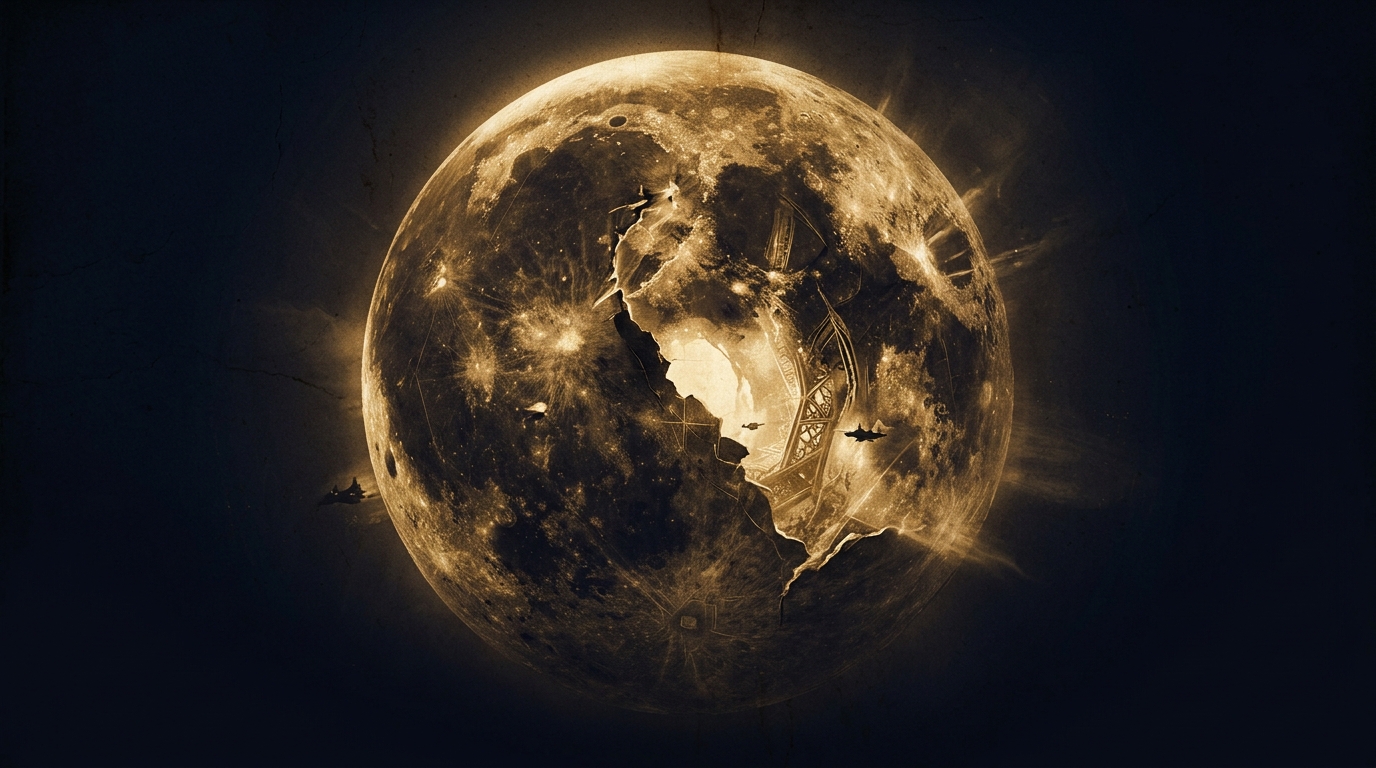
 Codex Illustration
Hollow Moon
Since at least 1970, a provocative hypothesis has circulated — sometimes dressed in scientific language, sometimes in science fiction — that Earth's Moon is not a solid body but an artificially engineered, hollow structure of unknown origin. The claim stretches from a pair of Soviet researchers to modern online conspiracy culture, yet it brushes against genuine, still-debated questions in lunar seismology and planetary science.
Overview
The Hollow Moon hypothesis entered popular consciousness most formally in 1970, when Soviet science writers Mikhail Vasin and Alexander Shcherbakov published an article titled 'Is the Moon the Creation of Alien Intelligence?' in the Soviet journal Sputnik. Their argument was not presented as rigorously tested science but as a speculative thought experiment: they proposed that the Moon might be a vast, artificially constructed spacecraft, its outer shell a processed metal hull covered by a layer of slag and regolith, its interior hollow and possibly inhabited. Vasin and Shcherbakov marshaled several lunar anomalies as circumstantial evidence — the Moon's apparently low mean density relative to Earth, unusual circular maria thought to represent ancient impact basins of implausibly shallow depth, and the puzzling behavior of 'moonquakes' recorded during the Apollo missions, which some described as the Moon ringing 'like a bell.' None of these observations were fabricated; all have genuine scientific records. What the hypothesis did, however, was interpret ambiguous data through the most dramatic lens imaginable.
The 'ringing bell' description — frequently cited as the hypothesis's strongest evidence — requires careful unpacking. During the Apollo 12 mission in November 1969, the spent ascent stage of the lunar module was intentionally crashed onto the Moon's surface, and seismometers placed by the astronauts recorded reverberation lasting approximately fifty-five minutes to an hour. Subsequent Apollo missions produced similar results. Planetary scientists have offered mainstream explanations: the Moon's dry, cold, fractured crust scatters seismic energy in ways that Earth's water-saturated rock does not, causing seismic waves to bounce repeatedly rather than dampen quickly. The 'ringing' is, on this account, a property of the crust's physical composition, not evidence of a hollow interior. Mainstream selenologists — including researchers affiliated with NASA, the Lunar and Planetary Institute, and universities involved in Apollo seismometry — regard the bell-ringing description as a colorful but misleading metaphor, not a datum pointing toward artificial construction.
The question of lunar density is more nuanced. The Moon's mean density is approximately 3.34 g/cm³, considerably lower than Earth's 5.5 g/cm³ but consistent with a rocky body lacking a large iron core — a feature explained by the widely accepted Giant Impact Hypothesis, which proposes that the Moon formed from debris ejected when a Mars-sized body (sometimes called Theia) struck proto-Earth roughly 4.5 billion years ago. This model, supported by isotopic analysis of lunar samples returned by Apollo missions and studied at institutions including NASA's Johnson Space Center and the Carnegie Institution for Science, accounts well for the Moon's low iron content without requiring a hollow interior. Gravity mapping by the GRAIL mission (2011–2012), which measured minute variations in the Moon's gravitational field with extraordinary precision, revealed a complex interior including a small iron core roughly 240 kilometers in radius, a mantle, and a fractured crust — a portrait entirely inconsistent with a large hollow cavity.
Despite the weight of contradicting evidence, the Hollow Moon hypothesis persists in popular culture, frequently grafted onto broader ancient-astronaut narratives, UFO contact claims, and secret space program theories. Writers such as David Icke have incorporated it into sprawling conspiratorial frameworks, while others cite anomalous lunar orbital mechanics — the Moon's near-perfect circular orbit, its precise relationship to the Sun producing total solar eclipses, its synchronous rotation always presenting the same face to Earth — as circumstantial 'design' signatures. Scientists acknowledge that some of these coincidences are striking but attribute them to well-understood physical processes: tidal locking, orbital mechanics, and the anthropic observation that humans exist to notice them. The hypothesis thus occupies a rare space: it began with published speculation in a credentialed Soviet journal, was never peer-reviewed as science, and has since migrated wholesale into fringe discourse, leaving behind a trail of genuine data points that are each separately explicable by mainstream planetary science.
Key Claims
Timeline
Evidence
Multiple Perspectives
Biblical Lens
Scripture Threads
Sources & Further Study
Questions to Explore
Go Deeper Path
Follow the Thread
Continue the Investigation
You’ve reached the Full Archive portion of this Case File.
Ask the Archivist
about this fileSign in to ask the Archivist
Create a free account to ask the Archivist 1 grounded question each day, cited straight from the CODEX case files.
Discussion
0Share findings, questions, and evidence with fellow Seekers. Be respectful and cite sources where you can.
No comments yet. Be the first to open this thread.