
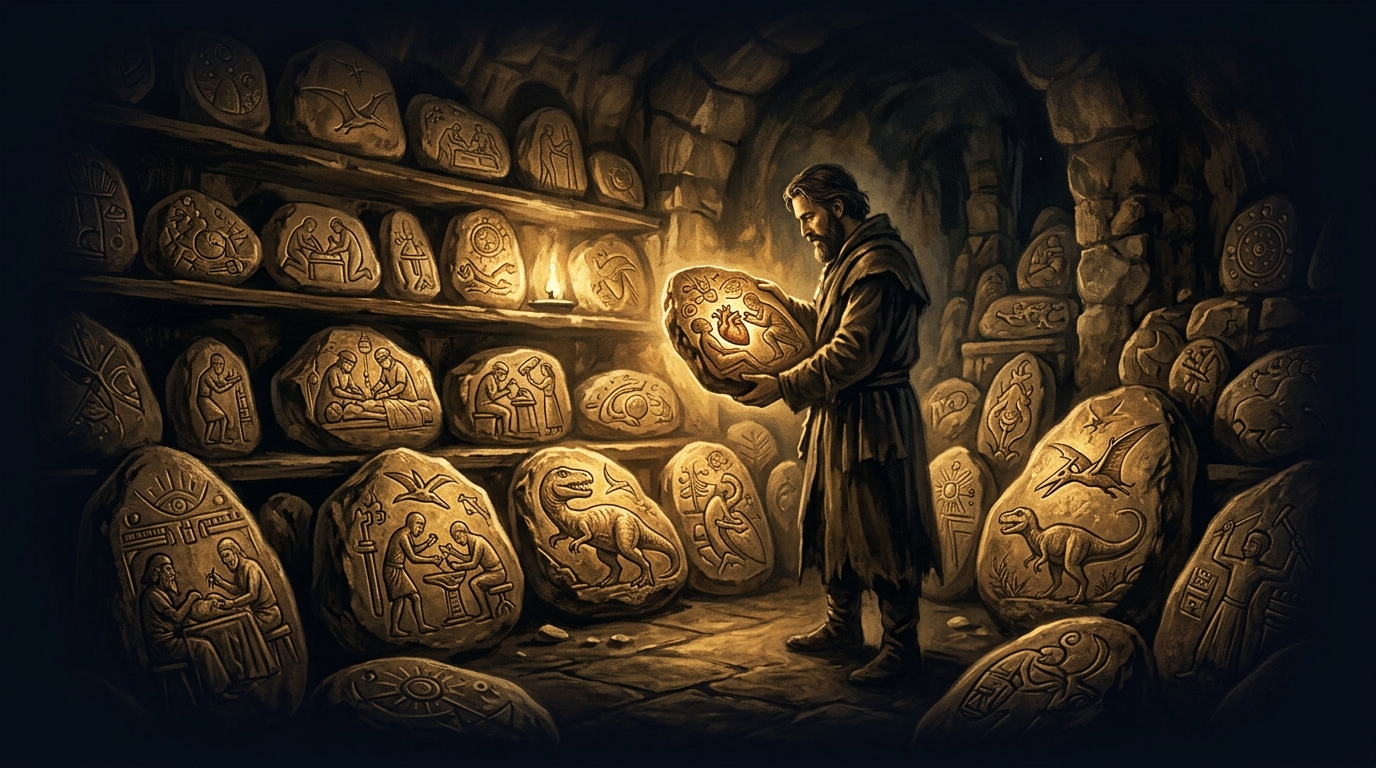
 Codex Illustration
Ica Stones
Thousands of engraved stones from the Ica region of Peru, promoted by physician Javier Cabrera Darquea as evidence of a lost prehistoric civilization with advanced knowledge of surgery and dinosaurs, have been largely demonstrated by archaeological investigation and the testimony of their makers to be modern carvings produced for the tourist and collector trade.
Overview
In the high desert of southern Peru, near the city of Ica, a peculiar collection of andesite stones bearing intricate engravings began attracting international attention in the 1960s. The stones depict an extraordinary range of subjects: human figures performing what appear to be surgical operations, including heart and brain procedures; humans interacting with creatures resembling dinosaurs and pterosaurs; astronomical charts; and scenes of apparent advanced technology. The physician and self-described 'paleo-anthropologist' Javier Cabrera Darquea became the collection's most ardent champion, ultimately amassing tens of thousands of stones and constructing an elaborate theoretical framework he called 'gliptolithic culture' — a hypothetical civilization predating all known pre-Columbian cultures by tens of thousands, or even millions, of years. His 1976 book El Mensaje de las Piedras Grabadas de Ica laid out these claims in systematic, if scientifically unverifiable, detail.
The immediate difficulty with the Ica Stones is one of provenance. No stones have ever been recovered from a securely documented, scientifically excavated archaeological context. All specimens trace to informal acquisition: purchased from local huaqueros (grave robbers and artifact dealers) or given directly to Cabrera. When investigators and journalists began interviewing local artisans in and around Ica — most notably the farmer Basilio Uschuya and members of his family — they received candid admissions that the stones were being carved by hand, using modern tools, and sold to meet demand. Uschuya reportedly demonstrated the carving process to investigators and confirmed that the patination effect convincing to casual inspection could be achieved by artificially accelerating surface oxidation. The BBC documentary team that visited the region in the 1970s documented these admissions directly.
Thermoluminescence and other scientific dating methods capable of establishing when a stone surface was last exposed to heat are largely inapplicable to cold-worked andesite carvings, creating a frustrating evidentiary gap that proponents have exploited. A small number of stones have been cited as showing genuine pre-Columbian origin — some researchers note that Spanish colonial chronicler Father José de Acosta and others mentioned engraved stones in the Ica region as early as the sixteenth century, and that a handful of stones have been found in association with pre-Columbian burial sites. However, archaeologists have pointed out that these earlier stones are far fewer, stylistically distinct, and bear no resemblance to the surgically and paleontologically ambitious imagery Cabrera promoted. The colonial-era references most plausibly document a limited pre-existing tradition of modest stone engraving, not a civilization with knowledge of Mesozoic fauna.
The Ica Stones have achieved remarkable longevity in alternative history circles precisely because they appear to challenge two foundational assumptions simultaneously: the standard timeline of human civilization, and the standard scientific account of when humans and non-avian dinosaurs coexisted. For young-earth creationist communities, the supposed dinosaur depictions offer apparent confirmation that humans and dinosaurs lived together in the post-Flood world. For ancient astronaut theorists, the surgical scenes suggest extraterrestrial or lost-civilization medical knowledge. For mainstream archaeologists and biologists, the stones represent a textbook case of motivated artifact production meeting motivated interpretation — a closed evidential loop in which the absence of proof is perpetually reframed as proof of suppression.
Key Claims
Timeline
Evidence
Multiple Perspectives
Biblical Lens
Scripture Threads
Sources & Further Study
Questions to Explore
Go Deeper Path
Follow the Thread
Continue the Investigation
You’ve reached the Full Archive portion of this Case File.
Ask the Archivist
about this fileSign in to ask the Archivist
Create a free account to ask the Archivist 1 grounded question each day, cited straight from the CODEX case files.
Discussion
0Share findings, questions, and evidence with fellow Seekers. Be respectful and cite sources where you can.
No comments yet. Be the first to open this thread.